Potsdam - Der 4. November 1989 war ein kühler Samstag. Nach und nach füllte sich kurz nach Mittag der Platz der Nationen, der heutige Luisenplatz, mit Menschen, die ihrem Unmut über den Realsozialismus Luft machen wollten. Tausende kamen zur ersten genehmigten Kundgebung der Bürgerbewegung, auf ihren Spruchbändern forderten sie aus Sicht der Herrschenden Ungeheuerliches: Meinungsfreiheit, Pressefreiheit, Reisefreiheit.
Und dann war da dieser Balkon im zweiten Stockwerk des Eckhauses an der Zimmerstraße, hoch über dem Platz. Die Pfarrersfamilie Stappenbeck, die dort wohnte, hatte ihn zur Verfügung gestellt. Wer hinabsah, blickte auf Menschenmassen, auf dem Balkon stand mit anderen Olaf Grabner. Der heute 55 Jahre alte gelernte Gärtner, der seit Jahren den Nepal-Himalaya-Park in Wiesent bei Regensburg leitet, erinnert sich noch gut „an dieses überwältigende Gefühl, dort zu stehen und frei zu sagen, was man will“.
Demonstration als "Vorbereitung zur Öffnung der Grenzen"
Er habe das Gefühl gehabt, „kurz vor der Freiheit“ zu sein, wenn auch niemand zuvor habe wissen können, „ob man nicht für ein paar Jahre im Knast landet“. Mit auf dem Balkon: Pfarrer Hans-Joachim Schalinski. Der heute 76-Jährige, einst Seelsorger am Stern und im Schlaatz, hält die Groß-Demonstration im Rückblick für „die Vorbereitung zur Öffnung der Grenzen“. Unerschrocken hatte er den Betrug bei der Kommunalwahl im Mai immer wieder angeprangert, „was sich dann an Forderungen nach Menschenrechten entwickelte, war nicht mehr zu ersticken“, sagt er. Schalinski kümmerte sich nach der Wende um sogenannte Wende-Verlierer: DDR-Bürger etwa, die ihre Arbeit verloren hatten.
Unten, inmitten der Massen, hielten die Fotografen Bernd Blumrich, heute 71, und Klaus Fahlbusch, 60, das Geschehen fest. „Es war allen klar, dass wir Geschichte miterleben“, sagt Blumrich. Fahlbusch erinnert sich an ein paar Polizisten, „die ganz bescheiden am Rand standen“.
[Wenn Sie aktuelle Nachrichten aus Potsdam und Brandenburg live auf Ihr Handy haben wollen, empfehlen wir Ihnen unsere App, die sie hier für Apple und Android-Geräte herunterladen können.]
Jetzt wird ein Denkmal an das Engagement der Bürger an diesem Tag vor 32 Jahren und in der Wendezeit erinnern, es soll am Donnerstag um 17 Uhr auf dem Luisenplatz eingeweiht werden. Stolz stand der Künstler Mikos Meininger am gestrigen Dienstag dort in dem Zelt, das sein Denkmal noch bedeckte. Tag für Tag verbrachte zuletzt auf der gusseisernen Platte, säuberte die Buchstaben, die die Babelsberger Firma Print1 dort eingefräst hatte und freute sich, als die ersten am Abend durch phosphoreszierendes Kunstharz zu leuchten begannen.
In der Dunkelheit scheinen die Zahlen zu verschwinden
Es ist ein beinahe genialischer Einfall: Tagsüber fällt in großen Ziffern das Datum 4.11.1989 ins Auge, mit der Dunkelheit scheinen die Zahlen zu verschwinden und überlassen ihren Auftritt den Losungen, die vor 32 Jahren auf den Spruchbändern und Plakaten der Groß-Demonstration standen: „Visa-frei bis Hawaii“, „SED-raus aus den Betrieben“, „Freie Wahlen – wahre Zahlen“.
Das Denkmal auf dem Luisenplatz hat der Künstler Mikos Meininger entworfen.Foto: Ottmar Winter
Die PNN sprachen in den vergangenen Tagen mit einigen Teilnehmern der größten Demonstration, die es je in Potsdam gab. Volker Wiedersberg etwa erzählte, er habe „eher in den hinteren als in den vorderen Reihen gestanden“, was einen Grund hatte. Er war erst drei Wochen zuvor aus dem Stasi-Untersuchungsgefängnis in der Lindenstraße entlassen worden, wo er eine Woche lang als „Rädelsführer einer Zusammenrottung“ eingesessen hatte.
Volker Wiedersberg.Foto: Promo
Er sympathisierte mit der Bürgerrechtsbewegung, obwohl er sich auch auf Distanz hielt: „Mich befremdete, dass sich auf einmal so viele versammelten, die vorher noch ruhig in ihren Gärten gesessen hatten. Mich befremdete auch, dass das alles so schnell ging: Von ,Wir sind das Volk’ zu ,Wir sind ein Volk’, und dann rückte plötzlich die D-Mark in den Vordergrund.“ Der heute 52-Jährige studierte Jura, arbeitete ein paar Jahre als Rechtsanwalt in Potsdam und ist heute Dezernatsleiter im Landesamt für Soziales und Versorgung. Politisch ist er aktiv geblieben – als Mitglied der Grünen und Vorsitzender der Gemeindevertretung von Michendorf.
Die Ungerechtigkeiten im DDR-System beseitigen
Annette Flade, inzwischen 71 Jahre alt, und ihr Mann Stephan, 70, leben nach Jahren als Seelsorger in Potsdam und Indonesien heute wieder in ihrer Heimatstadt Wittenberge im Landkreis Prignitz. Die Pastorin erzählte den PNN, dass sie auf dem Balkon „im wesentlichen Paragraphen der DDR-Verfassung vorgetragen“ habe, in denen das Recht auf Versammlungs- und Redefreiheit verbrieft war, „das wurde ja nur niemals praktiziert“.
Stephan Flade erkennt an, dass die Polizei „Blutvergießen vermeiden wollte“. Die Vorgesetzten hätten die Polizisten ohne Munition in den Einsatz geschickt. Den Flades sei es „überhaupt nicht um die Wiedervereinigung gegangen, wir wollten die Ungerechtigkeiten im DDR-System beseitigt wissen“. Nun machen beide auf die Ungerechtigkeiten im System der Bundesrepublik aufmerksam, etwa „auf die immer weiter auseinander gehende Schere zwischen Arm und Reich“.
Reinhard Meinel, heute 63 Jahre alt und Professor für theoretische Physik in Jena, war nach der Groß-Demonstration überrascht, „dass sich alles so schnell überschlagen würde“. Das Engagement habe sich gelohnt: „Die DDR war ein System, das man zu Recht Diktatur nannte.“
Reinhard Meinel.Foto: Jana Haase
Petra Walter-Streitz, heute 59, wird nie vergessen, dass sie zu DDR-Zeiten immer drei unerfüllte Wünsche hatte: Ebbe und Flut erleben, „das gab es an der Ostsee und am Schwarzen Meer ja nicht“. Die Dolomiten zu sehen und die Westküste der USA kennenzulernen. Sie nahm mit ihrem Mann an der Demonstration teil, der den Kinderwagen mit ihrem Sohn schob. „Angst hatten wir am 4. November nicht“, sagte sie, „wir wären ja sonst nicht mit unserem Jungen dabei gewesen“. Streitz fuhr noch im November 1989 ins schleswig-holsteinische Dithmarschen, um barfuß durchs Watt zu laufen. Dann folgten Reisen in die Dolomiten und die USA – nach der Eröffnung ihres Trekkingladens.
Die Bürgerrechtlerin Ute Bankwitz ist zufrieden mit den Folgen der friedlichen Revolution: „Ich genieße mein Leben und die Freiheit, für die wir damals gekämpft haben.“ Die größte Weitsicht aber hatte offenbar die heute 80 Jahre alte Potsdamer Autorin Sigrid Grabner. Sie offenbarte den PNN 2014, was sie am Abend jenes 4. November mit weisem Blick in die Zukunft in ihr Tagebuch geschrieben hatte: „Da ist sie – die Revolution, umfassend im Anspruch, visionär.“
Titelseite des verschwundenen Australasian Journal of Bone & Joint Medicine.
Quelle: Scan von der Website the-scientist.com
MANCHMAL IST PAPIER doch nützlich: Dieser grisselige Scan auf der Webseite von The Scientist gehört zu den wenigen Spuren, die das Australasian Journal of Bone & Joint Medicine hinterlassen hat. Das Blatt war Teil eines Bündels von Fake-Zeitschriften, die der Elsevier-Verlag als peer-reviewed journals anbot, die tatsächlich aber Werbung machten – unter anderem für das Medikament Vioxx des Pharmakonzerns Merck, das nach Todesfällen hastig vom Markt genommen wurde.
Die neun Fake-Zeitschriften sind nur ein Beispiel aus Jahrzehnten der Ausbeutung der Wissenschaft durch die Zeitschriftenverlage: Der Versuch, Open Access entweder durch den amerikanischen Research Works Act kriminalisieren oder durch PR diskreditieren zu lassen, die Bekämpfung von green open access, das Hintergehen von universitären Verhandlungspartnern und gegenwärtig das Ausforschen von Wissenschaftler*innen durch die Installation von Trackingtechnologien auf den Verlagsplattformen – sowie das Basteln an einer neuen Seidenstraße der Wissenschaftskommunikation durch Zusammenarbeit mit den chinesischen Behörden. In einer Zeit, in der die politischen Kultur- und Stammeskämpfe auf das Gebiet der Wissenschaft übergegriffen haben und in der Vertrauen in die Redlichkeit der Forschung damit so elementar nötig ist, wird damit das Publikationswesen, durch das Wissenschaft in die Öffentlichkeit tritt, immer zweifelhafter.
Irlands Science Foundation zum Beispiel hat gerade Elsevier unter Vertrag genommen, um die künftige Ausrichtung zu analysieren, und niemand frug danach, wo denn der bewundernswerte Datenschatz, den der Konzern dafür mitbrachte, eigentlich herkommt.
Diese Entwicklung führt zu einer Dreifaltigkeit des Versagens in den Publikationsinfrastrukturen:
o Die systemimmanenten Fehlanreize des publish or perish befeuern die Replikationskrise vieler Disziplinen: Publikationen in den renommiertesten Journalen fördern die Karriere, doch wird dort zugleich die unverlässlichste Wissenschaft publiziert.
o Die Kommerzialisierung von Open Access steigert die langjährige Zeitschriftenkrise zu einer Artikelkrise: Die Kosten steigen unaufhaltsam, wenn nur die Laufrichtung des Geldes vom Lesen zum Publizieren gedreht wird und das System ansonsten unter dem Regime der längst dem Großverlags-Status entwachsenen Monopolisten verbleibt und weiterhin konkurrenzfreie Arbitragegewinne ermöglicht.
o Der Fokus der Ex-Verlage auf Nutzerdaten, der Forschenden auf Publikationen und der Institutionen auf Geldströme und Rankings führte zu einer Funktionalitätskrise, bei der einige der grundlegendsten digitalen Funktionalitäten für Forschungsobjekte unerreichbar bleiben.
Ein Umstieg ist jederzeit möglich
Genau weil die wissenschaftlichen Journale im Zentrum dieser Dreifaltigkeit des Versagens stehen, fordern seit mindestens 15 Jahren Experten eine Modernisierung der Informationsinfrastrukturen in der Wissenschaft. Jetzt stehen gleich mehrere mögliche Alternativen bereit – ein Umstieg ist jederzeit möglich.
Von diesen Alternativen soll nur exemplarisch die Publikationsplattform "Open Research Europe" (ORE) herausgegriffen werden. Auf ORE publizieren von der Europäischen Union geförderte Forschende kostenlos und open access. ORE ist eine Plattform der EU und nicht eines Verlags, und die EU kann den Publikationsdienstleister, wenn sie mit ihm nicht zufrieden ist, durch einen anderen ersetzen. Damit entsteht echte Konkurrenz um Publikationsdienstleistungen, wie sie im renoméebasierten Journalsystem unmöglich ist. ORE ist Teil des Dienstes "Open Research Central" (ORC), bei dem Publikationsplattformen wie ORE zu einem gemeinsamen Literaturkorpus aggregiert werden, so dass alle Institutionen hier ihren Platz fänden.
Die Wissenschaftsverlage waren bereits eine Plattformökonomie, bevor die bekannten Internetkonzerne dieses Prinzip adaptierten, um ihre marktbeherrschende Stellung zu sichern. Auch die Verlage nutzen ihre unhintergehbare Position im Wissenschaftssystem, die Publikationen mit der Erhebung von Kennzahlen verknüpft – nicht unähnlich dem Notar im Immobilienmarkt, an dem auch kein Weg vorbeiführt. Lange vor der Entwicklung von Diensten wie ORC war es deshalb klar, dass ein Journalersatz einen Schnitt mit dieser Logik der Plattformökonomie machen muss. Denn sie sperrt die Wissenschaftskommunikation in ähnlicher Weise ein wie WhatsApp und andere Messenger die private Kommunikation– obwohl es zuvor bei E-Mail schon Protokolle und Standards gab, die den Austausch von Dienstleistern ermöglichten.
Analog dazu müssen die traditionellen Zeitschriften daher durch ein dezentralisiertes, belastbares, entwicklungsfähiges Netzwerk ersetzt werden, das durch offene Standards miteinander verbunden ist. Dies ermöglichte einen nahtlosen Wechsel von einem Anbieter zum anderen unter der Kontrolle der wissenschaftlichen Gemeinschaft und ließe den Zeitschriftenartikel als einzigen wissenschaftlicher Output, der "zählt", in den Hintergrund treten. Stattdessen läge der Fokus dann auf das ineinander verwobene Geflecht von Text, Daten und Code, was eine viel bessere Orientierungsfunktion über das wissenschaftliche Wissen schaffen würde, als es Zeitschriften bislang vermochten. Das Konzept hinter Diensten wie ORC zielt genau auf die Entwicklung einer solch dezentralen Informationsinfrastruktur ab.
Es geht auch ohne Gemetzel
Wissenschaftliche Zeitschriften sind weit davon entfernt, Vergleichbares zu leisten, und gelten in der Diskussion daher entweder als tot – oder man möchte dafür Sorge tragen, dass sie es bald sein werden: "Slaying the journals" hat sich eine Initiative auf die Fahnen geschrieben, und angesichts der leidvoll gesammelten Erfahrungen dürften bei dieser Version eines "eat the rich" sofort etliche Wissenschaftler*innen dabei sein.
Ein detaillierter Lösungsvorschlag, der kürzlich von einer internationalen Gruppe von Experten vorgelegt wurde, beinhaltet dagegen auch ohne Gemetzel zwei neuartige Ansätze, wie die Dreifaltigkeit des Versagens kurzfristig angegangen werden könnte: Es wird Forschungsförderern vorgeschlagen, die bestehenden Mindestanforderungen an die Infrastruktur der geförderten Institutionen zu erweitern, und zwar um die oben erwähnten dezentralen Informationsinfrastrukturen. So könnte die Alternativen zur Zeitschrift die bessere (und letztlich renomméeträchtigere) wissenschaftliche Praxis werden.
Der jahrzehntelange Stillstand in den digitalen Infrastrukturen an den Instituten zeigt, dass es offensichtlich dieser Modernisierungsanreize bedarf, um die Finanzierung der überteuerten und veralteten Zeitschriften auslaufen zu lassen und die Mittel stattdessen in moderne Technologien zu investieren.
Des Weiteren wird angeregt, offene Standards und Open Source Normen festzulegen, die einen effizient funktionierenden Markt garantieren und eine erneute Monopolisierung von wissenschaftlichen Werkzeugen oder des wissenschaftlichen Outputs verhindern. Dies ist elementar, weil bislang die aus der scientific community entwickelten Lösungen von den entsprechenden Playern aufgekauft wurden, damit sich keine alternativen Ökosysteme entwickeln können.
Solche offenen Standards sind in der Wissenschaft schon da und versprechen, wie die FAIR-Prinzipien, wissenschaftliche Qualität und gute Praxis zu sichern. Um diese auszubauen, zu sichern und durchzusetzen, wird vorgeschlagen, ein Standardisierungsgremium in der Art des World Wide Web Standard Gremiums (W3C) zu gründen – unter der Leitung der wissenschaftlichen Gemeinschaft, um die Entwicklung offener wissenschaftlicher Infrastrukturen zu ermöglichen, die den gesamten Forschungsablauf unterstützen.
In der langjährigen Diskussion um einen Ersatz für die wissenschaftlichen Zeitschriften wurde bisher stets auf die Frage der wissenschaftlichen Reputation und der damit gebotenen Orientierungsleistung verwiesen, welche anders nicht lösbar wäre. Dieses Argument übersieht jedoch zwei wesentliche Aspekte: Zum einen entbehrt das Renommée der Journale jeglicher empirischen Basis und stellt damit keine valide Evaluierungsgrundlage dar.
Es wäre absurd, den gleichen Fehler zu wiederholen
Daher haben sich begründete Alternativen entwickelt wie die San Francisco Declaration of Research Assessment, der mittlerweile sowohl die DFG wie der European Research Council beigetreten sind. Zum anderen wissen wir aus den Daten, die die Ex-Verlage verkaufen, dass es natürlich eine schier endlose Menge an quantitativen wie qualitativen Evaluationsmöglichkeiten gibt, die voll und ganz auf der täglichen Interaktion der Forschenden mit ihren digitalen Forschungsobjekten basiert. Nur sind diese feinkörnigen Daten nicht in der Hand der Wissenschaft, sondern im Besitz der Ex-Verlage, die, wie die Vorsitzende des Rats für Informationsinfrastrukturen, Petra Gehring, kürzlich schrieb, "den gesamten intellektuellen Zyklus staatlich getragener und damit freier Forschung als ihr künftiges Produkt" betrachteten.
Das irische Beispiel kann dabei zur Illustration ihrer harten Feststellung dienen: "Den globalisierten Kampf um gewinnträchtige Märkte, den diese neuen Formen der Wertschöpfung bieten, erkannte man nicht." Es wäre daher geradezu absurd, wenn die öffentlich finanzierte Wissenschaft den gleichen Fehler wie bei den Publikationen bei den Forschungs- und Nutzerdaten wiederholt: Erst bezahlt die Steuerzahler*in die Produktion und dann noch einmal, wenn die Wissenschaft sich ihr eigenes Produkt wieder zurückkauft. Bei einer Weiterführung des jetzigen Systems könnte die Wissenschaft hierauf keinen Einfluss nehmen und ebenso wenig die Mittelgeber darauf, dass von den aufgebauten Kompetenzen und den in den Daten liegenden Wertschöpfungspotentialen das Gemeinwesen profitiert.
Die gegenwärtig im Wissenschaftsbereich geführte Debatte über digitale Souveränität ergibt keinen Sinn ohne eine entschiedene Umleitung von Mitteln weg von den Zeitschriften, hin zu einer offenen Infrastruktur und zu deren Aufwertung als Grundlage der Renomméebildung. Diese würde nach 30 Jahren Stillstand der Dreifaltigkeit des Versagens unseres Publikationssystems endlich ein Ende bereiten
The most groundbreaking, transformative research results deserve a broad readership and a large audience. Therefore, scientists submit their best work to the journals with the largest audience. While the number of scientists has been growing exponentially over the last decades, the number of journals with a large audience has not kept up, neither has the number of articles published per journal. Consequently, rejection rates at the most prestigious journals has fallen below 10% and the labor of rejecting submissions has become these journals’ largest cost item. Assuming that this exclusivity allows the journals to separate the wheat from the chaff, successful publication in these journals is treated as a quality signal in hiring, promotion and funding decisions. If anything, these developments have fueled the circularity of this relationship: today, publishing ground-breaking science in a high ranking journals is not only important for science to advance but also for an author’s career to advance. Even before science became hypercompetitive at every level, now and again results published in prestigious journals were later found to be false. This is the nature of science. Science is difficult, complicated and perpetually preliminary. Science is self-correcting and better experimentation will continue to advance science to the detriment of previous experiments. Today, however, fierce competition exacerbates this trait and renders it a massive problem for scholarly journals. Now it has become their task to find the ground-breaking among the too-good-to-be-true data, submitted by desperate scientists, who face unemployment and/or laboratory closure without the next high-profile publication. This is a monumental task, given that sometimes it takes decades to find that one or the other result rests on flimsy grounds. How is our hierarchy of more than 30,000 journals holding up?
At first glance, it appears as if our journals fail miserably. Evaluating retractions, the capital punishment for articles found to be irreproducible, it was found that the most prestigious journals boast the largest number (Fang and Casadevall, 2011) and that most of these retractions are due to fraud (Fang et al., 2012). However, data on retractions suffer from two major flaws which make them rather useless for answering questions about the contribution of journals to the reliability (or lack thereof) of our scholarly literature: (1) retractions cover only about 0.05% of the literature; and (2) they are confounded by error-detection variables that are hard to trace. So may be our journals are not doing so horribly after all?
Journal Ranking
The most widely used metric to rank journals is Clarivate Analytics’ “Impact Factor” (IF), a measure based loosely on citations. Despite the numerous flaws described (e.g., Moed and van Leeuwen, 1996; Seglen, 1997; Saha et al., 2003; Rossner et al., 2007; Adler et al., 2009; Hernán, 2009; Vanclay, 2011; Brembs et al., 2013), the IF is an excellent and consistent descriptor of subjective journal hierarchy, i.e., the level of prestige scientists ascribe to the journals in their respective fields (Gordon, 1982; Saha et al., 2003; Yue et al., 2007; Sønderstrup-Andersen and Sønderstrup-Andersen, 2008). That a measure so flawed still conforms to the expectations of the customers expected to pay for it, is remarkable in its own right. Due to this consistency, the IF is used here as a measure for the subjective ranking of journals by the scientists using these journals: to what extent is this subjective notion of prestige warranted, based on the available evidence? Are prestigious journals really better at detecting the real breakthrough science in the sea of seemingly breakthrough science than average journals?
Retractions and Error Detection
If anything, one could tentatively interpret what scant data there are on retractions, as suggestive that increased scrutiny may only play a minor role in a combination of several factors leading to more retractions in higher ranking journals.
For instance, there are low ranking journals with high retraction rates (Fang et al., 2012), showing that the involved parties are motivated to retract articles even in low ranking journals. In fact, in absolute terms, most retracted articles come from low-ranking journals. This would be difficult to explain if low ranking journals were less willing to retract and/or scholars less motivated to pursue retractions from these journals. On the other hand, one can make the claim that the numbers would show even more retractions in low ranking journals, if the motivation and willingness to retract were equal. As neither willingness of journals to retract nor motivation in individuals to force a retraction can be quantified, all that the data can show is that it is not an all-or-nothing effect: there is both willingness and motivation to retract also for articles in lower ranking journals.
Another reason why scrutiny might be assumed to be higher in more prestigious journals is that readership is higher, leading to more potential for error detection. More eyes are more likely to detect potential errors. The consequence of this reasonable and plausible factor is difficult to test empirically. However, one could make a more easily testable, analogous claim, such as that one would also expect increased readership to lead to a higher potential not only for retractions but also for citations. More eyes are more likely to detect a finding worth citing. In fact, if anything, citations ought to correlate better with journal rank than retractions because citing an article in a leading journal is not only technically easier than forcing a retraction, it also benefits one’s own research by elevating the perceived importance of one’s own field. However, the opposite is the case: The coefficient of determination for citations with journal rank currently lies around 0.2, while that coefficient comes to lie at just under 0.8 for retractions and journal rank (Brembs et al., 2013). So while there may be a small effect of scrutiny/motivation, the evidence seems to suggest that it is a relatively minor effect, if there is one at all.
Taken together, there is currently no strong case to be made as to whether the likely increased scrutiny and readership of highly-ranked journals is a major factor driving retractions or not. If that were the case, it would indicate that the apparent increased unreliability in high-ranking journals is merely an artifact of the increased scrutiny to retract, combined with an increased willingness of these journals to correct the scientific record. At least two lines of inquiry did not turn up any conclusive evidence for such an argument. With such unclarified confounds in such a tiny section of the literature, it is straightforward to disregard retractions as extreme outliers and focus instead of the 99.95% of unretracted articles in order to estimate the reliability of highly ranked journals.
The Other 99.95% of the Literature
In the literature covering unretracted, peer-reviewed articles, one can identify at least eight lines of evidence suggesting that articles published in higher ranking journals are methodologically either not stronger or, indeed, weaker than those in lower ranking journals. In contrast, there is no evidence that articles published in higher ranking journals are methodologically stronger. Methodology here refers to several measures of experimental and statistical rigor with a potential bearing on subsequent replication or re-use. There is currently one article with evidence that higher ranking journals are better at detecting duplicated images (Bik et al., 2016).
In the following, I will quickly review the lines of evidence in the order of decreasing evidential strength.
Crystallographic Quality
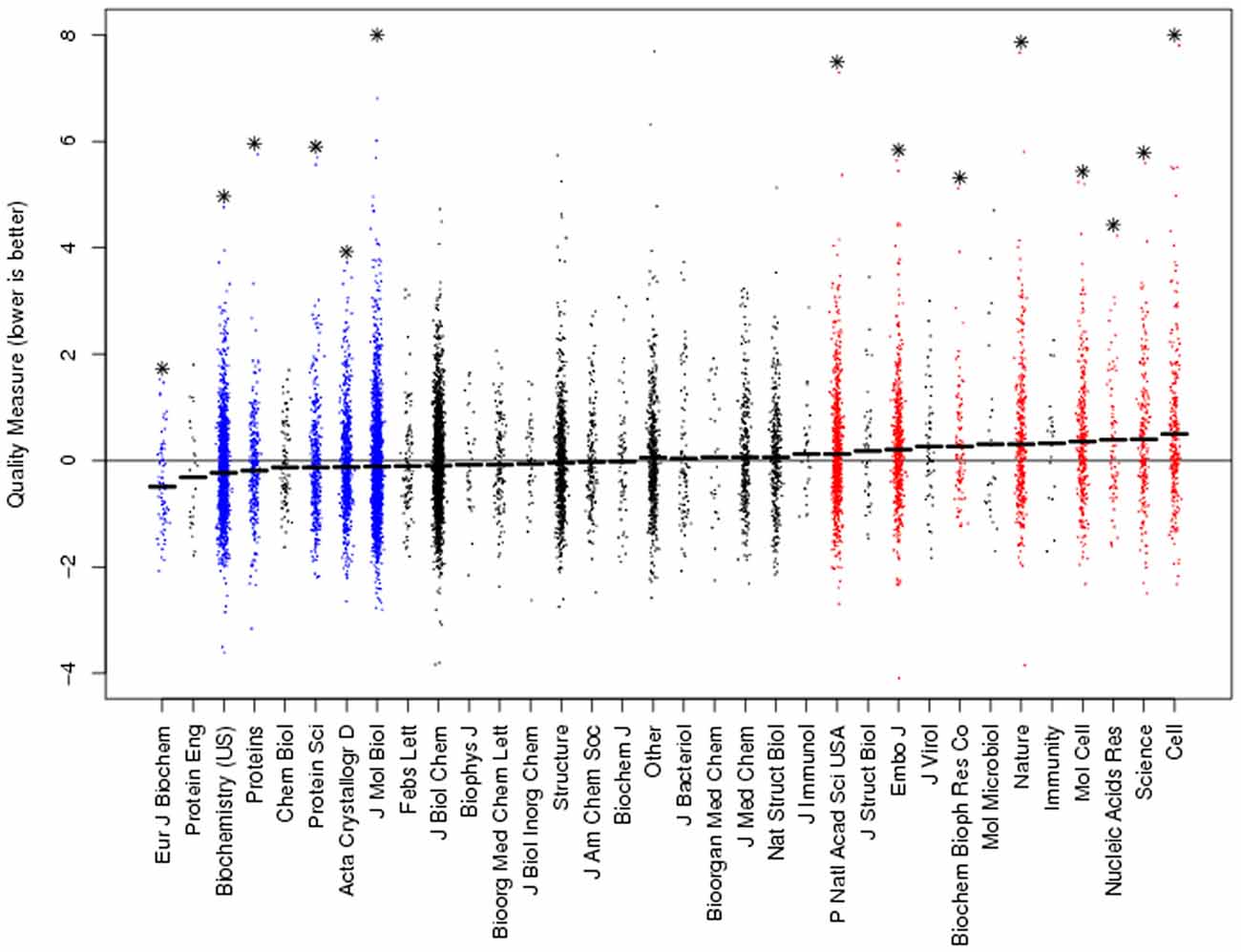
The quality of computer models of molecular structures, derived from crystallographic work, can be quantified by a method which includes the deviations from known atomic distances and other factors (Brown and Ramaswamy, 2007). Averaging the quality metric for each journal, high-ranking journals such as Cell, Molecular Cell, Nature, EMBO Journal and Science publish significantly substandard structures (Figure 1, courtesy of Dr. Ramaswamy, methods in Brown and Ramaswamy, 2007). The molecular complexity or the difficulty of the crystallographic work cannot explain this finding, as these factors are incorporated in the computation of the quality metric.
FIGURE 1
Figure 1. Ranking journals according to crystallographic quality reveals high-ranking journals with the lowest quality work. The quality metric (y-axis) is computed as a deviation from perfect. Hence, lower values denote higher quality work. Each dot denotes a single structure. The quality metric was normalized to the sample average and journals ranked according to their mean quality. Asterisks denote significant difference from sample average. Figure courtesy of Dr. Ramaswamy, methods in Brown and Ramaswamy (2007).
Effect Sizes in Gene-Association Studies
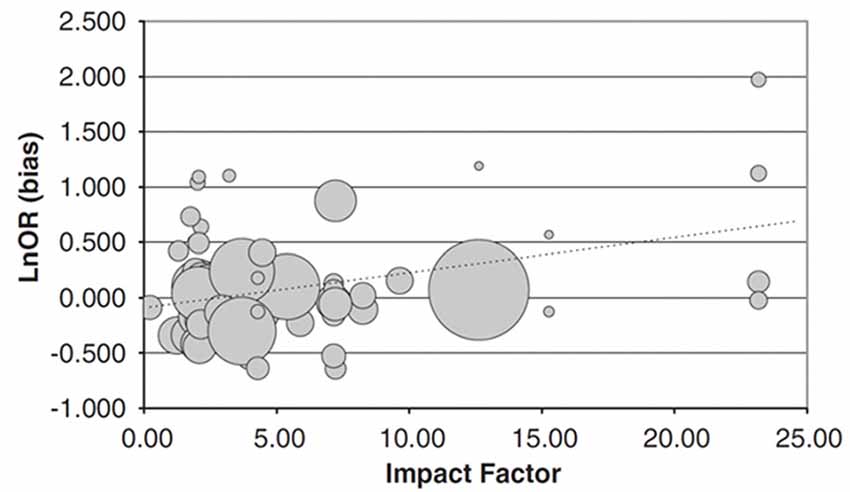
Analyzing effect sizes in gene-association studies, Munafò et al. (2009) found that for 81 different studies on psychiatric traits, higher ranking journals overestimated the size of the gene-trait association, while the sample size decreased with increasing ranking of the journal (Figure 2). Phrased differently and more generally, inflated effect sizes are disproportionately often found in journals which rank more highly and publish studies with lower sample sizes.
FIGURE 2
Figure 2. Relationship between impact factor (IF) and extent to which an individual study overestimates the likely true effect. Data represent 81 candidate gene studies of various candidate genes with psychiatric traits. The bias score (y-axis) represents the effect size of the individual study divided by the pooled effect size estimated indicated by meta-analysis, on a log-scale. Therefore, a value greater than zero indicates that the study provided an overestimate of the likely true effect size. This is plotted against the IF of the journal the study was published in (x-axis). The size of the circles is proportional to the sample size of the individual study. Bias score is significantly positively correlated with IF, sample size significantly negatively. Figure from Munafò et al. (2009).
Statistical Power in Neuroscience/Psychology
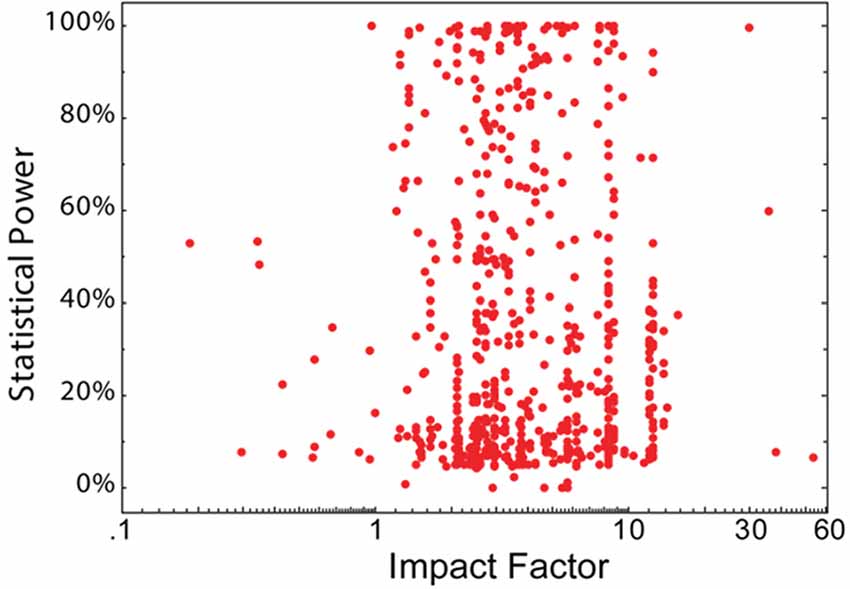
Statistical power (defined as 1—type II error rate; a measure computed from sample size and effect size) allows inference as to the likelihood that a nominally statistically significant finding actually reflects a true effect. As such, statistical power is directly related to the reliability of the experiments conducted. Button et al. (2013) analyzed the statistical power of 730 individual primary neuroscience studies. These data do not show any correlation with journal rank (Brembs et al., 2013; Figure 3).
FIGURE 3
Figure 3. No association between statistical power and journal IF. The statistical power of 650 eligible neuroscience studies plotted as a function of the IF of the publishing journal. Each red dot denotes a single study. Figure from Brembs et al. (2013).
Cognitive neuroscience and psychology also seem to suffer from insufficient statistical power. In their case, unlike in the neuroscience case, statistical power is even negatively correlated with journal rank (Szucs and Ioannidis, 2017). Taken together, these results suggest that in the covered fields at least, results from higher ranking journals tend to be less reliable than those from lower ranking journals, with a low overall reliability, as expressed in statistical power.
Experimental Design in in Vivo Animal Experimentation
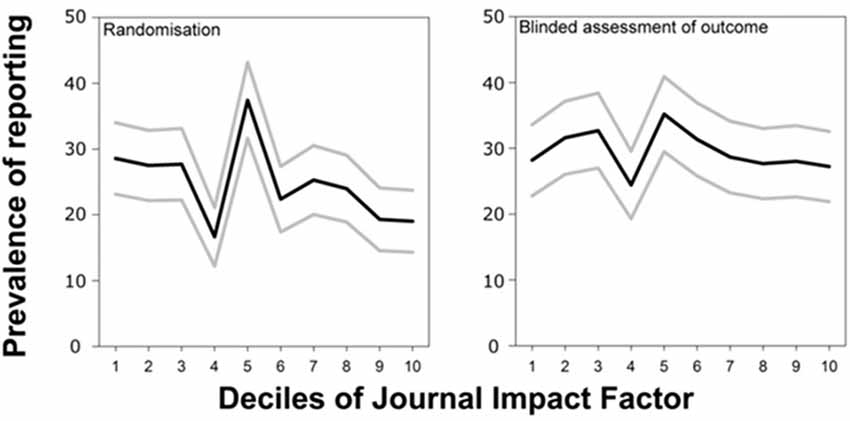
In preclinical research studying animal models of disease, a widely used standard experimental design requires randomized assortment of animals into the treatment and control group, respectively, as well as an outcome assessment where the assessor scoring the outcome is blind as to the treatment group of the animal. Analyzing the methods sections of publications reporting in vivo experiments of animal disease models where this design should have been applied, Macleod et al. (2015) found that the prevalence of reporting randomization before the treatment correlated negatively with journal rank, while reporting of blind outcome assessment was not correlated (Figure 4, modified from Macleod et al., 2015). Inasmuch as this reporting correlates with actual experimentation, such publications in higher ranking journals would hence be less reliable than those in other journals: not reporting bias precludes replication and a reported bias may still entail that the bias created the observed effect. If randomization were not rarer (or even more frequent) in high vs. low-ranking journals, authors of articles in high-ranking journals are at least failing to report this randomization more often than authors in lower ranking journals.
FIGURE 4
Figure 4. High ranking journals do not have a higher tendency to report more randomization nor blinding in animal experiments. Prevalence of reporting of randomization and blinded assessment of outcome in 2671 publications describing the efficacy of interventions in animal models of eight different diseases identified in the context of systematic reviews. Figure modified from Macleod et al. (2015).
Errors in Genomics, Cognitive Neuroscience and Psychology
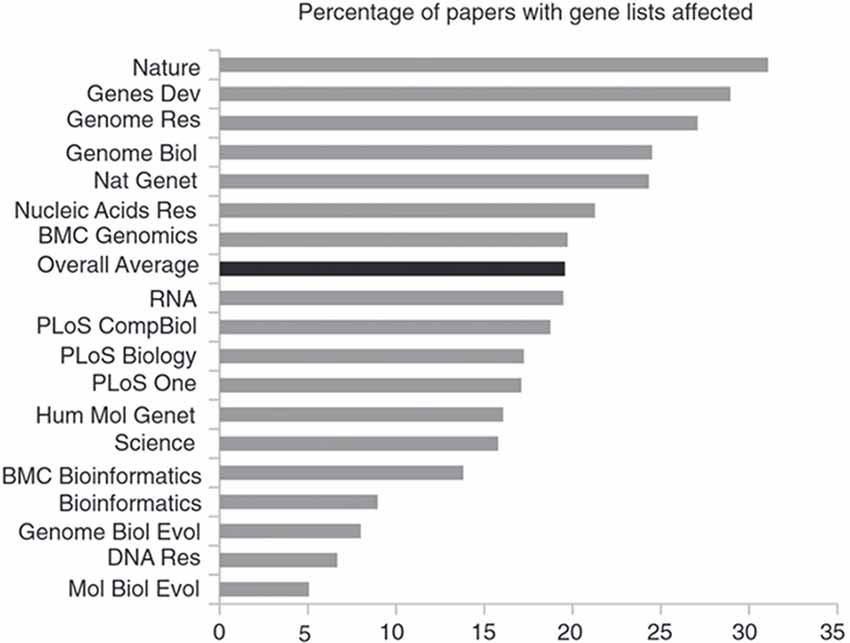
With the advent of data deposition mandates by some journals, it has become a regular practice to supply the required data as supplemental files, often in spreadsheet form, compatible with the Excel software (Microsoft Corp., Redmond, WA, USA). However, when using Excel’s default settings, gene symbols and accession numbers may inadvertently be converted into dates or floating point numbers (Ziemann et al., 2016). These errors are widespread in the literature and the journals with above average error-rate are more highly ranked than journals with below-average error rate (Figure 5, modified from Ziemann et al., 2016). The authors speculate that the correlation they found is due to higher ranking journals publishing larger gene collections. This explanation, if correct, would suggest that, on average, error detection in such journals is at least not superior to that in other journals.
FIGURE 5
Figure 5. Journals with above-average error-rate rank higher than journals with a lower error-rate. Shown is the prevalence of gene name errors in supplementary Excel files as the percentage of publications with supplementary gene lists in Excel files affected by gene name errors. Figure modified from Ziemann et al. (2016).
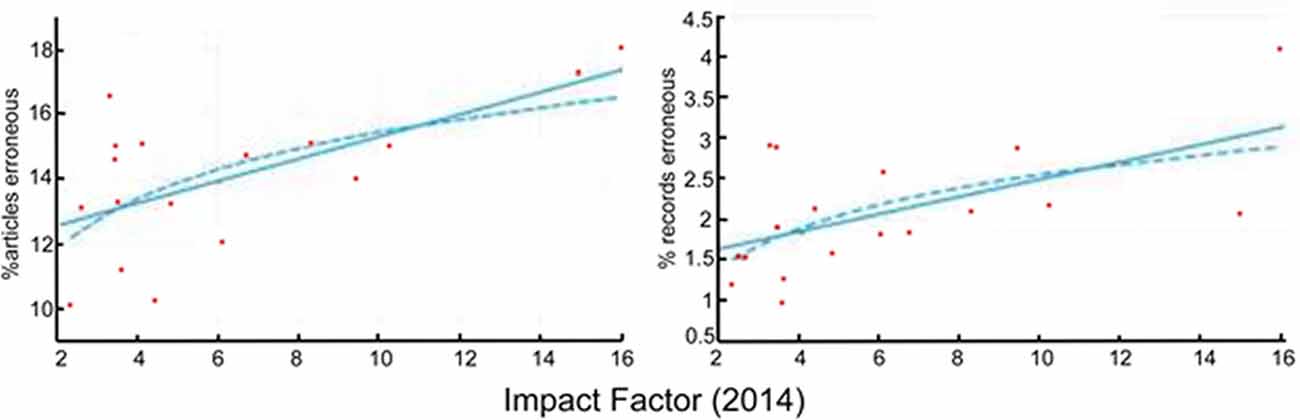
Another source of error in the literature are p-value reporting errors, i.e., the p-values reported in a publication deviate from the p-value calculated from the data. Comparing only those p-value reporting errors that changed the significance of the outcome across their sample of 18 journals in cognitive neuroscience and psychology, Szucs and Ioannidis (2016) found a significant correlation between the rate of such erroneous records and the IF of the journal (Figure 6, redrawn from Szucs and Ioannidis, 2016). Interestingly, the errors were highly skewed in the direction of reporting a non-significant computed p-value as significant (Szucs and Ioannidis, 2016).
FIGURE 6
Figure 6. p-value reporting errors correlate significantly with journal rank. The correlation of the median percentage of articles with erroneous articles (left; which can contain multiple erroneous records) or individual records (right) in a given journal and journal IFs. Both linear and logarithmic (log[journal IF]) trend lines are shown. Figure redrawn from Szucs and Ioannidis (2016).
Criteria for Evidence-Based Medicine
One way of estimating the reliability of scientific publications is to count how many criteria for evidence-based medicine (e.g., according to JBJS-A, Australian National Health and Medical Research Council guidelines or GRADE) have been fulfilled and correlate these data with journal rank. There currently are four such studies, where two found such a correlation, indicating higher-ranked journals publish work where more criteria are fulfilled (Obremskey et al., 2005; Lau and Samman, 2007) and two did not (Bain and Myles, 2005; Tressoldi et al., 2013). In the case of these studies, if there is any actual correlation between journal rank and levels of evidence in medicine, it appears to be too weak to be detected consistently. For further discussion of these studies see Brembs et al. (2013).
Reliability Metrics in Psychology
In the wake of recent replication efforts on psychology (Open Science Collaboration, 2015), metrics have been developed to detect tell-tale signs of questionable research practices or publication bias in a body of published work. These metrics commonly use p-value distributions or statistical power and other values which can be computed from the published articles to estimate the reliability of published research results. In a recent study (Bittner and Schönbrodt, 2017), the authors compared the p-values and statistical power in two psychology journals with very different IFs (0.79 vs. 5.03) for signs of p-hacking and other questionable research practices. In this study, a selection of three different metrics all indicate that the journal with the higher IF published less reliable results than the journal with the lower IF.
Reproducibility Efforts
Current reproducibility efforts are comparatively small scale, with regard to the number of journals covered in each initiative, and hence cannot provide conclusive evidence as to any differences between journals in the reproducibility of the studies they publish. However, in studies where several journals were covered, the highest ranking journals did not stand out with a particularly high reproducibility, suggesting it may be only average in these journals (Scott et al., 2008; Prinz et al., 2011; Begley and Ellis, 2012).
Conclusion
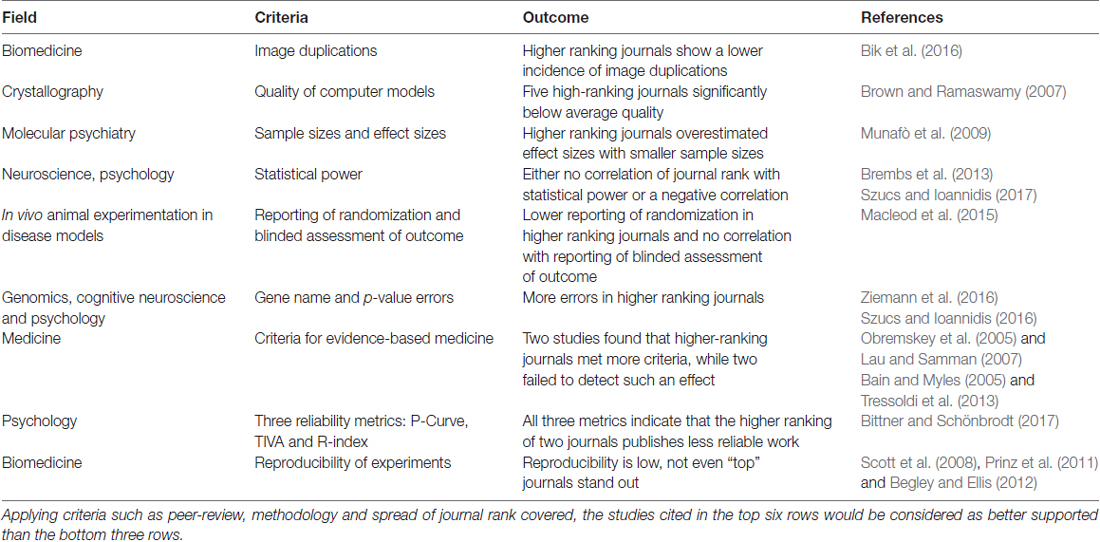
There are currently several lines of evidence in the literature, suggesting that highly prestigious journals fail to reach a particularly high level of reliability. On the contrary, some of the data seem to indicate that, on average, the highest ranking journals often struggle to raise above the average reliability levels set by the other journals (Table 1).
TABLE 1
Table 1. Overview of the cited literature on journal rank and methodological soundness.
In particular, comparing higher with lower ranked journals, two main conclusions can be drawn: (1) experiments reported in high-ranking journals are no more methodologically sound than those published in other journals; and (2) experiments reported in high-ranking journals are often less methodologically sound than those published in other journals.
Interestingly, not a single study provides evidence for the third option of higher-ranking journals publishing the most sound experiments. It is this third option that one would expect at least one area of inquiry to have conclusively demonstrated, if there was a true positive association between journal rank and reliability.
At the time of this writing, there is one single publication reporting that image duplication is lower in higher ranking journals (Bik et al., 2016). This result conflicts with the increased rate of fraud reported for higher ranking journals (Cokol et al., 2007; Fang and Casadevall, 2011; Fang et al., 2012). Potentially, these contradictory results may indicate that higher ranking journals may be more effective specifically in detecting duplicated images (perhaps due to a superior/more expensive software solution?), but failing in virtually all other aspects.
Importantly, these conclusions have been drawn from evidence collected from the published, unretracted literature, sampling many thousands of publications and data-sets from a variety of experimental fields. This method excludes differences in readership and associated scrutiny and directly approaches a reliability-based notion of methodological “quality”.
In total, none of the reported effects of journal rank, even those nominally significant, indicate a clear, obvious difference between journals. All journals seem to have difficulties coping with the issue of reliability, regardless of perceived prestige, regardless of the selectivity of the journal. Thus, the most conservative interpretation of the available data is that the reliability of scientific results does not depend on the venue where the results was published. In other words, the prestige, which allows high ranking journals to select from a large pool of submitted manuscripts, does not provide these journals with an advantage in terms of reliability. If anything, it may sometimes become a liability for them, as in the studies where a negative correlation was found. This insight entails that even under the most conservative interpretation of the data, the most prestigious journals, i.e., those who command the largest audience and attention, at best excel at presenting results that appear groundbreaking on the surface. Which of those results will end up actually becoming groundbreaking or transformative, rather than flukes or frauds, is a question largely orthogonal to the journal hierarchy.
It is up to the scientific community to decide if the signal-to-noise ratio in these journals is high enough to justify the cost of serial scandals and, in the case of medical journals, loss of life, due to unreliable research.
This body of evidence complements evolutionary models suggesting that using productivity as selection pressure in hiring, promotion and funding decisions leads to an increased frequency of questionable research practices and false positive results (Higginson and Munafò, 2016; Smaldino and McElreath, 2016). Arguably, scientists who become “successful” scientists by increasing their productivity through reduced sample sizes (i.e., as a consequence, reduced statistical power) and by publishing in journals with a track record of unreliable science, will go on teaching their students how to become successful scientists. Already after only one generation of such selection pressures, we begin to see the effects on the reliability of the scientific literature. If scholars strive to convince the public that the scientific endeavor deserves its trust and funds, abolishing these selection pressures is likely the most urgent evidence-based policy of any current reform efforts.
Author Contributions
The author confirms being the sole contributor of this work and approved it for publication.
Conflict of Interest Statement
The author declares that the research was conducted in the absence of any commercial or financial relationships that could be construed as a potential conflict of interest.
References
Adler, R., Ewing, J., and Taylor, P. (2009). Citation statistics. Statist. Sci. 24, 1–14. doi: 10.1214/09-STS285
Bain, C. R., and Myles, P. S. (2005). Relationship between journal impact factor and levels of evidence in anaesthesia. Anaesth. Intensive Care 33, 567–570.
Bik, E. M., Casadevall, A., and Fang, F. C. (2016). The prevalence of inappropriate image duplication in biomedical research publications. MBio 7, e00809–e00816. doi: 10.1128/mBio.00809-16
Bittner, A., and Schönbrodt, F. (2017). Assessing the Evidential Value of Journals with P-Curve, R-Index and TIVA. Nicebread. Available online at: http://www.nicebread.de/p-curving-journals/ [accessed May 9, 2017].
Brembs, B., Button, K., and Munafò, M. (2013). Deep impact: unintended consequences of journal rank. Front. Hum. Neurosci. 7:291. doi: 10.3389/fnhum.2013.00291
Brown, E. N., and Ramaswamy, S. (2007). Quality of protein crystal structures. Acta Crystallogr. D Biol. Crystallogr. 63, 941–950. doi: 10.1107/S0907444907033847
Button, K. S., Ioannidis, J. P. A., Mokrysz, C., Nosek, B. A., Flint, J., Robinson, E. S. J., et al. (2013). Power failure: why small sample size undermines the reliability of neuroscience. Nat. Rev. Neurosci. 14, 365–376. doi: 10.1038/nrn3475
Cokol, M., Iossifov, I., Rodriguez-Esteban, R., and Rzhetsky, A. (2007). How many scientific papers should be retracted? EMBO Rep. 8, 422–423. doi: 10.1038/sj.embor.7400970
Fang, F. C., Steen, R. G., and Casadevall, A. (2012). Misconduct accounts for the majority of retracted scientific publications. Proc Natl. Acad. Sci. U S A 109, 17028–17033. doi: 10.1073/pnas.1212247109
Gordon, M. D. (1982). Citation ranking versus subjective evaluation in the determination of journal hierachies in the social sciences. J. Am. Soc. Inf. Sci. 33, 55–57. doi: 10.1002/asi.4630330109
Higginson, A. D., and Munafò, M. R. (2016). Current incentives for scientists lead to underpowered studies with erroneous conclusions. PLoS Biol. 14:e2000995. doi: 10.1371/journal.pbio.2000995
Lau, S. L., and Samman, N. (2007). Levels of evidence and journal impact factor in oral and maxillofacial surgery. Int. J. Oral Maxillofac. Surg. 36, 1–5. doi: 10.1016/j.ijom.2006.10.008
Macleod, M. R., Lawson McLean, A., Kyriakopoulou, A., Serghiou, S., de Wilde, A., Sherratt, N., et al. (2015). Correction: risk of bias in reports of in vivo research: a focus for improvement. PLoS Biol. 13:e1002301. doi: 10.1371/journal.pbio.1002301
Munafò, M. R., Stothart, G., and Flint, J. (2009). Bias in genetic association studies and impact factor. Mol. Psychiatry 14, 119–120. doi: 10.1038/mp.2008.77
Obremskey, W. T., Pappas, N., Attallah-Wasif, E., Tornetta, P. III., and Bhandari, M. (2005). Level of evidence in orthopaedic journals. J. Bone Joint Surg. Am. 87, 2632–2638. doi: 10.2106/jbjs.e.00370
Open Science Collaboration. (2015). PSYCHOLOGY. Estimating the reproducibility of psychological science. Science 349:aac4716. doi: 10.1126/science.aac4716
Prinz, F., Schlange, T., and Asadullah, K. (2011). Believe it or not: how much can we rely on published data on potential drug targets? Nat. Rev. Drug Discov. 10:712. doi: 10.1038/nrd3439-c1
Scott, S., Kranz, J. E., Cole, J., Lincecum, J. M., Thompson, K., Kelly, N., et al. (2008). Design, power, and interpretation of studies in the standard murine model of ALS. Amyotroph. Lateral Scler. 9, 4–15. doi: 10.1080/17482960701856300
Sønderstrup-Andersen, E. M., and Sønderstrup-Andersen, H. H. K. (2008). An investigation into diabetes researcher’s perceptions of the journal impact factor—reconsidering evaluating research. Scientometrics 76, 391–406. doi: 10.1007/s11192-007-1924-4
Szucs, D., and Ioannidis, J. P. A. (2016). Empirical assessment of published effect sizes and power in the recent cognitive neuroscience and psychology literature. bioRxiv doi: 10.1101/071530
Szucs, D., and Ioannidis, J. P. A. (2017). Empirical assessment of published effect sizes and power in the recent cognitive neuroscience and psychology literature. PLoS Biol. 15:e2000797. doi: 10.1371/journal.pbio.2000797
Tressoldi, P. E., Giofré, D., Sella, F., and Cumming, G. (2013). High impact = high statistical standards? Not necessarily so. PLoS One 8:e56180. doi: 10.1371/journal.pone.0056180
Vanclay, J. K. (2011). Impact factor: outdated artefact or stepping-stone to journal certification? Scientometrics 92, 211–238. doi: 10.1007/s11192-011-0561-0
Ziemann, M., Eren, Y., and El-Osta, A. (2016). Gene name errors are widespread in the scientific literature. Genome Biol. 17:177. doi: 10.1186/s13059-016-1044-7
Wissenschaftsverlage wie Elsevier oder Springer Nature sind nur noch vordergründig Verlagshäuser – eigentlich arbeiten sie daran, Tracking-Tools zur Analyse und Überwachung wissenschaftlicher Arbeit zu entwickeln. Das sagt Björn Brembs im Interview mit iRights.info. Der Naturwissenschaftler beobachtet und kritisiert die Entwicklungen seit Jahren.
Forscher*innen erarbeiten wissenschaftliche Erkenntnisse, fassen sie in Texten zusammen und veröffentlichen diese als Aufsätze oder Bücher in wissenschaftlichen Verlagen. Dieses System ist seit Jahrzehnten eingespielt, es wird selten hinterfragt.
Brembs ist der Meinung: Die Wissenschaft habe mit den Großverlagen ein System mitaufgebaut, das ihr mehr schade als nütze. Denn die Verlage investierten das viele Geld, das sie von den Universitäten zur Publikation bekämen – darunter auch hohe Open-Access-Gebühren – um datengestützte Tracking- und Analysesysteme zu entwickeln, die sich auch zur Überwachung von Wissenschaftler*innen einsetzen lassen.
Im Interview mit iRights.info erläutert Brembs seine Beobachtungen, übt Kritik an Knebeldeals zwischen Verlagen und Bibliotheken und macht sich für eine Modernisierung der digitalen Infrastruktur in der Wissenschaft stark.
Herr Brembs, Sie beobachten das akademische Verlagswesen schon seit einigen Jahren und schreiben kritisch darüber, zum Beispiel auf Ihrem Blog. Für unsere Leser*innen: Was machen wissenschaftliche Großverlage wie Elsevier eigentlich?
Es geht um die großen vier mit Marktdominanz: Elsevier, Springer Nature, Taylor & Francis und Wiley. Diese vier publizieren natürlich nicht nur naturwissenschaftliche, sondern beispielsweise auch wirtschaftswissenschaftliche Journale.
Das Geschäftsmodell von diesen vier großen Verlagen ist identisch, unabhängig von den Fächern. Die Daten sagen dazu folgendes: Circa 85 Prozent der Einkünfte der Verlage kommen aus der öffentlichen Hand, also aus Bibliotheken. Was man auch weiß, das ist das Gesamtvolumen der Subskriptionseinkünfte weltweit, etwa 10 Milliarden Dollar pro Jahr für ungefähr zwei bis drei Millionen Artikel.
Damit liegt man ungefähr bei einem Preis zwischen 4.000 und 5.000 Dollar pro publizierten Artikel, der an die Verlage geht. Über diese Subskriptionsgebühren finanzieren sich die Verlage, seit einiger Zeit zunehmend auch über die sogenannte Artikel Processing Charge (APC) von Open-Access-Publikationen. Bei APC bezahlt man also nicht mehr dafür, dass man liest, sondern dafür, dass man als Autor*in publiziert.
Wenn man so einen Artikel für 4.000 Dollar nimmt, dann sind davon ungefähr 600 Dollar Publikationskosten und etwa 30 % Profit, also etwa 1.200 Dollar. Dann bleiben 2.200 Dollar übrig.
Wie kommen Sie denn auf diese Zahlen?
Die Produktionskosten kann man ausrechnen: Die verschiedenen Dienstleistungen, die so eine Publikation benötigt, lassen sich nachschlagen. Wenn es nur eine Angabe der Arbeitszeit gibt, kann man abschätzen, wie viele Stunden so ein typischer Artikel bearbeitet wird für einen Arbeitsgang. Das lässt sich einfach zusammenzählen. Die Gewinne werden bei großen Verlagen häufig auch öffentlich gemacht. Aus diesen kann man einen Mittelwert bilden. Und so kommt man auf diese Zahlen.
Es bleiben also durchschnittlich etwa 2.200 Dollar pro Artikel übrig. Was stellen die Verlage damit an?
Seit etwa zehn Jahren investieren die Verlage sehr viel Geld, kaufen verschiedene Technologien und Startups auf. Ziel ist, den gesamten wissenschaftlichen Ablauf abzudecken und zu überwachen: Von der Ideenentwicklung übers Daten sammeln und auswerten, Publizieren, Publikationen auswerten, Forschungstrends antizipieren – also alles von der ersten Idee und der Kooperation mit anderen Kolleg*innen bis hin zum Ende, wenn Institutionen wie Universitäten und Forschungsinstitute auswerten, in welcher Fakultät welche Ergebnisse wie publiziert und präsentiert und zitiert werden. Vom allerkleinsten Anfang bis hin zum großen, aggregierten Ende.
Das klingt sehr umfassend und auch nach Überwachung: Um was für Startups und Technologien handelt es sich da?
2013 beispielsweise hat Elsevier den Referenzmanager Mendeley gekauft, einer der ersten großen Käufe. Ein Referenzmanager verwaltet Literatur. Im Grunde ist das eine Datenbank, in der steht, wer wen zitiert. Elsevier kann also auswerten, wer welche Artikel in Mendeley speichert und liest, und kann entsprechende Daten extrahieren.
Zudem hat Elsevier den Preprint-Server SSRN gekauft. Dort werden Texte publiziert, bevor sie offiziell in den Journals erscheinen. In den Wirtschaftswissenschaften kann das ja Jahre dauern, bis so ein Arbeitspapier als Artikel in einem Journal erscheint. Das heißt, diejenigen, die diese Datenbank haben, können auch Trends vorhersehen und sich gegenüber anderen einen Vorteil verschaffen, etwa gegenüber anderen Universitäten. Sei dieser Vorteil nun monetärer Art, wenn man diese Daten verkauft, oder eben um sich in einer Konkurrenz Vorteile zu verschaffen, wenn es darum geht, den wissenschaftlichen Workflow zu monopolisieren.
In einem Blogpost habe ich kürzlich die Firmen aufgelistet, die die Großverlage aufgekauft haben. Zum Beispiel hat Holtzbrinck, der Mutterkonzern von Springer Nature, Overleaf gekauft: Ein digitales System, bei dem mehrere Autor*innen an einem Text zusammen schreiben und dabei andere Publikationen zitieren können. Und da entstehen auch Daten darüber, was noch nicht publiziert ist, die der Konzern dann auswerten kann. Vielleicht hat ja bereits jede*r Ihrer Leser*innen an Forschungsinstituten mindestens ein solches Werkzeug in Gebrauch, ohne es zu realisieren?
„Denn die Forschung wird so für alle Leute und Organisationen, die rausfinden wollen, wer unliebsame Forschung macht, über finanzielle Mittel zugänglich.“
Was ist problematisch, wenn so ein Verlagshaus so viele verschiedene Technologien besitzt?
Da gibt es mehrere Probleme. Die Marktmacht ist da nur das eine Problem. So ein Verlag kann dann an eine Universität, eine Exzellenzinitative oder an ein Max-Planck-Institut herantreten und sagen: Hier, wir haben ein Paket, mit dem sind Sie alle ihre Sorgen los. Wir kümmern uns um ihre Daten, um Ihren Quellcode, ihre Verwaltungen können rausfinden, welche Mitarbeiter*innen wo was machen und wie erfolgreich sie sind. Wir bieten Ihnen das alles in einem Paket an, mit super Service zum günstigen Preis – der genauso viel kostet wie die Subskriptionen für die Journals, die Sie die ganze Zeit zahlen.
Und wenn man als Institution darauf eingeht und so einen Vertrag abschließt, dann möchte man als Kunde gerne, dass man bei Unzufriedenheit den Anbieter auch wechseln kann. Und das liegt natürlich nicht im Interesse eines solchen Anbieters. Der Anbieter möchte eine Situation haben, wo der Kunde eben nicht mehr wegkann. Das nennt man Kundenbindung …
… oder auch „Lock-in-Effekt“, also eine Situation, in der die Kosten für einen Anbieterwechsel für den Kunden so hoch sind, dass dieser sich genau überlegt, ob es sich lohnt, den Vertrag zu kündigen.
Ja, und wenn diese Kundenbindung so angelegt ist, dass es unmöglich ist zu wechseln, ist es sogar noch besser für die Verlage.
Das nächste Problem ist: Die Wissenschaft ist ja ein grundrechtlich geschützter Bereich. Wenn es nun eine komplette Übersicht darüber gibt, was Wissenschaftler*innen machen und die Verlage die dazugehörigen Daten monetarisieren, wie sie es ja tun, dann gerät die Wissenschaftsfreiheit in Gefahr. Denn die Forschung wird so für alle Leute und Organisationen, die rausfinden wollen, wer unliebsame Forschung macht, über finanzielle Mittel zugänglich.
Man kann sich also mit entsprechenden finanziellen Mitteln Zugang zu allen möglichen wissenschaftlichen Daten verschaffen, welche Forschung gerade geplant wird oder entsteht oder veröffentlicht wird. Die Verlage sind mittlerweile Datenanalyse-Firmen. Das sind nicht mehr Verlage im engeren Sinne, sondern die machen „Data Analytics“, das steht auch überall bei denen groß drauf.
Können Sie ein Beispiel geben, was man mit den Daten machen kann?
Das aus unserer europäischen Sicht noch harmloseste Beispiel ist, dass das Datenbanksystem LexisNexis von Elseviers Mutterkonzern RELX mit dem US-amerikanischen Immigration und Customs Enforcement (ICE) zusammenarbeitet, also der dortigen Bundespolizei- und Zollbehörde. Diese Behörde darf diese Daten, die LexisNexis anbietet, nicht selbst erheben. Dazu bräuchten sie einen Durchsuchungsbeschluss. Aber kaufen dürfen sie die! Es steht nirgends, dass es verboten ist, die Daten zu kaufen, wenn sie erhältlich sind. Nur selbst erheben darf die Behörde sie nicht.
Das heißt ein Verlag wird zum Datenbroker, zu einer Firma, die mit Daten handelt?
Genau, das sind eigentlich Datenbroker. Ein anderes Beispiel ist die Science Foundation in Irland (SFI), eine wissenschaftliche Förderinstitution, so ähnlich wie die Deutsche Forschungsgemeinschaft (DFG). Die SFI vermeldete kürzlich, dass sie sich mit Elsevier zusammengetan haben. Elsevier habe, so die SFI, einen herausragenden Datensatz, der ihnen dabei helfe herauszufinden, in welchen Fächern sie noch besser werden könnten, wie und wo sie schnell Talente abgreifen könnten, bevor jemand anders sie abgreift, um in diesem Markt führend zu werden. Es geht in der Tat darum, dass Irland Daten – unter anderem natürlich auch aus Deutschland – abgreift, um sich gegenüber Deutschland und anderen Ländern besser zu positionieren.
„Das ist nicht nur ein Publikationsproblem, sondern ein regelrechtes Infrastrukturproblem.“
Bei ihrem eigentlichen Kerngeschäft, dem Verlegen von Literatur, haben die Verlage Konkurrenz aus dem Untergrund bekommen: Eines der bekanntesten Beispiele ist dieSchattenbibliothek SciHub.Damit verschaffen sich Wissenschaftler*innen Zugriff auf Literatur, die Verlage hinter Paywalls stecken. Was bewirken solche illegalen oder rechtlich zumindest fragwürdigen Angebote?
Es gibt ja nicht nur SciHub, sondern auch verschiedene weitere Möglichkeiten an Artikel zu kommen, die völlig legal sind. Deswegen ich möchte da nicht unbedingt SciHub herausgreifen, auch wenn es schon sehr gut funktioniert.
Ich würde da lieber über „Workarounds“ sprechen, also Wege, um an Paywalls vorbeizukommen. Es gibt jede Menge Technologien, die uns auf die eine oder andere Art und Weise helfen, an Paywalls vorbeizukommen, zum Beispiel die Bibliotheksfernleihe. Die ist völlig legal, darüber komme ich auch ohne ein Abonnement an die Publikationen. Unpaywall wäre ein anderes Beispiel, das ist ein Browser-Plugin, das automatisch Preprint-Server und Open-Access-Repositorien durchsucht.
Es gibt noch weitere solcher Technologien. Aber die sind alle keine Lösung, denn die funktionieren nur retroaktiv, also für Publikationen, die bereits veröffentlicht sind. Die lösen nicht irgendein generelles Problem, sondern nur ein sehr spezifisches Problem, nämlich das des Zugangs.
Können diese Technologien dazu beitragen, die Verlage unter Druck zu setzen und mehr Open Access zu veröffentlichen?
Der Zugang ist nur ein technisches Problem. Die Paywall ist letztlich nur eine Technologie, die uns daran hindert, dass wir freien Zugriff haben. Zugang wird immer gern als ethisches oder finanzielles Problem dargestellt. Aber ganz im Kern ist es ein technisches Problem. Das eigentliche Problem liegt woanders: Nach wie vor gibt es so viel Literatur, an die wir immer noch nicht über die Unis rankommen, außer über Subskriptionen.
Das ist nicht nur ein Publikationsproblem, sondern ein regelrechtes Infrastrukturproblem. Man könnte jetzt sagen: Um das zu lösen, brauchen wir Geld, zumindest für eine Übergangszeit. Das Geld wird momentan aber an Verlage verschwendet, die einen Teil davon einsetzen, um uns zu überwachen. Wir wussten schon vorher, dass das Geld nicht gut investiert ist, aber mit den Erkenntnissen, die ich beschrieben habe, wissen wir noch viel mehr, wie schlecht es ist, dass wir den Verlagen so viel bezahlen.
Das klingt nach einem großen Versäumnis.
Es wird immer deutlicher, dass uns diese ganze Überbezahlung der letzten Jahrzehnte richtig dicke auf die Füße fällt. Dass wir hier seit Jahrzehnten einen Gegner bezahlen, der nicht an der Wissenschaft interessiert ist, sondern nur am Profit. In den letzten zehn Jahren haben wir kollektiv auf der ganzen Welt als wissenschaftliche Gemeinde, ganz grob über den Daumen gepeilt, etwa 100 Milliarden Dollar für ein Verlagswesen ausgegeben, das wir eigentlich gar nicht mehr nötig haben.
Das Hauptproblem war, dass die Universitäten die teuren Abonnements nicht canceln können, weil sonst die Wissenschaftler*innen nicht weiterarbeiten können. Hauptsächlich diese Kundenbindung hat die Verlage so mächtig gemacht. Wir hätten während der letzten fünf bis zehn Jahre tatsächlich diese ganzen Abonnements abbestellen können und mit dem vielen, vielen Geld sehr schnell ein paar Komponenten kaufen können, um eine alternative Struktur aufzubauen.
„Die Verlage waren der Wissenschaft immer einen Schritt voraus – oder eigentlich hundert.“
Kommen wir zum Schluss noch auf das„Projekt DEAL“, das Vertragskonstrukt zwischen den deutschen Wissenschafts-Organisationen und den drei großen Verlagen Elsevier, Springer Nature und Wiley.DEAL wurde 2014 ins Leben gerufen, die Hochschulrektorenkonferenz (HRK) ist federführend.Zentraler Baustein von DEAL ist eine Vergütung nach Publikationsvolumen, die sogenannte „Read-and-Publish“-Vereinbarung.
Kürzlich versandte die HRK gemeinsam mit der Max-Planck-Gesellschaft (MPG) einen Brief an die Direktor*innen der Universitätsbibliotheken. Darin fordern sie die Hochschulleitungen zu einer „baldigen Anpassung der Zahlungsströme“ auf. Was soll das bedeuten?
Dieser Brief existiert, weil man bei DEAL offensichtlich nicht darüber nachgedacht hat, dass eine Umwandlung nach Publikationsvolumen im Zuge des DEAL-Projekts natürlich die gesamten Bezahlströme ändert: Denn die wenig publizierenden Fachhochschulen müssen dann wenig oder nichts mehr bezahlen. Und die Universitäten, die besonders viel publizieren, müssen fast alles bezahlen. Die Unis stemmen also die finanzielle Hauptlast, die sich vorher auf alle Institutionen mit Abonnements verteilt hat.
Das hat die HRK bei den Verhandlungen einfach nicht bedacht. Und in dem Brief fordern HRK und MPG nun richtig viel Geld und Unterstützung für die forschungsstarken Universitäten, weil sonst DEAL nicht mehr funktioniert. Das ist eine Implementierung, die eine Katastrophe ist! Wenn man das vorher bedacht hätte, gäbe es diesen Brief gar nicht, dann wäre schon früher eine bessere Lösung als DEAL entwickelt worden. Und das ist sehr peinlich.
Das heißt, mit DEAL haben sich die Probleme verschärft?
Die Abonnement-Verträge vor DEAL waren schon schwer kündbar, aber mit der „Read-and-publish“-Vereinbarung durch DEAL sind sie noch viel schwerer zu kündigen geworden! Denn es ist klar: Die Wissenschaftler*innen werden einen viel größeren Aufstand machen, wenn sie aufgrund eines nicht verlängerten Vertrags nicht mehr publizieren können, als wenn sie aufgrund eines nicht verlängerten Vertrags nicht mehr lesen können.
DEAL reduziert also die Kosten nicht, die Verlage können weiter investieren, und das Geld aus der Wissenschaft nehmen und gegen die Wissenschaft einsetzen. Das ist ein Open Access nach dem Motto „koste es, was es wolle“.
Und es zeigt den Unterschied zwischen den Verlagen und der wissenschaftlichen Gemeinschaft: Die Verlage haben früh das wirtschaftliche Potential der Digitalisierung erkannt und realisiert, dass sie sich diversifizieren müssen: Akademische Texte zu publizieren und zugänglich machen – das trägt nicht mehr als alleiniges Geschäftsmodell.
Die Verlage waren der Wissenschaft immer einen Schritt voraus – oder eigentlich hundert. Und die Wissenschaft arbeitet sich heute immer noch am gleichen Open-Access-Problem ab, das wir seit 30 Jahren haben und obwohl es ja durch die Workarounds seit mittlerweile gut acht bis neun Jahren komplett an Relevanz verloren hat.
For years, we women have kept our heads down and played by the rules. We’ve been certain that with enough hard work, our natural talents would be recognized and rewarded.
We’ve made undeniable progress. In the United States, women now earn more college and graduate degrees than men do. We make up half the workforce, and we are closing the gap in middle management. Half a dozen global studies, conducted by the likes of Goldman Sachs and Columbia University, have found that companies employing women in large numbers outperform their competitors on every measure of profitability. Our competence has never been more obvious. Those who closely follow society’s shifting values see the world moving in a female direction.
The authors, Claire Shipman (left), a reporter for ABC News, and Katty Kay (right), the anchor of BBC World News America. In two decades of covering American politics, they have interviewed some of the most influential women in the nation. They were surprised to discover the extent to which these women suffered from self-doubt. (Henry Leutwyler)
And yet, as we’ve worked, ever diligent, the men around us have continued to get promoted faster and be paid more. The statistics are well known: at the top, especially, women are nearly absent, and our numbers are barely increasing. Half a century since women first forced open the boardroom doors, our career trajectories still look very different from men’s.
Some observers say children change our priorities, and there is some truth in this claim. Maternal instincts do contribute to a complicated emotional tug between home and work lives, a tug that, at least for now, isn’t as fierce for most men. Other commentators point to cultural and institutional barriers to female success. There’s truth in that, too. But these explanations for a continued failure to break the glass ceiling are missing something more basic: women’s acute lack of confidence.
The elusive nature of confidence has intrigued us ever since we started work on our 2009 book, Womenomics, which looked at the many positive changes unfolding for women. To our surprise, as we talked with women, dozens of them, all accomplished and credentialed, we kept bumping up against a dark spot that we couldn’t quite identify, a force clearly holding them back. Why did the successful investment banker mention to us that she didn’t really deserve the big promotion she’d just got? What did it mean when the engineer who’d been a pioneer in her industry for decades told us offhandedly that she wasn’t sure she was really the best choice to run her firm’s new big project? In two decades of covering American politics as journalists, we realized, we have between us interviewed some of the most influential women in the nation. In our jobs and our lives, we walk among people you would assume brim with confidence. And yet our experience suggests that the power centers of this nation are zones of female self-doubt—that is, when they include women at all.
We know the feeling firsthand. Comparing notes about confidence over dinner one night last year, despite how well we knew each other, was a revelation. Katty got a degree from a top university, speaks several languages, and yet had spent her life convinced that she just wasn’t intelligent enough to compete for the most-prestigious jobs in journalism. She still entertained the notion that her public profile in America was thanks to her English accent, which surely, she suspected, gave her a few extra IQ points every time she opened her mouth.
Claire found that implausible, laughable really, and yet she had a habit of telling people she was “just lucky”—in the right place at the right time—when asked how she became a CNN correspondent in Moscow while still in her 20s. And she, too, for years, routinely deferred to the alpha-male journalists around her, assuming that because they were so much louder, so much more certain, they just knew more. She subconsciously believed that they had a right to talk more on television. But were they really more competent? Or just more self-assured?
We began to talk with other highly successful women, hoping to find instructive examples of raw, flourishing female confidence. But the more closely we looked, the more we instead found evidence of its shortage.
VIDEO: The authors discuss the confidence gap with The Atlantic’s Hanna Rosin.
The All-Star WNBA player Monique Currie, of the Washington Mystics, displays dazzling agility and power on the basketball court. On the subject of confidence, however, she sounded disconcertingly like us. Currie rolled her eyes when we asked whether her wellspring of confidence was as deep as that of a male athlete. “For guys,” she said, in a slightly mystified, irritated tone, “I think they have maybe 13- or 15-player rosters, but all the way down to the last player on the bench, who doesn’t get to play a single minute, I feel like his confidence is just as big as the superstar of the team.” She smiled and shook her head. “For women, it’s not like that.”
The tech entrepreneur Clara Shih, who founded the successful social-media company Hearsay Social in 2010 and joined the board of Starbucks at the tender age of 29, is one of the few female CEOs in the still-macho world of Silicon Valley. But as an undergrad at Stanford, she told us, she was convinced that courses she found difficult were easy for others. Although Shih would go on to graduate with the highest GPA of any computer-science major in her class, she told us that at times she “felt like an imposter.” As it happens, this is essentially what Facebook COO Sheryl Sandberg told us a year before her book, Lean In, was published: “There are still days I wake up feeling like a fraud, not sure I should be where I am.”
We were inspired by these conversations, and many more, to write a book on the subject, with a particular eye to whether a lack of confidence might be holding women back. We ended up covering much more territory than we’d originally anticipated, ranging from the trait’s genetic components to how it manifests itself in animals to what coaches and psychologists have learned about cultivating it. Much of what we discovered turns out to be relevant to both women and men.
Even as our understanding of confidence expanded, however, we found that our original suspicion was dead-on: there is a particular crisis for women—a vast confidence gap that separates the sexes. Compared with men, women don’t consider themselves as ready for promotions, they predict they’ll do worse on tests, and they generally underestimate their abilities. This disparity stems from factors ranging from upbringing to biology.
A growing body of evidence shows just how devastating this lack of confidence can be. Success, it turns out, correlates just as closely with confidence as it does with competence. No wonder that women, despite all our progress, are still woefully underrepresented at the highest levels. All of that is the bad news. The good news is that with work, confidence can be acquired. Which means that the confidence gap, in turn, can be closed.
The shortage of female confidence is increasingly well quantified and well documented. In 2011, the Institute of Leadership and Management, in the United Kingdom, surveyed British managers about how confident they feel in their professions. Half the female respondents reported self-doubt about their job performance and careers, compared with fewer than a third of male respondents.
Linda Babcock, a professor of economics at Carnegie Mellon University and the author of Women Don’t Ask, has found, in studies of business-school students, that men initiate salary negotiations four times as often as women do, and that when women do negotiate, they ask for 30 percent less money than men do. At Manchester Business School, in England, professor Marilyn Davidson has seen the same phenomenon, and believes that it comes from a lack of confidence. Each year she asks her students what they expect to earn, and what they deserve to earn, five years after graduation. “I’ve been doing this for about seven years,” she has written, “and every year there are massive differences between the male and female responses.” On average, she reports, the men think they deserve $80,000 a year and the women $64,000—or 20 percent less.
A meticulous 2003 study by the Cornell psychologist David Dunning and the Washington State University psychologist Joyce Ehrlinger homed in on the relationship between female confidence and competence. At the time, Dunning and a Cornell colleague, Justin Kruger, were just finishing their seminal work on something that’s since been dubbed the Dunning-Kruger effect: the tendency for some people to substantially overestimate their abilities. The less competent people are, the more they overestimate their abilities—which makes a strange kind of sense.
Dunning and Ehrlinger wanted to focus specifically on women, and the impact of women’s preconceived notions about their own ability on their confidence. They gave male and female college students a quiz on scientific reasoning. Before the quiz, the students rated their own scientific skills. “We wanted to see whether your general perception of Am I good in science? shapes your impression of something that should be separate: Did I get this question right?,” Ehrlinger said. The women rated themselves more negatively than the men did on scientific ability: on a scale of 1 to 10, the women gave themselves a 6.5 on average, and the men gave themselves a 7.6. When it came to assessing how well they answered the questions, the women thought they got 5.8 out of 10 questions right; men, 7.1. And how did they actually perform? Their average was almost the same—women got 7.5 out of 10 right and men 7.9.
To show the real-world impact of self-perception, the students were then invited—having no knowledge of how they’d performed—to participate in a science competition for prizes. The women were much more likely to turn down the opportunity: only 49 percent of them signed up for the competition, compared with 71 percent of the men. “That was a proxy for whether women might seek out certain opportunities,” Ehrlinger told us. “Because they are less confident in general in their abilities, that led them not to want to pursue future opportunities.”
In studies, men overestimate their abilities and performance, and women underestimate both. Their performances do not differ in quality.
Talking with Ehrlinger, we were reminded of something Hewlett-Packard discovered several years ago, when it was trying to figure out how to get more women into top management positions. A review of personnel records found that women working at HP applied for a promotion only when they believed they met 100 percent of the qualifications listed for the job. Men were happy to apply when they thought they could meet 60 percent of the job requirements. At HP, and in study after study, the data confirm what we instinctively know. Underqualified and underprepared men don’t think twice about leaning in. Overqualified and overprepared, too many women still hold back. Women feel confident only when they are perfect. Or practically perfect.
Brenda Major, a social psychologist at the University of California at Santa Barbara, started studying the problem of self-perception decades ago. “As a young professor,” she told us, “I would set up a test where I’d ask men and women how they thought they were going to do on a variety of tasks.” She found that the men consistently overestimated their abilities and subsequent performance, and that the women routinely underestimated both. The actual performances did not differ in quality. “It is one of the most consistent findings you can have,” Major says of the experiment. Today, when she wants to give her students an example of a study whose results are utterly predictable, she points to this one.
On the other side of the country, the same thing plays out every day in Victoria Brescoll’s lecture hall at Yale’s School of Management. M.B.A. students are nurtured specifically to project confidence in the fashion demanded by today’s business world. But although all of her students are top-of-the-chart smart, she’s been startled to uncover her female students’ lack of belief in themselves.
“There’s just a natural sort of feeling among the women that they will not get a prestigious job, so why bother trying,” she explained. “Or they think that they are not totally competent in the area, so they’re not going to go for it.” As a result, female students tend to opt out. “They end up going into less competitive fields, like human resources or marketing,” she said. “They don’t go for finance, investment banks, or senior-track faculty positions.”
And the men?
“I think that’s really interesting,” Brescoll said with a laugh, “because the men go into everything just assuming that they’re awesome and thinking, Who wouldn’t want me?”
Do men doubt themselves sometimes? Of course. But not with such exacting and repetitive zeal, and they don’t let their doubts stop them as often as women do. If anything, men tilt toward overconfidence—and we were surprised to learn that they come by that state quite naturally. They aren’t consciously trying to fool anyone. Ernesto Reuben, a professor at Columbia Business School, has come up with a term for this phenomenon: honest overconfidence. In a study he published in 2011, men consistently rated their performance on a set of math problems to be about 30 percent better than it was.
We were curious to find out whether male managers were aware of a confidence gap between male and female employees. And indeed, when we raised the notion with a number of male executives who supervised women, they expressed enormous frustration. They said they believed that a lack of confidence was fundamentally holding back women at their companies, but they had shied away from saying anything, because they were terrified of sounding sexist. One male senior partner at a law firm told us the story of a young female associate who was excellent in every respect, except that she didn’t speak up in client meetings. His takeaway was that she wasn’t confident enough to handle the client’s account. But he didn’t know how to raise the issue without causing offense. He eventually concluded that confidence should be a formal part of the performance-review process, because it is such an important aspect of doing business.
The fact is, overconfidence can get you far in life. Cameron Anderson, a psychologist who works in the business school at the University of California at Berkeley, has made a career of studying overconfidence. In 2009, he conducted some novel tests to compare the relative value of confidence and competence. He gave a group of 242 students a list of historical names and events, and asked them to tick off the ones they knew.
Among the names were some well-disguised fakes: a Queen Shaddock made an appearance, as did a Galileo Lovano, and an event dubbed Murphy’s Last Ride. The experiment was a way of measuring excessive confidence, Anderson reasoned. The fact that some students checked the fakes instead of simply leaving them blank suggested that they believed they knew more than they actually did. At the end of the semester, Anderson asked the students to rate one another in a survey designed to assess each individual’s prominence within the group. The students who had picked the most fakes had achieved the highest status.
Confidence, Anderson told us, matters just as much as competence. We didn’t want to believe it, and we pressed him for alternative theories. But deep down, we knew we’d seen the same phenomenon for years. Within any given organization, be it an investment bank or the PTA, some individuals tend to be more admired and more listened to than others. They are not necessarily the most knowledgeable or capable people in the room, but they are the most self-assured.
“When people are confident, when they think they are good at something, regardless of how good they actually are, they display a lot of confident nonverbal and verbal behavior,” Anderson said. He mentioned expansive body language, a lower vocal tone, and a tendency to speak early and often in a calm, relaxed manner. “They do a lot of things that make them look very confident in the eyes of others,” he added. “Whether they are good or not is kind of irrelevant.” Kind of irrelevant. Infuriatingly, a lack of competence doesn’t necessarily have negative consequences. Among Anderson’s students, those who displayed more confidence than competence were admired by the rest of the group and awarded a high social status. “The most confident people were just considered the most beloved in the group,” he said. “Their overconfidence did not come across as narcissistic.”
That is a crucial point. True overconfidence is not mere bluster. Anderson thinks the reason extremely confident people don’t alienate others is that they aren’t faking it. They genuinely believe they are good, and that self-belief is what comes across. Fake confidence, he told us, just doesn’t work in the same way. Studies Anderson is now conducting suggest that others can see the “tells.” No matter how much bravado someone musters, when he doesn’t genuinely believe he is good, others pick up on his shifting eyes and rising voice and other giveaways. Most people can spot fake confidence from a mile away.
Women applied for a promotion only when they met 100 percent of the qualifications. Men applied when they met 50 percent.
Once we got over our feeling that Anderson’s work suggests a world that is deeply unfair, we could see a useful lesson: For decades, women have misunderstood an important law of the professional jungle. It’s not enough to keep one’s head down and plug away, checking items off a list. Having talent isn’t merely about being competent; confidence is a part of that talent. You have to have it to excel.
We also began to see that a lack of confidence informs a number of familiar female habits. Take the penchant many women have for assuming the blame when things go wrong, while crediting circumstance—or other people—for their successes. (Men seem to do the opposite.) David Dunning, the Cornell psychologist, offered the following case in point: In Cornell’s math Ph.D. program, he’s observed, there’s a particular course during which the going inevitably gets tough. Dunning has noticed that male students typically recognize the hurdle for what it is, and respond to their lower grades by saying, “Wow, this is a tough class.” That’s what’s known as external attribution, and in a situation like this, it’s usually a healthy sign of resilience. Women tend to respond differently. When the course gets hard, Dunning told us, their reaction is more likely to be “You see, I knew I wasn’t good enough.” That’s internal attribution, and it can be debilitating.
Perfectionism is another confidence killer. Study after study confirms that it is largely a female issue, one that extends through women’s entire lives. We don’t answer questions until we are totally sure of the answer, we don’t submit a report until we’ve edited it ad nauseam, and we don’t sign up for that triathlon unless we know we are faster and fitter than is required. We watch our male colleagues take risks, while we hold back until we’re sure we are perfectly ready and perfectly qualified. We fixate on our performance at home, at school, at work, at yoga class, even on vacation. We obsess as mothers, as wives, as sisters, as friends, as cooks, as athletes. Bob Sullivan and Hugh Thompson, the authors of The Plateau Effect, call this tendency the “enemy of the good,” leading as it does to hours of wasted time. The irony is that striving to be perfect actually keeps us from getting much of anything done.
So where does all of this start? If women are competent and hardworking enough to outpace men in school, why is it so difficult to keep up later on? As with so many questions involving human behavior, both nature and nurture are implicated in the answers.
The very suggestion that male and female brains might be built differently and function in disparate ways has long been a taboo subject among women, out of fear that any difference would be used against us. For decades—for centuries, actually—differences (real or imagined) were used against us. So let’s be clear: male and female brains are vastly more alike than they are different. You can’t look at scans of two random brains and clearly identify which is male and which is female. Moreover, each individual’s confidence level is influenced by a host of genetic factors that do not seem to have anything to do with his or her sex.
Girls lose confidence, so they quit competing in sports,thereby depriving themselves of one of the best ways to regain it.
Yet male and female brains do display differences in structure and chemistry, differences that may encourage unique patterns of thinking and behavior, and that could thereby affect confidence. This is a busy area of inquiry, with a steady stream of new—if frequently contradictory, and controversial—findings. Some of the research raises the intriguing possibility that brain structure could figure into variations between the way men and women respond to challenging or threatening circumstances. Take, for example, the amygdalae, sometimes described as the brain’s primitive fear centers. They are involved in processing emotional memory and responding to stressful situations. Studies using fMRI scans have found that women tend to activate their amygdalae more easily in response to negative emotional stimuli than men do—suggesting that women are more likely than men to form strong emotional memories of negative events. This difference seems to provide a physical basis for a tendency that’s been observed in behavioral studies: compared with men, women are more apt to ruminate over what’s gone wrong in the past. Or consider the anterior cingulate cortex. This little part of the brain helps us recognize errors and weigh options; some people call it the worrywart center. And, yes, it’s larger in women. In evolutionary terms, there are undoubtedly benefits to differences like these: women seem to be superbly equipped to scan the horizon for threats. Yet such qualities are a mixed blessing today.
You could say the same about hormonal influences on cognition and behavior. We all know testosterone and estrogen as the forces behind many of the basic, overt differences between men and women. It turns out they are involved in subtler personality dynamics as well. The main hormonal driver for women is, of course, estrogen. By supporting the part of the brain involved in social skills and observations, estrogen seems to encourage bonding and connection, while discouraging conflict and risk taking—tendencies that might well hinder confidence in some contexts.
Testosterone, on the other hand, helps to fuel what often looks like classic male confidence. Men have about 10 times more testosterone pumping through their system than women do, and it affects everything from speed to strength to muscle size to competitive instinct. It is thought of as the hormone that encourages a focus on winning and demonstrating power, and for good reason. Recent research has tied high testosterone levels to an appetite for risk taking. In a series of studies, scientists from Cambridge University followed male traders at a London hedge fund, all high rollers (with annual bonuses greater than $5 million). Using saliva samples, the researchers measured the men’s testosterone levels at the start and end of each day. On days when traders began with higher levels of testosterone, they made riskier trades. When those trades paid off, their testosterone levels surged further. One trader saw his testosterone level rise 74 percent over a six-day winning streak.
There’s a downside to testosterone, to be sure. As we’ve just seen, higher levels of the hormone fuel risk taking, and winning yields still more testosterone. This dynamic, sometimes known as the “winner effect,” can be dangerous: animals can become so aggressive and overconfident after winning fights that they take fatal risks. Moreover, a testosterone-laced decision isn’t always a better one. In research conducted at University College London, women who were given testosterone were less able to collaborate, and wrong more often. And several studies of female hedge-fund managers show that taking the longer view and trading less can pay off: investments run by female hedge-fund managers outperform those run by male managers.
So what are the implications of all this? The essential chicken-and-egg question still to be answered is to what extent these differences between men and women are inherent, and to what extent they are a result of life experiences. The answer is far from clear-cut, but new work on brain plasticity is generating growing evidence that our brains do change in response to our environment. Even hormone levels may be less preordained than one might suppose: researchers have found that testosterone levels in men decline when they spend more time with their children.
For some clues about the role that nurture plays in the confidence gap, let’s look to a few formative places: the elementary-school classroom, the playground, and the sports field. School is where many girls are first rewarded for being good, instead of energetic, rambunctious, or even pushy. But while being a “good girl” may pay off in the classroom, it doesn’t prepare us very well for the real world. As Carol Dweck, a Stanford psychology professor and the author of Mindset: The New Psychology of Success, put it to us: “If life were one long grade school, women would be the undisputed rulers of the world.”
It’s easier for young girls than for young boys to behave: As is well established, they start elementary school with a developmental edge in some key areas. They have longer attention spans, more-advanced verbal and fine-motor skills, and greater social adeptness. They generally don’t charge through the halls like wild animals, or get into fights during recess. Soon they learn that they are most valuable, and most in favor, when they do things the right way: neatly and quietly. “Girls seem to be more easily socialized,” Dweck says. “They get a lot of praise for being perfect.” In turn, they begin to crave the approval they get for being good. There’s certainly no harm intended by overworked, overstressed teachers (or parents). Who doesn’t want a kid who works hard and doesn’t cause a lot of trouble?
What doomed the women was not their actual ability to do well on the tests. They were as able as the men were.What held them back was the choice not to try.
And yet the result is that many girls learn to avoid taking risks and making mistakes. This is to their detriment: many psychologists now believe that risk taking, failure, and perseverance are essential to confidence-building. Boys, meanwhile, tend to absorb more scolding and punishment, and in the process, they learn to take failure in stride. “When we observed in grade school classrooms, we saw that boys got eight times more criticism than girls for their conduct,” Dweck writes in Mindset. Complicating matters, she told us, girls and boys get different patterns of feedback. “Boys’ mistakes are attributed to a lack of effort,” she says, while “girls come to see mistakes as a reflection of their deeper qualities.”
Boys also benefit from the lessons they learn—or, more to the point, the lessons they teach one another—during recess and after school. From kindergarten on, they roughhouse, tease one another, point out one another’s limitations, and call one another morons and slobs. In the process, Dweck contends, such evaluations “lose a lot of their power.” Boys thus make one another more resilient. Other psychologists we spoke with believe that this playground mentality encourages them later, as men, to let other people’s tough remarks slide off their backs. Similarly, on the sports field, they learn not only to relish wins but also to flick off losses.
Too many girls, by contrast, miss out on really valuable lessons outside of school. We all know that playing sports is good for kids, but we were surprised to learn just how extensive the benefits are, and how relevant to confidence. Studies evaluating the impact of the 1972 Title IX legislation, which made it illegal for public schools to spend more on boys’ athletics than on girls’, have found that girls who play team sports are more likely to graduate from college, find a job, and be employed in male-dominated industries. There’s even a direct link between playing sports in high school and earning a bigger salary as an adult. Learning to own victory and survive defeat in sports is apparently good training for owning triumphs and surviving setbacks at work. And yet, despite Title IX, fewer girls than boys participate in athletics, and many who do quit early. According to the Centers for Disease Control and Prevention, girls are still six times as likely as boys to drop off sports teams, with the steepest decline in participation coming during adolescence. This is probably because girls suffer a larger decrease in self-esteem during that time than do boys.
What a vicious circle: girls lose confidence, so they quit competing, thereby depriving themselves of one of the best ways to regain it. They leave school crammed full of interesting historical facts and elegant Spanish subjunctives, proud of their ability to study hard and get the best grades, and determined to please. But somewhere between the classroom and the cubicle, the rules change, and they don’t realize it. They slam into a work world that doesn’t reward them for perfect spelling and exquisite manners. The requirements for adult success are different, and their confidence takes a beating.
Consider the following tale of two employees. A female friend of ours in New York was supervising two 20‑something junior staffers, one female (whom we will call Rebecca) and one male (whom we will call Robert). Even though Robert had been on the job for only a few months, he was already stopping by our friend’s office to make off-the-cuff pitches for new ad campaigns, to comment on business strategy, and to share unsolicited opinions about magazine articles he’d recently read. Our friend often found herself shooting down his ideas, correcting his misperceptions, and sending him off for further research. “No problem” seemed to be his attitude. Sometimes he’d respond with a counterargument; other times, he’d grin and shrug his shoulders as he headed back to his desk. A few days later, he’d be back in to pitch more ideas and to update her on what he was doing, even if all he had to say was “I’m still working on this.”
Our friend was struck by how easily Robert engaged her, and how markedly different his behavior was from that of Rebecca, with whom she’d worked for several years. Rebecca still made appointments to speak with her and always prepared a list of issues for their discussions. She was mostly quiet in meetings with clients, focused as she was on taking careful notes. She never blurted out her ideas; she wrote them up with comprehensive analyses of pros and cons. Rebecca was prepared and hardworking, and yet, even though our friend was frequently annoyed by Robert’s assertiveness, she was more impressed by him. She admired his willingness to be wrong and his ability to absorb criticism without being discouraged. Rebecca, by contrast, took negative feedback hard, sometimes responding with tears and a trip to her own office to collect herself before the conversation could continue.
Our friend had come to rely on and value Rebecca, but she had a feeling it was Robert’s star that would rise. It was only a matter of time before one of his many ideas would strike the right note, and he’d be off and running—probably, our friend was beginning to fear, while Rebecca was left behind, enjoying the respect of her colleagues but not a higher salary, more responsibilities, or a more important title.
Here’s a thorny question: If Rebecca did behave just like Robert, exhibiting his kind of confidence, what would her boss think then? There is evidence that Rebecca wouldn’t fare so well, whether her boss was male or female.
Which is why any discussion of this subject requires a major caveat. Yes, women suffer consequences for their lack of confidence—but when they do behave assertively, they may suffer a whole other set of consequences, ones that men don’t typically experience. Attitudes toward women are changing, and for the better, but a host of troubling research shows that they can still pay a heavier social and even professional penalty than men do for acting in a way that’s seen as aggressive. If a woman walks into her boss’s office with unsolicited opinions, speaks up first at meetings, or gives business advice above her pay grade, she risks being disliked or even—let’s be blunt—being labeled a bitch. The more a woman succeeds, the worse the vitriol seems to get. It’s not just her competence that’s called into question; it’s her very character.
Back at the Yale School of Management, Victoria Brescoll has tested the thesis that the more senior a woman is, the more she makes a conscious effort to play down her volubility—the reverse of how most men handle power. In the first of two experiments, she asked 206 participants, both men and women, to imagine themselves as either the most senior figure or the most junior figure in a meeting. Then she asked them how much they’d talk. Those men who’d imagined themselves as the senior figure reported that they would talk more; men who’d picked the junior position said they’d talk less. But women who’d selected the high-ranking role said they would talk the same amount as those women who’d envisioned themselves as the low-ranking woman. Asked why, they said they didn’t want to be disliked, or seem out of line. In Brescoll’s next experiment, men and women rated a fictitious female CEO who talked more than other people. The result: both sexes viewed this woman as significantly less competent and less suited to leadership than a male CEO who talked for the same amount of time. When the female CEO was described as talking less than others, her perceived competency shot up.
So confident women can find themselves in a catch-22. For now, though, for Rebecca and for most women, coming across as too confident is not the problem.
When we embarked on this quest two years ago, we had a slight conflict of interest. As journalists, we were exhilarated by the puzzle of why high-achieving women were so lacking in confidence, but as women, we grew gloomy. Delving into research and interviews, we more than once found ourselves wondering whether the entire female sex was doomed to feel less than self-assured. Biology, upbringing, society: all seemed to be conspiring against women’s confidence.
But as our understanding of this elusive quality shifted, we began to see the outlines of a remedy. Confidence is not, as we once believed, just feeling good about yourself. If women simply needed a few words of reassurance, they’d have commandeered the corner office long ago. Perhaps the clearest, and most useful, definition of confidence we came across was the one supplied by Richard Petty, a psychology professor at Ohio State University, who has spent decades focused on the subject. “Confidence,” he told us, “is the stuff that turns thoughts into action.” Of course, other factors also contribute to action. “If the action involves something scary, then what we call courage might also be needed,” Petty explained. “Or if it’s difficult, a strong will to persist might also be needed. Anger, intelligence, creativity can play a role.” But confidence, he told us, is essential, because it applies in more situations than these other traits do. It is the factor that turns thoughts into judgments about what we are capable of, and that then transforms those judgments into action.
The simplicity is compelling, and the notion that confidence and action are interrelated suggests a virtuous circle. Confidence is a belief in one’s ability to succeed, a belief that stimulates action. In turn, taking action bolsters one’s belief in one’s ability to succeed. So confidence accumulates—through hard work, through success, and even through failure.
We found perhaps the most striking illustration of how the connection between action and confidence might play out to women’s benefit in Milan. There we tracked down Zachary Estes, a research psychologist who’s long been curious about the confidence disparity between men and women. A few years ago, he gave 500 students a series of tests that involved reorganizing 3‑D images on a computer screen. He was testing a couple of things—the idea that confidence can be manipulated and the idea that, in some areas, women have less of it than men.
When Estes had the students solve a series of these spatial puzzles, the women scored measurably worse than the men did. But when he looked at the results more closely, he found that the women had done poorly because they hadn’t even attempted to answer a lot of the questions. So he repeated the experiment, this time telling the students they had to at least try to solve all the puzzles. And guess what: the women’s scores increased sharply, matching the men’s. Maddening. Yet also hopeful.
Estes’s work illustrates a key point: the natural result of low confidence is inaction. When women don’t act, when we hesitate because we aren’t sure, we hold ourselves back. But when we do act, even if it’s because we’re forced to, we perform just as well as men do.
Using a different test, Estes asked everyone to answer every question. Both the men and the women got 80 percent right, suggesting identical ability levels. He then tested the students again and asked them, after each question, to report their confidence in their answer. Just having to think about whether they felt certain of their answer changed their ability to do well. The women’s scores dipped to 75 percent, while the men’s jumped to 93. One little nudge asking women how sure they are about something rattles their world, while the same gesture reminds men that they’re terrific.
Finally, Estes decided to attempt a direct confidence boost. He told some members of the group, completely at random, that they had done very well on the previous test. On the next test they took, those men and women improved their scores dramatically. It was a clear measure of how confidence can be self-perpetuating.
These results could not be more relevant to understanding the confidence gap, and figuring out how to close it. What doomed the women in Estes’s lab was not their actual ability to do well on the tests. They were as able as the men were. What held them back was the choice they made not to try.
The advice implicit in such findings is hardly unfamiliar: to become more confident, women need to stop thinking so much and just act. And yet, there is something very powerful about this prescription, aligning as it does with everything research tells us about the sources of female reticence.
Almost daily, new evidence emerges of just how much our brains can change over the course of our lives, in response to shifting thought patterns and behavior. If we keep at it, if we channel our talent for hard work, we can make our brains more confidence-prone. What the neuroscientists call plasticity, we call hope.