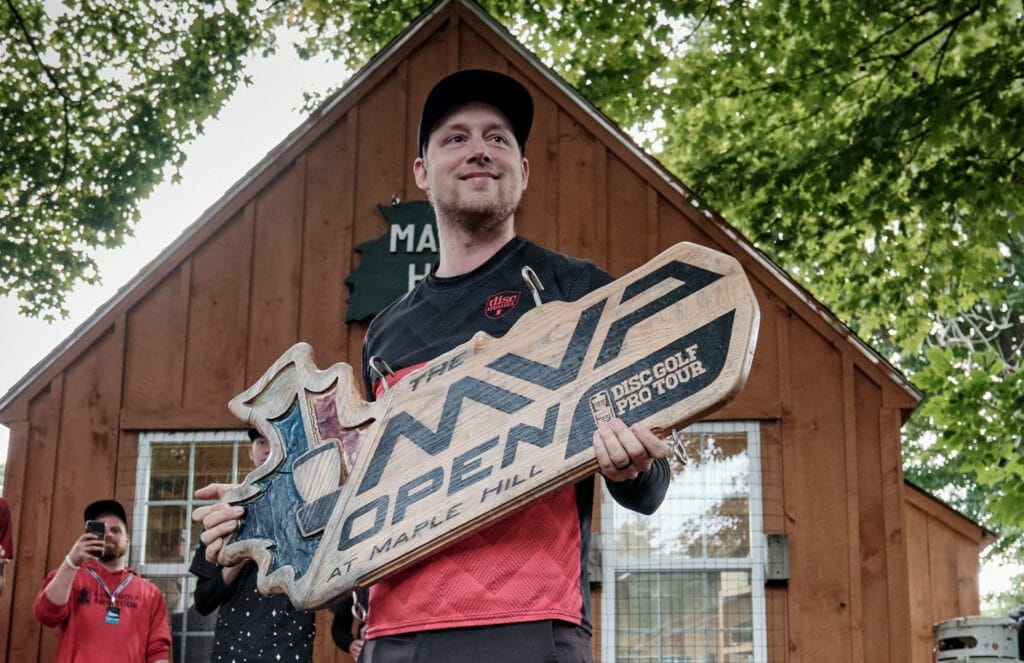
Simon Lizotte after winning the MVP Open. Photo: DGPT
In October, MVP Open TD and DGPT founder Steve Dodge called Simon Lizotte out of the blue. He wanted to know — was there anything that could get Simon to leave Discmania? Simon said probably not, but that he would always be willing to entertain an offer.
Earlier, MVP had contacted Dodge and inquired into Lizotte. “MVP reached out to me and said, ‘With Simon living so close to Maple [Hill disc golf course], and Maple hosting an MVP event, we’d be remiss to at least try to find out if Simon is interested,'” said Dodge. He arranged a lunch with Simon, not revealing its true purpose or that a representative for MVP would be there.
“Suddenly, I find myself in a lunch meeting with Steve Dodge and [Marketing Director] Andrew [Johnson] from MVP,” said Lizotte. “And they didn’t really give an offer, but they said, ‘What do you want?'”
In that meeting, Lizotte discussed some of things he would be looking for in a new sponsorship deal — sufficient compensation, the opportunity to work on new disc projects, stability for his young family — and MVP just kept saying yes.
“The framework was set that first meeting,” said Dodge.
The Deal
After weeks of negotiations and legal review, today MVP announced a 10-year endorsement deal with Lizotte. It is the longest such contract since Paul McBeth signed for 10 years with Discraft for $10 million — and it reaches a similar scope.
MVP will pay Lizotte a guaranteed seven figures a year along with a six figure signing bonus, with an uncapped potential for more earnings through disc sales and performance incentives. MVP also paid Discmania the $1,000,000 buyout clause in their contract with Lizotte, which was restructured last spring and set to run through 2026.
“The Leading Edge in disc golf now is paired with the leading man in disc golf – charisma, charm, and one heck of an arm,” MVP wrote on their website. “This partnership is a perfect match of technical and manufacturing skill, and the most naturally talented disc golfer on the planet – we are ready to turn the disc golf world upside down.”
“This whole thing is a new motivation for me to try harder,” said Lizotte.
Already, MVP has announced a new Tour Series Eclipse Hex, featuring a stamp inspired by Lizotte’s pet axolotl. Many further releases are expected, including a lineup of discs designed specifically for Lizotte, similar to what other top pros are getting from their manufacturing sponsors. Might it even be called the Simon Line? (“The great thing about Simon Line is it’s already a brand, so it makes perfect sense,” said Lizotte, though he declined to comment on any potential disc lineup.)
Lizotte discussed two different offers from MVP — one a 5-year, the other the agreed-upon 10-year. The contract contains a built-in renegotiation period near its halfway point. “MVP said, ‘We want this to be a lifelong thing. We want to be your family,'” said Lizotte.
After 10 years with Discmania — Simon’s first contract with them was for “25 discs and a shirt” — he had plenty of family to consider on that side. He spent weeks in phone meetings with Discmania founder Jussi Meresmaa, friend and co-Discmania sponsored player Eagle McMahon, team manager Avery Jenkins, and Director of Operations Austin Montgomery. Discmania made substantial counteroffers — Montgomery says he thought at points they were really close to getting a new deal done and Lizotte said their best offer was “extremely attractive” — but they didn’t get to the finish line.
“My relationship with Jussi and Discmania was very family forward, and even a bit too close,” said Lizotte. “I had this weird feeling inside of me that I didn’t even want Discmania to pay me that much.” He expressed feeling a sense of guilt when thinking about accepting a large offer from Discmania, a sensation he didn’t feel when discussing compensation with MVP.
“I think the reasons for Simon leaving don’t come down to the details of the offer but, rather, it’s been a decade,” said Montgomery. “He was looking for something new.”
“Even if Discmania matched, I think I still would have made the switch,” said Lizotte.
Boom Years
Simon Lizotte had his best year as a disc golfer in 2022. And it came as a surprise even to him.
“I actually wrote down three pages last year of what I was going to do with my disc golf career because I thought I couldn’t compete anymore,” he said, noting that he planned out efforts to get more involved in media and expand his YouTube channel.
Instead, he won four Elite Series events — the OTB Open, Portland Open, Des Moines Challenge, and MVP Open — which thrust him into the Player of the Year conversation and sent him home with eight times more in tournament winnings than he took down in 2021. Meanwhile, MVP was exploding in size, still basking in the aura of James Conrad’s Holy Shot. MVP produced more discs in 2021 than they had in their 11 previous years combined, per the Wall Street Journal, expanding from 2 injection molding machines at the beginning of 2020 to 15 by the end of last year.
With revenues rocketing higher and a freshly signed deal with Maple Hill to be the title sponsor of the MVP Open for the next 10 years, an opportunity to sign the winner of their namesake event and arguably the sport’s most likable player was tantalizing. And MVP had also watched on as Discraft blossomed when it took on the risk of signing McBeth to a long-term deal. They custom-tailored a deal to fit Lizotte and convinced him to leave his long-time sponsor. Ultiworld Disc Golf was unable to reach MVP for comment.
Lizotte said that he is “extremely happy to do whatever they want me to,” but MVP has been clear — “the main thing they want me to do is just be me, and they’ll be happy.”
The Bag
Simon has already begun to explore what discs he will throw in a new YouTube video. He will be permitted to throw any MVP, Axiom, or Streamline discs, but he has been asked to fill no more than one-third of his bag from the Streamline lineup. He has also been asked to putt with a Gyro disc.
His first Tour Series disc, the Hex, has already found a place in his bag. “I don’t remember being this excited about a midrange, ever,” said Lizotte.
He said that he has only thrown his new discs a handful of times and has yet to play a round with them, so a lot is still in flux — “There’s so many molds — it’s so hard to choose” — but he praised the quality of MVP discs that he’s worked with so far. “MVP is top 1, maybe top 2 most consistent with their molds and plastics [in the industry],” he said.
“Everything is so different and unique,” he added. “Just the way they do things, I really enjoy it.”
Next Season
The 2023 disc golf season is just six weeks away. Lizotte got off to a slower start last year, beginning his season with a 60th place finish at the Waco Annual Charity Open but ramped up quickly to back-to-back wins at the end of May and beginning of June. Now, he’ll face the challenge of learning an entirely new bag in just a few wintry weeks.
“I’m not going to make the mistake to put too much pressure on myself, because I know that MVP doesn’t really only want me because of my performance on the course,” he said. “And I’m glad I bring more to the table than being a top 10 disc golfer.”
He said he will be practicing putting extensively and throwing indoors into a net while getting in as many rounds outdoors in Massachusetts as he can. For now, he’s planning to remain there with his family, nearby his mother-in-law, though he’s keeping his eye out for an abandoned golf course somewhere on the East Coast that he could purchase and turn into “a sick disc golf complex.”
With his new contract, he’s got a sharpened mindset. “This is my real job,” he said. “I’m a professional athlete — let’s attack.”
Von Null auf Passwort-Manager – etwas Aufwand, großer Sicherheitsgewinn
Dirk Knop
(Bild: Shutterstock/selinofoto)
Der ideale Zeitpunkt auf einen Passwort-Manager anstatt auf Passwort-Schemas, einer Loseblattsammlung oder Browser-Verwaltung zu setzen, ist: jetzt!
Dem Wechsel auf einen Passwort-Manager haftet ein ähnlicher Reiz an wie der Einführung von einem Backup. Eigentlich wissen alle, dass so etwas nötig ist. Aber sich darum zu kümmern, bedeutet Aufwand. Um den inneren Schweinehund zu überwinden, braucht es eine Art Zündfunken. Den soll dieser Artikel liefern.
Dabei soll nicht verharmlost werden, dass der Umzug auf einen Passwort-Manager tatsächlich kurzzeitig etwas Arbeit macht. Bereits nach geringer Zeitspanne gehen jedoch die geänderten Wege im Browser so ins Blut über, dass davon nichts stört oder negativ auffällt.
Vergessene Konten
Auslöser zum Schwenk auf einen externen Passwort-Manager war bei mir der aufgeregte Anruf eines Freundes, dessen Facebook-Zugang aufgrund kinderpornografischer Inhalte gesperrt wurde. Die stammten selbstverständlich nicht von ihm. Er fand jedoch eine Erpresser-E-Mail, in der die Einbrecher Kryptogeld für die Löschung der Zugangsdaten forderten.
An die Zugänge gelangten Cyberkriminelle durch einen alten, vergessenen Account bei einem Mail- und Webprovider. Bei einem Einbruch dort konnten die dortigen Zugangsdaten offenbar entwendet werden, ohne, dass der Anbieter einen Passwortwechsel im Anschluss forderte. Der Facebook-Zugang kann nicht wiederhergestellt werden, aber mit umfangreichen Passwort-Änderungen für diverse Zugänge, Anzeige bei der Polizei und auch sonstig viel Ärger ist die Situation zumindest im Griff.
Alte, vergessene Zugänge sind also ganz offenbar ein Problem. Auch ich hatte bis vor wenigen Jahren ein noch immer genutztes Konto, dessen Passwort seit 17 Jahren unverändert blieb. Allerdings ohne ernste Folgen. Der Vorfall des Freundes war jedoch der nötige Augenöffner, doch einmal die bequeme Zone zu verlassen und es nun besser zu machen. Das Kombinieren von Zugangsdaten aus diversen Datenlecks und Einbrüchen gehört zum derzeitigen Standardrepertoire von Cyberkriminellen, es wird also dringlicher.
Auswahl des Passwort-Managers
Eigentlich sollte die Nutzung des Passwort-Managers aus dem Webbrowser schon helfen, dass komplexe und stets andere Passwörter zum Einsatz kommen können. Die sind dann in der Regel auch geräteübergreifend verfügbar. Inzwischen kann etwa Google Chrome die Passwörter lokal verschlüsselt ablegen [1], sodass Google theoretisch keinen Zugriff darauf hat. Das müssen (Alt-)Nutzer jedoch selbst aktivieren, was erfahrungsgemäß also nicht stattfindet.
Die Passwörter können Cyberkriminelle jedoch aus den Browser-Speichern oftmals einfach auslesen. Weiterreichende Funktionen wie das Teilen von Zugangsdaten mit anderen oder Passwortgeneratoren bieten sie in der Regel nicht. Zudem fehlen den Browser-eigenen Passwortspeichern praktische Zusatzfunktionen, etwa Konten aus Programmen und Apps zu verwalten.
Es gibt zahlreiche, oftmals gute Passwort-Manager am Markt [2]. Allen gemein ist, dass Nutzerinnen und Nutzer sich statt zahlreicher individueller Passwörter lediglich ein einziges Master-Passwort merken müssen. Oder gar auf biometrische Freischaltung etwa per Fingerabdruck setzen können. Das ist sicherer und zugleich bequem.
Die Wahl fiel im konkreten Fall auf Bitwarden. Das ist Open-Source, kostenlos und sehr flexibel. Es bietet zudem Zusatzfunktionen, wie das verschlüsselte und geschützte Abspeichern etwa von Kreditkartendaten oder das Teilen von Zugangsdaten für Teams respektive Arbeitsgruppen.
Die anderen Passwort-Manager sind jedoch ebenfalls eine legitime Wahl. Der Umzug dorthin unterscheidet sich dann im Detail etwas von Bitwarden, grundsätzlich läuft der jedoch sehr ähnlich ab.
Umzugspläne
Der Umzug selbst gestaltete sich schlussendlich einfach – die nötigen Informationen liegen jedoch verteilt im Netz und manche hilfreiche Einstellung lässt sich nicht intuitiv finden. Die konkrete Aufgabe lautete, die lokal verschlüsselten Passwörter aus Google Chrome zu Bitwarden zu migrieren.
Dazu müssen Interessierte zunächst die Bitwarden-Software herunterladen [3] und installieren sowie ein Bitwarden-Konto einrichten. Die Zugangsdaten landen dadurch mit dem Master-Passwort verschlüsselt auf den Bitwarden-Servern. Wer das nicht möchte, kann sich eine eigene Bitwarden-Instanz aufsetzen und behält so vollständig die Kontrolle – auch der Server ist als Open-Source verfügbar. Insbesondere für den Einsatz in Firmennetzen ist das eine oft wichtige Funktion.
Bitwarden nutzt dazu eine Hauptanwendung und Plug-ins für die gängigen Webbrowser. Theoretisch ließe sich der Passwort-Manager jetzt schon nutzen, aber ein paar Optionen in den Einstellungen bringen deutlichen Komfort. Außerdem sollen die bestehenden Passwörter gleich in den Passwort-Manager einziehen.
In den Einstellungen von Bitwarden lässt sich das Freigeben mittels Biometrie (etwa Windows Hello) aktivieren.
(Bild: Screenshot)
Unter "Datei" finden sich die "Einstellungen" im Bitwarden-Hauptprogramm. Unter Windows sind bei vorhandenen Biometrie-Sensoren die Einstellungen zu Windows Hello spannend, diese sollten Nutzerinnen und Nutzer aktivieren. Zudem fehlen unter den tiefer liegenden App-Einstellungen alle Haken.
Weitere Einstellungen sorgen dafür, dass Bitwarden unauffällig im Hintergrund läuft.
(Bild: Screenshot)
Das Taskleisten-Symbol sorgt dafür, dass Bitwarden stets zugreifbar bleibt. Die Optionen "Zum Taskleisten-Symbol minimieren", "In den Infobereich minimieren", "Minimiert in Taskleiste starten" sowie "Automatisch bei der Anmeldung starten" sorgen für einen aufgeräumten Desktop auch dann, wenn Bitwarden aktiv im Hintergrund bleibt. Wichtig ist zudem natürlich, die "Browser-Integration aktivieren" auszuwählen, damit Bitwarden die Passwörterverwaltung in den Webbrowsern übernehmen kann.
Hin und her
Damit die Passwörter in Bitwarden landen können, müssen Anwender sie zunächst etwa aus Google Chrome exportieren. Der Passwort-Manager des Browsers findet sich im Chrome-Menü hinter den drei gestapelten Punkten unter "Einstellungen", "Autofill" und dort "Passwortmanager". Alternativ klappt der Aufruf via URL [4]. Dort bietet Google den Export in eine unverschlüsselte CSV-Datei an.
Google Chrome erlaubt den Passwort-Export in eine unverschlüsselte CSV-Datei.
(Bild: Screenshot)
Nach dem Speichern der Daten kann ein kurzer Blick in die CSV-Datei nicht schaden: Dort lagern gelegentlich auch veraltete Zugangsdaten zu Konten, die vor einem Import in einen anderen Passwort-Manager für Dubletten und Verwirrung sorgen könnten – dort stehen mitunter dann mehrere Zugangsdaten für ein Konto zur Auswahl. Bei der Suche nach dem korrekten Zugang könnten Nutzerinnen und Nutzer in der Praxis in einer Zugangssperre aufgrund häufiger Fehlversuche landen. Daher empfiehlt sich, bekannt veraltete Passwörter zu einem Konto in der CSV-Datei zu löschen.
Die Daten lassen sich sehr einfach in Bitwarden importieren – im Web-Tresor.
(Bild: Screenshot)
Anschließend lässt sich diese Datei nun in Bitwarden einfach importieren. Entweder melden Sie sich online in Ihrem neu erstellten Bitwarden-Konto an [5] oder an dem eigenen, selbstgehosteten Web-Tresor. Dort findet sich unter "Werkzeuge" der Eintrag "Daten importieren". Anschließend sollte die CSV-Datei gelöscht werden, da sie die Zugangsdaten unverschlüsselt enthält.
Jetzt müssen die Daten nur noch aus dem Google Passwortspeicher gelöscht werden. Am Einfachsten gelingt das durch das Deaktivieren der Option "Speichern von Passwörtern anbieten" in den Chrome-Einstellungen oder dem Google-Passwort-Tresor-Link. Einen Browser-Neustart später sind die Zugangsdaten im Webbrowser verschwunden.
Browser-Plug-ins
Jetzt fehlt noch ein Browser-Plug-in, um das (automatische) Ausfüllen von Zugangsdaten durch Bitwarden zu ermöglichen. Im Bitwarden-Hauptprogramm findet sich unter "Hilfe" – "Browser-Erweiterung installieren" eine Sammlung der verfügbaren Plug-ins. Die führen im Standard-Webbrowser des Systems auf den jeweiligen Store, aus dem sich die Erweiterung rasch installieren lässt.
Auch das Bitwarden-Browser-Plug-in lässt sich biometrisch entsperren.
(Bild: Screenshot)
Dort sollten Nutzerinnen und Nutzer den Einstellungen ebenfalls kleine Optimierungen angedeihen lassen. So lässt sich auch im Browser-Plug-in die Einstellung vornehmen, es "Mit Biometrie entsperren" sowie es "Beim Start nach biometrischen Daten fragen" zu lassen. Unter "Sonstige" – "Optionen" hat sich die Auswahl von "Host" für die "Standard-URI-Match-Erkennung" als praxistauglicher als die Voreinstellung erwiesen. Dadurch berücksichtigt Bitwarden bei der Daten-Auswahl auch Subdomains. Das Löschen der Zwischenablage sollte einen Zeitraum, beispielsweise "20 Sekunden" erhalten, damit nach dem Kopieren eines Passworts dieses nicht dauerhaft darin erhalten bleibt.
Im Browser-Plug-in von Bitwarden lässt sich ebenfalls die Nutzung von Biometrie aktivieren.
(Bild: Screenshot)
Am Ende der Optionen finden sich Einstellungen zum automatischen Ausfüllen von Zugangsdaten-Feldern in Webseiten. Durch das Aktivieren der Funktion sowie der Auswahl "Automatisches Ausfüllen beim Laden der Seite" erreicht man den maximalen Komfort. Manchen ist das automatische Ausfüllen jedoch aus Sicherheitsgründen zu heikel, sie sollten die Standardvorgabe belassen. Dann lassen sich die Felder durch Klick auf das Bitwarden-Icon im Browser auswählen und nach Klick automatisch einfügen.
Die Einstellungen zum automatischen Ausfüllen sollten Nutzer ebenfalls aktivieren und anpassen.
(Bild: Screenshot)
Andere Geräte
Bitwarden lässt sich anschließend auf weiteren Rechnern einfach installieren. Idealerweise aktivieren Sie die Zwei-Faktor-Authentifizierung, sodass nur Kontoinhaber neue Geräte hinzufügen können. Bitwarden läuft zudem auch unter Android und iOS. Hier gibt es auch einige Optionen für mehr Komfort zu aktivieren, sodass etwa der "Auto-Ausfüllen Dienst" läuft oder Bitwarden sich "mit Biometrie entsperren" lässt. Unter "Auto-Ausfüllen" finden sich die Optionen, mit denen sich neben "Inline Auto-Ausfüllen verwenden" auch "Bedienungshilfen verwenden" lassen, die dann auch automatisches Ausfüllen in Apps erlaubt, die das Auto-Fill-Framework von Android nicht unterstützen.
Umgewöhnung nach dem Umzug
An dieser Stelle ist der schwierige Teil des Umzugs auf einen vollwertigen Passwort-Manager mit mehr Sicherheitsfunktionen und Features wie einem integrierten Passwortgenerator bereits vollzogen. Was nun folgt, sind ein paar Stunden der Umgewöhnung, was jedoch aufgrund intuitiver Bedienung ein Selbstläufer ist. Etwas aufwendiger gestaltet sich das Entrümpeln von Zugangsdaten-Dubletten. Das sollte nach wenigen Tagen aber ebenfalls weitestgehend abgeschlossen sein.
Mit dem Passwort-Manager kann man die Passwörter für die diversen Konten schließlich Stück für Stück neu erstellen lassen und ändern. Der Sicherheitsgewinn dadurch ist enorm: Durch den besonders einfachen und damit auch stattfindenden Passwortwechsel beißen Cyberkriminelle sich anschließend die Zähne daran aus, mit veralteten erbeuteten Zugangsdaten Zugriff auf die sensiblen Daten und Zugänge zu erhalten. Noch mehr Sicherheitsgewinn liefert schließlich das Aktivieren von Mehrfaktorauthentifizierung, wo immer möglich – das sollten Umsteiger im gleichen Atemzuge gleich mit erledigen.
()
URL dieses Artikels: https://www.heise.de/-7358142
Links in diesem Artikel: [1] https://www.heise.de/news/Google-Endlich-richtig-verschluesselte-Passwoerter-7152387.html [2] https://www.heise.de/ratgeber/Im-Test-25-Passwortmanager-fuer-PC-und-Smartphone-5049332.html [3] https://bitwarden.com/de-DE/download/ [4] https://passwords.google.com/options?ep=1 [5] https://vault.bitwarden.com/ [6] mailto:dmk@heise.de
Der „Harry Potter“-Autorin wird Transfeindlichkeit vorgeworfen. J.K. Rowling reagiert mit einem offenen Brief, indem von einer „erstickenden Atmosphäre" die Rede ist.
J.K. Rowling hat auf Twitter erneut Wut und Empörung ausgelöst.
Die „Harry Potter“-Autorin veröffentlichte eine Reihe transfeindlicher Tweets.
Neben zahlreichen Aktivistinnen und Aktivisten ergreift auch „Harry Potter“-Schauspieler Daniel Radcliffe das Wort
Update vom Donnerstag, 09.07.2020, 10.40 Uhr: Gemeinsam mit weiteren 151 Intellektuellen hat J.K. Rowling einen offenen Brief geschrieben. In dem Schreiben solidarisieren sich die Unterzeichner*innen auf der einen Seite mit den weltweiten Protesten gegen Rassismus und Polizeigewalt, kritisieren auf der anderen aber eine intolerante Kultur, die der offenen Debatte schaden würde.
„Der freie Austausch von Informationen und Ideen, der Lebensnerv einer liberalen Gesellschaft, wird jeden Tag weiter verengt“, schreiben J.K. Rowling und ihre Kolleg*innen, zu denen unter anderem der deutsche Autor Daniel Kehlmann, der amerikanische Linguistik-Professor Noam Chomsky und die kanadische Schriftstellerin Margaret Atwood gehören. Veröffentlicht wurde der Brief durch das „Harper‘s Magazine“.
Die internationale Riege von Intellektuellen um Rowling kritisiert außerdem die feindliche Kultur, die ihnen entgegengebracht werden würde. Es gebe „im Geiste eine panische Schadenskontrolle“, die einen freien Austausch von Ideen verhindern oder zumindest beeinträchtigen würde. Auch Beispiele werden in dem Brief aufgeführt: „Redakteure werden entlassen, weil sie umstrittene Texte veröffentlicht haben. Bücher werden wegen angeblicher Inauthentizität zurückgezogen. Journalisten dürfen nicht über bestimmte Themen schreiben. Gegen Professoren wird ermittelt, weil sie im Unterricht literarische Werke zitiert haben.“
Die Idee des Briefes stammt laut Informationen der New York Times von Thomas Chatterton Williams. Der amerikanische Autor sagte gegenüber der US-Zeitung, der Brief sei „eine Verteidigung“ der freien Rede, „ohne Angst vor Strafe oder Vergeltung haben zu müssen“.
Die Kritik blieb nicht aus und entzündete sich vor allem an der prominentesten Unterzeichnerin, J.K. Rowling. Sie stand aufgrund ihrer Tweets, die von der Transgender-Community als feindlich eingestuft wurden, ohnehin in der Kritik. Emily VanDerWerff, Autorin für das US-Nachrichtenportal „Vox“, veröffentlichte auf Twitter ein Statement, in dem sie angab, sich als trans Frau durch den Brief an ihrem Arbeitsplatz unwohl zu fühlen, weil auch Teile ihrer Kollegen und „prominente Anti-Trans-Stimmen" zu den Unterzeichnern gehören würden.
Update vom Dienstag, 07.07.2020, 11.56 Uhr:J.K. Rowling steht wegen ihren transfeindlichen Tweets zunehmend in der Kritik. Jetzt äußerte sie sich auf Twitter zu Hormontherapien für Transmenschen und vergleicht diese mit Konversionstherapien. Sie schreibt in einer Reihe von Tweets unter anderem, dass „Jugendliche, die mit ihrer psychischen Gesundheit zu kämpfen haben, Hormone verabreicht bekommen oder Operationen durchführen lassen, die möglicherweise nicht in deren Interesse sind“.
Die Auswirkungen einer Hormontherapie vergleicht Rowling dabei mit Konversionstherapien, die den Zweck haben, Transmenschen zu „therapieren". Kritisch sieht sie vor allem einen möglichen Verlust der Fruchtbarkeit durch die Hormontherapie, der ihrer Meinung nach medizinisch bewiesen ist. Das sehen Trans-Aktivisten allerdings anders.
Update vom Dienstag, 16.06.2020, 15.37 Uhr: Einige Beschäftigte des Verlags Hachette sollen aus Protest gegen J.K. Rowlings Äußerungen ihre Arbeit an dem neuen Buch „The Ickabog“ niedergelegt haben. Laut der britischen Daily Mail wollen die Beschäftigten damit ihre Unterstützung für trans Menschen zeigen.
Der britische Verlag Hachette hatte sich in einem Statement für Rowlings Meinungsfreiheit ausgesprochen. Daher werde man ihre persönlichen Ansichten nicht kommentieren.
Update vom Sonntag, 14.06.2020, 16.40 Uhr: „Harry Potter“-Autorin J.K. Rowling steht wegen transfeindlicher Aussagen weiterhin in der Kritik. Nach Daniel Radcliffe und Emma Watson hat sich nun auch Schauspieler Rupert Grint geäußert. In einem Interview mit der britischen Tageszeitung „The Times“ sagte er, dass er fest hinter der Transgender-Gemeinschaft stehe und er die Meinung seiner Kollegen teile. „Transmänner sind Männer“, so Grint.
Mit Daniel Radcliffe, Emma Watson und Rupert Grint stellt sich nun der gesamte Hauptcast von „Harry Potter“ gegen Autorin J.K. Rowling.
Update vom Freitag, 12.06.2020, 10.01 Uhr: Auch „Harry Potter“-Schauspielerin Emma Watson hat sich nach der Kritik an Autorin J.K. Rowling geäußert. Watson war durch ihre Darstellung der Figur „Hermine Granger“ berühmt geworden. Auf Twitter machte sie nun ihre Unterstützung für trans Menschen deutlich.
„Trans Menschen verdienen es ihr Leben zu leben, ohne konstant dafür in Frage gestellt zu werden“, schrieb die Schauspielerin. „Ich und so viele andere Menschen weltweit sehen euch, respektieren euch und lieben euch.“ Zudem forderte sie dazu auf an gemeinnützige Organisationen zu spenden, die sich unter anderem für trans Menschen engagieren.
Update vom Donnerstag, 11.06.2020, 10.20 Uhr: J.K. Rowling (54) hat zum ersten Mal über sexuelle Übergriffe und Missbrauch in einer früheren Ehe gesprochen. „Ich stehe nun seit mehr als zwanzig Jahren im Blickpunkt der Öffentlichkeit und habe nie öffentlich darüber gesprochen, dass ich eine Überlebende von häuslicher Gewalt und sexuellen Übergriffen bin“, schrieb sie in einem Essay auf ihrer Internetseite. Sie schäme sich nicht für diese Dinge, die ihr passiert seien. Dass sie nicht darüber spreche, liege daran, dass es traumatisch sei.
„Die Narben, die Gewalt und sexuelle Übergriffe hinterlassen haben, verschwinden nicht - egal wie sehr man geliebt wird und wie viel Geld man verdient hat.“ Rowling erläuterte ihre Erfahrungen, um Stellung zu ihren umstrittenen Äußerungen über trans Menschen zu beziehen. Grundsätzlich sei sie besorgt, dass radikale trans Aktivisten keine Differenzierung der Geschlechter mehr zulassen würden, schrieb sie.
Erstmeldung:
Die „Harry Potter“- Autorin Joanne K. Rowling steht derzeit erneut im Zentrum der Entrüstung, nachdem sie am Samstagnachmittag (06.06.2020) eine Reihe transfeindlicher Tweets abgesetzt hat.
Rowling hatte auf Twitter einen Artikel von Devex, einer Plattform für Entwicklungszusammenarbeit, geteilt und sich über dessen Überschrift lustig gemacht. Genauer gesagt über die Formulierung „People who menstruate“, zu deutsch „Personen, die menstruieren“. Rowling spielte in ihrem Tweet darauf an, dass es sich stattdessen um Frauen handeln müsse.
Die Äußerungen der Autorin wurden in den Kommentaren schnell als transfeindlich bezeichnet. Der Grund: In ihren Tweets machte sich J. K. Rowling über die Notwendigkeit einer solchen Inklusion lustig. Denn die Formulierung „Menschen, die menstruieren“ schließt nicht nur biologische Frauen, sondern explizit auch trans, nonbinäre und gender-nonkonforme Menschen mit ein. Also Menschen, die entweder einem anderen Geschlecht jenseits binärer Geschlechter oder keinem bestimmten Geschlechtsideal zugehörig sind.
Auf die Kritik reagierte Rowling mit einer Argumentation, die auf einem angeblich unveränderbaren biologischen Geschlecht basiert. Ohne biologisches Geschlecht, schreibt Rowling, gebe es auch keine gleich-geschlechtliche Anziehung. Homosexualität sei also ein Beweis für die Exklusivität der biologischen Geschlechter. Damit impliziert die Autorin eine Art Konkurrenz zwischen der Existenz von trans und homosexuellen Menschen. Doch trans sein und homosexuell sein schließt sich keinesfalls gegenseitig aus.
Im modernen Feminismus, der trans Menschen miteinschließt, werden sowohl biologisches Geschlecht als auch das gesellschaftliche Geschlecht, zwischen denen im englischsprachigen Raum als „sex“ und „gender“ unterschieden wird, als fluide, also wandelbar gesehen. Die sexuelle und geschlechtliche Identität der Menschen wird also nicht zwangsweise an den Geschlechtsorganen festgemacht, mit denen sie geboren werden. Das Konstrukt der strikt binären Geschlechter, also männlich und weiblich, ist unterdessen auch in der Wissenschaft kein Konsens mehr.
J.K. Rowling betonte trotz ihrer biologistischen Argumentation, dass sie selbst trans Menschen kenne und liebe und dass es kein „Hass“ sei, die Wahrheit zu sagen. Es ist allerdings nicht das erste Mal, dass der „Harry Potter“-Autorin vorgeworfen wird, transfeindlich zu sein. Mehrfach fiel auf, dass sie auf Twitter transfeindliche Beiträge anderer Accounts mit „Likes“ versah. Im Dezember 2019 verteidigte Rowling dann auch die Ökonomin Maya Forstater, die aufgrund transphober Äußerungen gefeuert worden war.
Seither wird Rowling von einigen Menschen online „TERF“ genannt. Einen Bezeichnung, gegen die sich die Autorin vehement wehrt und deshalb als „Frauenhass“ abtut.
Die Abkürzung „TERF“ steht für „Trans-Exclusionary Radical Feminism“, auf Deutsch also einen „trans-ausschließenden radikalen Feminismus“. Wie Autor Linus Giese im „Queerspiegel“-Blog erklärt, handelt es sich dabei um ein Denken, das trans Menschen ihre Identität oder Existenz abspricht. Die sogenannten TERFS gehen, wie Rowling, von einem unveränderbaren biologischen Geschlecht aus.
In diesem Sinne sehen sie trans Männer als Opfer von frauenfeindlichen Strukturen. Anders gesagt: Biologische Frauen, die vor dem unterdrückenden Patriarchat in einen männlichen Körper flüchten. In diesem Gedankengang werden allerdings insbesondere trans Frauen zu Feindbildern. Nämlich als biologische Männer, die sich angeblich als Frauen verkleiden, um so andere Frauen in geschützten Räumen angreifen zu können. In den Vereinigten Staaten kochten genau diese transfeindlichen Argumente im Bezug auf öffentliche Toiletten hoch.
Zurück zu der Formulierung, die J.K. Rowling in ihrem Ursprungstweet kritisierte. Die inklusive Bezeichnung „Menschen, die menstruieren“ oder auch „Menschen mit Uterus“ gelten laut der TERF-Denkweise als frauenfeindlich, da so biologische Frauen angeblich unsichtbar gemacht würden. Ziel dieser Formulierungen ist es aber nicht, biologische Frauen unterdrücken, sondern schlicht mehr Menschen in der Debatte mitzudenken.
Der „Harry Potter“-Darsteller Daniel Radcliffe hat sich im Zuge der Kontroverse um Rowling klar für die Rechte von trans Frauen ausgesprochen „Transgeschlechtliche Frauen sind Frauen“ schrieb er in einem Statement für „The Trevor Project“, eine US-Organisation, die sich für LGBTQI*-Kinder und -Jugendliche engagiert. Er selbst lerne weiterhin ein guter Verbündeter für trans und nonbinäre Menschen zu sein. Radcliffe entschuldigte sich darüber hinaus bei allen Menschen, deren Erinnerung an die „Harry Potter“-Bücher durch J.K.Rowlings Kommentare getrübt wurde.
Innerhalb der Twitter-Debatte kritisierten zudem viele Nutzerinnen und Nutzer Rowlings rassistische Benennung der „Harry Potter“-Figur Cho Chang. Daher äußerte sich auch deren Schauspielerin Katie Leung. Sie nutzte ihren Tweet aber, um stattdessen Aufmerksamkeit auf gemeinnützige Organisationen für Schwarze trans Menschen zu lenken.
Von Valérie Eiseler
Ex-Präsident Obama hatte zum Schutz der Bürgerrechte im Gesundheitswesen die Definition von Geschlecht ausgeweitet. Trump schafft Regelung zum Schutz vor Trans-Personen nun wieder ab. Dafür wird er scharf kritisiert.
Editor's note: On December 12, 2022, the Professional Disc Golf Association announced changes to rules governing transgender women's participation in women's divisions at sanctioned disc golf competition that will take effect on January 1, 2023. The rules described in this post only remain valid until that date.
Over 1.6 million individuals, or about 0.6 percent of the population, identify as transgender in the United States, according to the Centers for Disease Control and Prevention’s (CDC) Behavior Risk Factor Surveillance System (BRFSS) and Youth Risk Behavior Survey (YRBS). While visibility and open dialogue have increased dramatically in recent years, the UCLA School of Law, with use of CDC data, concluded that the percentage and number of adults who identify as transgender in the U.S. has actually remained relatively steady over time (2016 was the earliest point of comparison with the BRFSS and YRBS). Notably, that same data illustrates a recent shift toward acceptance of gender identity earlier in life as the youth transgender population has nearly doubled.
If the percentage of transgender individuals has largely remained unchanged, what has caused a perceived increase in conversation and controversy surrounding transgender athletes?
Polarization About Transgender Rights in Sports
Transgender rights have become a hot-button issue in both politics and sports. News outlets, politicians, and social media have a massive impact on the public perception of transgender individuals.
In sports, particularly, there has been a zoomed-in lens on transgender women competing in gender-protected divisions. In 2021, Laurel Hubbard became the first openly transgender woman to compete in the Olympics when she participated in weightlifting. This sparked a wide range of public response, including outrage and hate speech. Many spoke to the "male advantage" in sports despite Hubbard's less than impressive showing (completing zero accepted lifts).
Though the big debates are extremely recent, the International Olympic Committee (IOC) has actually discussed and developed its framework for transgender athletes to compete for close to two decades: The IOC first convened an ad-hoc committee of its Medical Commission in October 2003 in Stockholm, Sweden; in May 2004 the IOC publicly adopted the committee's recommendation that transgender athletes could compete at that year's games in Athens.
Since its initial ruling, the IOC has continued to review and update its gender-based eligibility guidelines based on new evidence. Only following Hubbard's performance, though, did the IOC's rules receive widespread public scrutiny.
Similar history is true of disc golf. The structure and policy for transgender athletes was in place years before the first openly transgender disc golfer began competing.
What Are the Rules for Transgender Women Disc Golfers?
Currently, transgender women athletes are eligible to compete in women's divisions in disc golf if they either:
Have undergone removal of testosterone-producing organs, which may be accompanied by gender-affirming surgery, or
Had suppressed testosterone levels below 10 nmol/L for at least 12 consecutive months
This means that to play in a women's division at any PDGA-sanctioned event, transgender women competitors must submit paperwork, blood work, and/or medical history to show they have met all standards. Keep in mind, too, that access to and the affordability of medical transitions vary across states and countries, with many places requiring a therapist's diagnosis of "gender dysphoria" before any intervention takes place.
The PDGA's rules follow those adopted by the International Olympic Committee in 2015. The PDGA adopted them in 2019.
The 10 nmol/L measure was set based on research of typical hormone levels for cisgender men and women (men and women who identify with their sex as assigned at birth). However, the IOC recently released guidance on rules related to transgender athletes that advocates moving away from testosterone level testing as the practice has caused international controversies. For example, cisgender women athletes like sprinter Dutee Chand and middle-distance runner Caster Semenya – neither of whom is transgender – have a condition called hyperandrogenism that affects their testosterone levels and have both faced bans from competing in women's divisions.
Much like the IOC, the PDGA had rules in place for transgender athletes prior to the years it adopted its current regulations. After the IOC set its first set of rules for transgender athletes in 2004, the PDGA adopted those in 2010.
The first openly transgender woman competed in a women's division in disc golf in 2014.
"The PDGA medical subcommittee is committed to aligning the PDGA competition standards in conjunction with the new IOC guidelines and framework with regard to participation for transgender athletes," said PDGA Director of Marketing Danny Voss. "The committee's priority is to balance inclusion and access to competition with fair competitive practices formulated from evidence-based information. In the meantime, the current PDGA standards are in effect for all PDGA-sanctioned events."
Do Transgender Women Have an Advantage in Sports?
Research looking at the effects of gender transformation on athletes is generally sparse though there has been a small amount of data published on the topic.
One study performed by Joanna Harper, a medical physicist, long-distance runner, and transgender athlete, used the age grading method to compare race times of herself and seven other transgender female distance runners before, during, and after their transitions. The results of this study showed that all of the athletes tested within average range relative to their cisgender competitors. Obviously, these results cannot be extrapolated for all sports, but with the limited studies of transgender athletes available, this is one to note.
Another study performed by Timothy Roberts, a pediatrician and director of an adolescent medicine training program, utilized the Air Force's fitness test to compare athletic advantage before, during, and after transition. This study found that at the one-year mark currently used by the IOC, slight advantages may still exist. However, by the two-year mark, all advantages had been largely reduced to the level of an average cisgender female athlete.
Roberts said there is no way to remove all of an athlete's advantages – regardless of their gender identity – according to a report of the study by NBC News.
Roberts referred to the notion that upbringing, economic standing, and hereditary factors all play major roles in an individual’s athletic advantage. Someone who grows up in a supportive household that can fund athletic training, for example, will have an inherent advantage over someone who doesn't have access to equal opportunities. Additionally, even among cisgender women there is massive disparity between "good" or "bad" frames for different sorts of athleticism (e.g., the vast differences between ideal builds for gymnasts versus those of basketball players).
Some individual sports' governing bodies, such as cycling's UCI, rugby's World Rugby, and swimming's FINA, have gone further than the IOC in their rules regarding when transgender women can compete in gender-separated divisions. World Rugby has an openly-stated ban on transgender women participating in women's competitions, and, though they aren't phrased as such, FINA's requirements also essentially amount to a ban.
Largely, these decisions were made due to uncertainty surrounding potential advantages of transgender athletes. More information and scientific research are vital to a fair assessment of competition moving forward.
The Effects of Gender Transformation on Transgender Women Disc Golfers
In a sport such as disc golf that is largely based on touch and technique, the effects of transitioning on transgender women may look different than other sports.
"The athlete would lose strength, explosiveness, stamina, endurance," said Laura Nagtegaal, a transgender FPO player and member of PDGA's Board of Directors, Competition Committee, and Women's Committee. "In disc golf, that would mean losing distance [the more that distance is based on technique rather than muscle/power, the lower the effect on distance thrown by losing testosterone is most likely going to be]. They would not lose their putting game or their mental game. Technique is not hereditary, and it certainly is not gendered. It's thousands of hours of practice and perhaps a bit of talent and predisposition."
Nagtegaal went through her gender transformation surgeries all while continuing to play disc golf in the MPO division until she met all standards to move to FPO.
"As the effects of Hormone Replacement Therapy lead to testosterone deprivation, my power level dropped - and with it, my rating," Nagtegaal said.
Nagtegaal's rating as she transitioned.
At Nagtegaal's peak in MPO, her rating was 905. After beginning hormones, her rating fluctuated greatly but eventually dropped to below 875. After her gender reassignment surgery, her rating took another hit: She dropped to below 870. In addition to her power dropping, she saw her usable distance decrease considerably, falling from about 380-390 feet/116-119 meters to barely 300 feet/91 meters.
Natalie Ryan, a transgender woman competing in FPO who recently won her first Disc Golf Pro Tour event at the Great Lakes Open, transitioned prior to learning how to play disc golf. Her distance, she said, came from a strict fieldwork regimen – six to seven hours per day in her early career – and not biological advantages.
“Not a lot of people know that’s what it actually takes to throw as far as I do," Ryan said. "They think it comes to me naturally, but it doesn’t."
Hate the Rules, Not the Players
Currently, what most frustrates many transgender women disc golfers we spoke with is that public discussion of transgender women athletes largely consists of personal attacks on individuals who are playing by the rules.
"If the policy is correct or not, that is for the medical committee to decide," Nagtegaal said. "Currently, we are all eligible to compete following all of the rules. Don't like it? Say you don't like it, but do not personally attack us for following the rules."
The two entities most involved in disc golf competition policy, the PDGA and the Disc Golf Pro Tour (DGPT), are unified in their mission to protect players and uphold the current rules. Within the last year, both organizations released official statements regarding transgender competitors. These statements emphasize the sport's rules related to transgender competitors (bloodwork requirements prior to playing in gender-protected divisions to show hormone suppression through medication and/or surgical procedure) and established policies that prohibit hate speech, misgendering, and other harassment both online and in-person.
"Whether folks agree or disagree with the current PDGA policy on transgender competition, any comments that are hateful, bullying, or incite potential violence against any DGPT athletes will simply not be tolerated," Disc Golf Pro Tour CEO and Tour Director Jeff Spring said. "There is plenty of room to have an opinion in contradiction with the PDGA policy on transgender competition and to also show respect and understanding for the human beings involved with the topic. I implore the members of the disc golf community that feel compelled to speak their minds on this topic to consider this and to find more appropriate rhetoric or spaces to share their thoughts if necessary."
The efforts of these governing bodies are vital to the safety and support of transgender players.
"I don't think the importance of these statements can be emphasized enough," said Nova Politte, an openly transgender disc golfer. "We have so few staunch allies that this gesture means everything. It means that at least at a PDGA-sanctioned tournament or a DGPT tournament it's not open season on us, that there will be consequences for treating us badly, and that we will be taken seriously as people when we report abuse."
Personal attacks and hate speech are an unfortunate, but prevalent, portion of the transgender narrative within the sport of disc golf.
"It's strange to me to read what they write because almost all of it is dead wrong," said Politte. "They get my life wrong, they get my motivations wrong, they even get basic biographical facts about me wrong. It is as if they have made a scarecrow which bears almost no similarity to me whatsoever, hung a sign around its neck which reads 'Nova,' and then they point and laugh at the scarecrow, thinking this will somehow hurt me. It doesn't. The only emotion that registers for me is pity because these strangers are expending so much mental energy on just hating someone they don't even know."
Transphobic comments and hate speech – calling a transgender woman a man or addressing her as "he," for example – and are especially harmful when individuals are newly open with their gender identity or sexuality.
"Local groups have a big opportunity to make people feel more welcomed, but they can also do the opposite," said Chloe Alice, an openly transgender disc golfer. "Bullies in the sport, especially when you're new to coming out, will hinder people from playing. To those people commenting horrible things: There are people watching and you're the ones keeping the sport from growing."
Visibility of Transgender Athletes in Disc Golf
Professional disc golfer Natalie Ryan set out on tour to help increase visibility of transgender players. Photo: Kevin Huver / Disc Golf Pro Tour
When on a bigger stage, transgender disc golfers are bigger magnets for negative comments and criticism.
"I was the first openly transgender world champion," said Nagtegaal, who won the FA40 division in 2019. "I faced a lot of turmoil, but I faced it head-on knowing I wanted to be the lightning rod so maybe one day someone like Natalie or Chloe or whoever else could show up and not have to face the same storm I did."
As ugly as the conversations often get, Nagtegaal realizes that never having an open discussion about transgender or any LGBTQ+ issues is also not a solution. Acknowledgement of the LGBTQ+ community and discourse about how current societal norms affect its members aren't political statements but necessary stepping stones to understanding and peaceful, respectful coexistence.
"Visibility will inevitably lead to awareness; through awareness the path to acceptance can be found and followed; somewhere between awareness and acceptance, open dialogue must exist," said Nagtegaal.
While this dialogue happens, some transgender athletes hope to serve as beacons for others like them – visible lights to help guide those wading through confusion, vitriol, and even threats of physical violence.
"The visibility of transgender competitors is incredibly important," Ryan said. "The more visible each person can be, the more likely more people will join. It not only can help grow the sport, it can help kids that don't have anyone to look up to to have someone there to root for – someone more familiar to them that is going through the same struggles. I chose to tour so that all the other people who needed someone like them to be represented would have someone."
Work to Be Done, On and Off the Fairway
Through open dialogue, increased visibility, and structural support from the governing bodies of the sport, there is hope for increasing disc golf’s acceptance of diversity. However, there is a lot of work to be done by all parties active in the community.
"Being welcoming means being not welcoming to intolerance," said Politte. "If intolerant voices are speaking, and no tolerant people are countering that message, then intolerance carries the day. What this means at the local club level, or even just out at the park, is that if someone is saying or doing bigotry, it's not enough to just let them speak and then to carry on as if nothing had happened. They must be challenged, out loud, at that very time. How many times has an LGBTQ+ player who is new to a group been slurred indirectly, heard nobody challenge this, then drifted away from disc golf never to return?"
Allies are a vital part of the fight for equality on and off the fairway.
"When just those affected speak up, you don't get the traction," said Nagtegaal. "You're 'just a minority.' When allies join, the traction grows. It was the case for the #metoo and Black Lives Matter movements. I hope, for diversity, that is the case here too."
For female professional disc golfers, the July 29–31 Discraft Great Lakes Open (DGLO) in Milford, Michigan represented a watershed—marking the first time in the young sport’s history that an Elite-series tournament offered women the same first-place prize money as men. “It should have been a great moment,” one of the female competitors told me once the crowds had gone home. “But then the thing ended, and the winners weren’t a male and a female. It was basically two males.”
By this, the woman was referring to male star Calvin Heimburg, who won what is formally called the “Open” division (but which, in practice, is 100 percent male); and the female-division winner, Natalie Ryan, a trans woman who’s been playing disc-golf tournaments for only three years. Despite this lack of experience, Ryan already is starting to make victory something of a habit, winning not only DGLO, but also a second Elite event in Leicester, Massachusetts this past weekend. As a result, Ryan is now ranked as one of the world’s top five female-classified disc golfers.
The first-place prizes at DGLO were US$6,000—hardly a bonanza by the standards of professional sports. But for disc golf’s touring women, many of whom have spent a decade or more on the road, trying to scratch out a living as full-time athletes, it’s a huge amount of money.
“The [current] female tour only came on the scene in 2016,” a well-known female pro told me. “There’d been a tour going on since 2000, but in those days, even most of the top professionals had side jobs. The men’s game was probably economically viable as a full-time occupation by the early 2010s, but the women’s game wasn’t really viable until a few years ago. So yeah, the timing of this is interesting. It’s just all too convenient that now is when [trans women] decide to jump in and make a splash.”
Ryan is not the first openly transgender disc golfer to compete in a Professional Disc Golf Association (PDGA) event—a distinction claimed by a Massachusetts trans woman named Kelly Jenkins. Nor is Ryan the first openly trans disc golfer to win a prominent event—a distinction that belongs to Dutch player Laura Nagtegaal. And in both 2021 and 2022, the PDGA Masters World FP50 championship (for women aged 50 or over) went to a trans woman named Nova Politte (who, at 6‘4”, self-describes as ”the tallest female disc golfer in the world”). But Ryan’s victory was different, because DGLO is such an important tournament. Thanks to its Elite Series classification within the Disc Golf Pro Tour (DGPT), it ranks as one of the few events that allow top players to compete for the annual Tour Championship, which in turn can yield higher payouts and more prominent media opportunities.
Among the tight-knit touring group of about three dozen top female players, concerns about male-bodied disc golfers once remained largely confined to private conversations, as most were anxious to protect the feelings of trans players and avoid offending corporate sponsors. But Ryan’s DGPT victories seem to have prodded some of these women to become more vocal. This month, two of them—whom I’ll refer to as Jane and Mary in the reporting that follows—spoke to Quillette on condition of anonymity.
Until recently, disc golf occupied something of an ambiguous place in the sporting hierarchy, halfway between niche hipster hobby and mass-participation activity. But the sport positively exploded during the COVID years, when otherwise housebound athletes found themselves looking for something new to do with their time and energy (myself among them). And the boom has done much to bring disc golf into the mainstream. The game is simple, cheap, safe, and fun—basically regular golf, but with discs and baskets instead of balls and holes. And for many, it’s proven equally fun to watch as play. Major US tournaments sometimes attract tens of thousands of fans. The sport has also developed a rich Internet subculture, including a US$99-per-year subscription-based broadcast called Disc Golf Network.
Rounds of disc golf recorded on UDisc, a popular scoring app, by year, 2016-2020.
Because disc golf is a modern sport played mostly by young people, it tends to channel a liberal live-and-let-live ethos. Recreational drug use isn’t uncommon, and even some of the most skilled professionals seem to exhibit something of a beatnik attitude. Hyper-competitiveness is generally shunned, and a spirit of inclusiontypically prevails. So it’s easy to see why a progressive posture toward transgender participation would come naturally to the people who enjoy and govern the sport. This attitude was encoded in a Statement on Transgender Athletes & Community Guidelines put outby the Disc Golf Pro Tour earlier this year, indicating that the DGPT “recognizes the validity of the transgender experience [and] support[s] the decisions made by any members of the disc golf community to live their life in the most authentic way possible.”
Meanwhile, industry publications such as Release Point have covered the issue of gender largely through Pride-themed homages to trans disc golfers. In early 2021, a PDGA Event Support and Training Manager named Mike Sullivan authored a long Twitter thread in which he assured everyone that “women’s divisions are not in danger of being dominated by whatever South Park satire version of transgender women you might be concerned about,” and warned that those voicing concerns had been swayed by “people with bad intentions” such as podcaster Joe Rogan.
Yet the PDGA’s own reported data suggest that performance differences between males and females are stark. In the “Advanced” amateur division (a classification that is technically open to all amateur players but which is almost entirely male), players typically are capable of throwing a maximum distance of between 300 feet and 450 feet. In the case of “Advanced Women,” on the other hand, the corresponding figures are a third lower: 200 feet and 300 feet. The world record for longest disc golf throw by a man is 1,109 feet. For female players, the record is 569 feet. And it is worth noting that Ryan, the female tour’s only trans player, also happened to win disc golf’s 2021 US Distance Championship in the female category with a throw of 458 feet.
Nor is the male-bodied advantage in disc golf confined to full-throttle open-field drives. According to Jane and Mary, the disparity also manifests itself on densely wooded holes, which sometimes require players to contort their bodies in awkward positions while shooting around trees from a standstill.
“I would say that one of the biggest advantages of the [male-bodied] players is their ability to scramble in tight situations when a disc goes off the fairway, to just stand there and blast a shot through the woods,” Mary tells me. “I’ve seen both [trans player] Chloe [Alice] and Natalie [Ryan] do this. They’re just standing still and throw the kind of [forehand shot] that I’ve never seen a female throw even under perfect conditions.”
“What makes it worse is that Ryan’s form isn’t even that good,” says Jane. “If it were, she’d be out-throwing us by even more. So while the rest of us spend years refining our form, trying to keep up and get more distance, she’s been in the sport only—what?—three years or something. And she’s already said [publicly], ‘Oh, I’ve got my form down. I don’t need to practice that.’”
“One time, a friend on the tour—another female golfer—told me about Kelly [Jenkins] throwing a 320-foot thumber [a difficult overhead shot launched over tall obstacles with an unusual grip] at women’s nationals,” Jane adds. “And then, when people were standing there in disbelief, [Jenkins] says, ‘Ha ha, softball!’—like, telling people that she learned to do this kind of shot from playing softball when she was young. But I know women disc golfers who’ve played softball their whole lives. They’ve never seen a woman throw a disc like that.”
None of this should come as a surprise to anyone who’s studied male-female differences in other sports that involve throwing. The world javelin record, for instance, is 98.5 meters for men, but just 72.3 meters for women. In shot put, hammer throw, and discus, men and women tend to throw similar distances, but do so with differently weighted objects: For men, the metal ball used in shot put and hammer throw weighs more than seven kilograms; for women, just four kilograms. In discus competition, the disc used by men weighs two kilograms, while women use a disc that weighs just one kilogram. Earlier this year, The New York Timesprofiled pitcher Kelsie Whitmore, the first woman of our era to play in any league partnered with Major League Baseball. Whitmore’s fastball tops out below 80 mph, a speed that’s commonly achieved by male high schoolers in their mid-teens.
On August 2nd, days after Ryan won the female division at DGLO, the Disc Golf Pro Tour put out a statement titled DGPT Reiterates Statement on PDGA Transgender Competition Policies, noting (somewhat euphemistically) “an increase in the volume of questions and feedback from the disc golf community on the topic of gender-based divisions and fair play,” and emphasizing that Ryan, and the tour itself, are simply going by the policies set down by the PDGA—policies that permit biologically male players to compete as females, so long as they bring their blood testosterone levels down below 10 nmol/L.
The problem, as critics of male-bodied participation in female sports often have pointed out, is that academic reviews of musculoskeletal changes in transwomen have shown that the strength loss associated with post-pubescent testosterone-reduction regimes is small, and so the trans strength advantage over biologically female competitors persists. As discussed below, moreover, there seems to be some confusion about whether the PDGA is enforcing even its own loose standards.
Tennessee-based player Jennifer Castro, who competes in the Amateur Masters Women 40+ category, says that “I personally know of women who refuse to sign up for events if a transgender is playing, not because we hate them but because we feel we have zero chance, so what is the point of wasting our money on registration fees?”
Jennifer Castro, photographed following the 2022 Alabama Women‘s Disc Golf Championships
In late August, Castro became so exasperated by the PDGA’s permissive stance that she mounted a sort of sting operation, presenting herself anonymously to the organization as a transgender woman seeking to compete in a female category. After Castro’s inquiry was routed to the PDGA’s medical committee, outgoing board member (and five-time Women’s Open World Champion) Elaine King wrote back with the following advice:
If you meet the criteria to play in gender-based divisions then you can register with the PDGA as “F” or “female.” You are under no obligation to discuss your personal information with anyone. No one may challenge your eligibility to play in a female division unless they can provide evidence that you may not meet the requirements. Note that a player’s appearance is NOT a basis for any challenge … Some transgender women have voluntarily elected to provide proof of their eligibility to the Medical Committee in confidence. In doing so, any potential question about their eligibility to play in that division could be quickly settled. However this is purely voluntary and not required.
In the days since, Castro has gone on a very public Facebook campaign, citing King’s message as evidence that, except in cases where a player who’s already listed as male seeks to change status to female, “transgenders don’t need to submit anything upfront. [The PDGA] is just taking their word that they meet the criteria medically.” Castro also has linked to a TikTok video by trans female competitor Chloe Alice, who’s confessed on Instagram to neglecting to take prescribed testosterone-suppressing “pretty pills” (as Alice describes them) for days at a time.
Castro believes that she’ll pay a price for speaking out, but told me during a recent phone call that she doesn’t care. “I don’t play at the pro level, so it’s not like my livelihood is on the line,” Castro told me. “Unlike the pro women, I can speak my mind and say what they’d be saying if they felt they could.”
At a recent Nashville tournament, Castro reports, her sponsor, a small local company called Momentary Bliss discs, politely suggested that she take a less “hostile” approach with her anti-PGDA commentary. Castro refused, and the partnership was ended.
According to four-term PDGA Board of Directors member Wilbur Wallis, “it is almost certain that this topic”—by which he means trans women competing in protected female disc-golf categories—“will be discussed at length at the upcoming PDGA Fall Summit,” and he has asked that interested members submit “scientific studies” for consideration by the PDGA’s newly formed Medical Subcommittee on Gender-Based-Divisions to review. It is possible that the process Wallis outlines will end with the PDGA taking steps to exclude natal males from protected female categories. Much as the controversial participation of trans NCAA swimmer Lia Thomas in female races caused a reckoning within that sport, so might Ryan’s triumphs spark a similar reckoning in disc golf.
On the other hand, because disc golf is a relatively young and (until recently) obscure pursuit, those “scientific studies” Wallis is looking for are in short supply. What few academic articles exist in regard to disc golf tend toward titles such as Disc Golf, a Growing Sport and Disc Golf as a Public Health Option. Since it might be years before authoritative peer-reviewed studies that focus specifically on male athletic advantages within disc golf are produced, the PDGA board would likely have the cover it needs to maintain the status quo, should that be the preferred option of a majority of board members.
In this regard, it’s worth noting that the seven-person PDGA board of directors includes the aforementioned Laura Nagtegaal, a trans woman who self-describes on the PDGA’s website as “a volunteer counsellor for gender-questioning and transgender folx … active (both on an activistic and philosophical level) in advocating for diversity, equity and inclusion.” In 2019, shortly after transitioning to female self-identification, Nagtegaal entered the Amateur Masters Women 40+ World Championships, and won by 21 strokes in a field of 17 players. According to King, Nagtegaal also runs “a closed [Facebook] discussion group for transgender women [disc golfers].” Another board member is Leah Tsinajinnie, whose listed priorities include expanding disc golf’s appeal to “people identifying as LGBTQ+.” The other five members are all men.
According to one source I spoke with, several board members are sympathetic with the complaints of women who want male bodies excluded from protected female categories. But they also feel reluctant to act unless their stance is publicly supported by a critical mass of high-profile players. For their part, on the other hand, many top players reportedly don’t feel they can provide that public support until the board signals clearly that plain talk about male and female biology won’t be denounced as transphobic.
It’s a collective-action problem, in other words. According to Jane and Mary, about 80 percent of the women on tour oppose the inclusion of male-bodied players in female divisions (a figure that’s admittedly impossible for me to confirm). But no one in this majority group wants to be among the first to come forward, for fear of being labelled a bigot—thereby allowing the other 20 percent to hold sway.
Moreover, any PDGA move to tighten the rules on female participation in protected female categories will have the effect of invalidating—or at least implicitly devaluing—victories that have already been earned by trans disc golfers. In particular, board members would face the mortifying prospect of retroactively demeaning their own board colleague’s 2019 Amateur Masters Women 40+ World Championships. Ryan, too, would go from someone being feted weekly in PDGA corporate media to, overnight, a male-classified also-ran who happens to have a few awkwardly asterisked victories in the female record books. In such a scenario, it would be difficult not to feel sympathy for these trans women, and others like them, all of whom relied on the existing rules set by the PDGA.
On the other side of the ledger, however, are the vastly more numerous biological women who see the presence of trans women as more than just a competitive and financial threat, but also a source of on-field social and psychological tension.
“My experience is that about half of the trans women are really fun to play with,” Jane tells me. “With the other half, they have this really obvious masculine energy—and so you’re constantly being reminded that you’re basically playing with an amateur-level male. It’s gotten to the point that even the players that I personally like who are transgender—I can't watch them play. I don’t watch them throw. I don’t watch them putt. The sight of it reminds me that I’m in an unfair situation and it makes it hard for me to maintain my mental game. I’m just constantly thinking about, you know, ‘Wow, she shouldn’t be able to throw that far because that’s really bad form, but it went 400 feet.’”
“I’ve been playing sports since I was in kindergarten,” Mary says. “I was always small, but I didn’t care what the sport was. I would take on any girl, any woman. But then with this thing that’s happening now, it’s different. No matter how much I work out, that’ll never be enough to have the physical advantages of a person who’s a male and can be strong without [going to the gym].”
During my research, I spent a lot of time reading social-media threads and arguments about trans disc golfers participating in protected female categories. Readers won’t be surprised to learn that attitudes break down largely (though not entirely) by medium. On Twitter, where discourse on this subject tends toward fashionable, hashtag-compliant political postures, the dominant view is that of Sullivan, the aforementioned PDGA manager who instructs women that “we don’t have evidence that there’s an unfair [trans female] advantage.” On Reddit, the argument is more mixed. Then there are the deeply tribalized private Facebook groups—one of which I was given access to—that tend strongly toward one side or the other.
Almost everyone acknowledges that trans women have at least some physical advantages over their biologically female competitors. The question comes down to whether those female competitors should be forced to accommodate male bodies as the price of inclusion. Jane, Mary, and Castro argue that the answer comes down to science and the reality of human biology. Their opponents say that it comes down to attractive-sounding moral imperatives such as “recogniz[ing] the validity of the transgender experience” and giving trans individuals the “comfort to be who they are, on and off the fairway, every day of their lives.”
This kind of battle is playing out in dozens of sports, and has been for years. But disc golf provides an especially interesting case study, because Ryan’s sudden ascent has caused years’ worth of female concerns to spill out in a compressed time period. The regulatory environment has also become a lot more fluid of late, giving women hope that things might change.
The PDGA has a long-term goal of getting disc golf admitted as an Olympic sport. And since 2010, PDGA rules on trans participation have tracked the pronouncements of the International Olympic Committee, including the IOC’s 2015 standards, which established the 10 nmol/L testosterone standard for trans women. But in 2021, following the controversy surrounding the appearance of middle-aged trans female weightlifter Laurel Hubbard at the Tokyo Games, the IOC created new guidelines that allow “each sport and its governing body to determine how an athlete may be at a disproportionate advantage against their peers, taking into consideration the nature of each sport.” This means that the PDGA is now at liberty to go the way of World Rugby, which recently declared flat-out that “Transgender women may not currently play women’s rugby” (though the violent nature of that game arguably makes it a special case); or the international governing body for swimming, which recently barred swimmers who “experienced any part of male puberty” from women’s events.
The disc-golf case study is also informative in the way it lays bare the different motivations of powerful actors within the sport’s overall community. According to industry estimates, females account for just 20 percent of elite players, and about 14 percent of active competitive players at all levels. For many years, groups such as Sara Nicholson’s Throw Pink have sought to recruit women into the game. It’s an obvious growth opportunity for the sport, and so one might think that female concerns would rank high on the PDGA agenda. But in reality, the most powerful voices are often the corporate sponsors who effectively supply the bulk of touring pros’ income. The #MeToo movement had its heyday years ago, and many of these companies are stepping over themselves to present themselves as champions of more faddish causes. The vast bulk of disc buyers, after all, aren’t professionals in sex-protected categories, but recreational consumers playing in mixed male-and-female leagues. Rainbow stickers and slogans about inclusivity lend themselves well to marketing campaigns. Angry women describing their frustrations with all those stickers and slogans, much less so.
“I actually had a candid conversation with my sponsor the other day for an hour about this issue,” Mary told me. “And toward the end, I said, you know, ‘If I can just be as honest and blunt as possible, I think [the situation] is disrespectful because no man will ever understand or know what it’s like to be a woman.’”
Like other players—including one who showed me a long set of text messages with her sponsor—Mary says she got a fair hearing. But in the end, she still wasn’t given permission to go public with her concerns, unless it was done in concert with a critical mass of other tour players. Again, the collective-action problem rears its head.
Both Jane and Mary report receiving private messages of support from male colleagues. But in those cases where male disc golfers speak out publicly, it’s more likely to be in the service of transgender rights. (Castro’s Facebook page, for instance, has been regularly trolled by a male player named Sam Gibson, a progressive activist known for his participation in the Occupy Portland movement.)
Even some top female veterans have lent their voices to the cause of trans participation in sex-protected categories. This includes Paige Pierce, the sport’s all-time highest earnings leader and a pre-eminent female presence within PDGA branding.
In January, about a dozen female players avoided the highest female division of a small Alabama tournament, apparently in order to protest the PDGA’s laissez-faire approach to trans women. When that move left Chloe Alice (whose TikTok video about “pretty pills” was referenced above) playing alone in that division, Pierce and several other high-ranked women signed up to play alongside Alice as a gesture of solidarity. On Instagram, Pierce then explained her decision this way:
This isn’t an event I would typically play being that it was during my off season and it was a lower tier of an event. I wanted to talk with you all about why I chose to play. It was a local event and I started to hear talk around town that there was a big group of women that had initially signed up for the event only to later drop out of the division because one of the competitors is transgender. I want to stop here and take a breath. I am not sure my exact opinions on what ‘should’ happen yet. Should we have a separate division? Should we test hormone levels of every competitor? I don’t know. But should we ban [them al]together and leave them behind? HELL NO. I am sorry for my language, but I feel very strongly about this … We are all a part of the frisbee family. We are all doing our part to find our own happiness. As I write this I am finding that I AM going to make a New Years resolution. Whenever I hear someone passing judgement towards another, I don’t nod or let it pass. I stop them in their tracks and remind them, we are all human. Let’s spread love, not hate.
For Pierce’s supporters, the move was the epitome of grace and empathy. “You’re using your power and privilege for good! We look up to you, Paige!” said one commenter. Another replied, “Paige, you’re awesome, and a shining example of how we should treat others. You made a horrible story an awesome story.”
But as Jane and Mary see it, Pierce’s declaration was a low blow, even a betrayal. A group of female players were protesting what they see as a discriminatory anti-female policy, and the game’s biggest female star swooped in to present herself as a saviour figure. What’s more, Paige suggested that those behind the act of protest were motivated by “hate” and a desire to “ban” transgender people from the sport, which both Jane and Mary see as a complete misrepresentation of what had happened. (Pierce, Ryan, and Nagtegaal were given an opportunity to provide comment for this article, but did not respond.)
Other commenters suggested that Pierce was merely being opportunistic with her virtue signalling at a time when no trans competitor had yet presented as a serious tour threat. But in the months since, that’s changed, of course. At the MVP Open, Ryan’s victory bumped Pierce from a second place finish down to third. And of the last four Elite tournaments in which Pierce and Ryan have both competed, Ryan has bested Pierce in three of them. The former, as already noted, has been playing competitive disc golf for just three years. The latter is a 16-year veteran who’s won the Women’s Open World Championship in five out of the last 11 seasons.
It’s notable that Pierce hasn’t, to my knowledge, spoken publicly about the issue of trans inclusion in female events in recent months. And some fans are wondering why. Back in January, a commenter on her Instagram post darkly noted, “Just wait until you finish second behind a ‘man’ for a few years. [Your] opinion will change.”
Maybe it already has. We’ll find out in coming days, I suspect, as I am told that there is a petition that’ll soon be making the rounds among touring female players, finally putting on public record a majority opinion that, till now, the women have largely confined to private conversations. What remains to be seen is whether PDGA officials, faced with such a document, will respect the “validity” and “authenticity” of the biological female experience.