Article note: #thx! + #good2read
CC-BY-NC-ND 2.0 fabian.hick

The Covid-19 pandemic is the greatest public health threat that Europe has seen in the last 100 years. Countries have thus introduced various levels of lockdown to reduce the number of new infections. Lockdowns, however, come at a great cost to workers, firms and families. Recent epidemiological models also predict that the epidemic will start anew once the lockdown is lifted (Ferguson et al. 2020).

Scientists have thus discussed a second approach to keeping the epidemic in check: app-based contact tracing. Several apps are currently under development, for instance in the UK and by a pan-European initiative, or have already been launched, as in Singapore.

Why would such an app be useful at all? We still don’t know many things about the coronavirus. The data so far suggest that about half of all infections occur before the dreaded symptoms of fever or a persistent cough appear. It is thus not enough to quarantine people once they show symptoms. To reduce infections, one would need to act quickly when a person is diagnosed with Covid-19 to find all people this person was in close proximity with. The risk of infection is highest if one has been within 1.5 to 2 meters of an infected person for at least 10 to 15 minutes.

If we could determine who had been in such close proximity, then one could ask freshly-infected, pre-symptomatic people to self-isolate and thus stop them from infecting more people. Mathematical models of the pandemic show that fast contact tracing combined with a large-scale virus-testing program might be able not just to delay the epidemic but to stop it entirely. This would also mean that the lockdown measures currently in place around the world could be slowly loosened up again. However, such fast contact tracing is not possible manually. Only a digital, largely automatic solution would help.

Epidemiology meets data protection

Some might argue that the demands of the Covid-19 crisis justify even extreme countermeasures. After all, this is about saving the lives and preserving the health of as many people as possible. Weakening data protection might be preferable to the far-reaching restrictions of personal freedom, and to the economic costs of the current lockdown. However, even in the face of an existential threat, we should interfere with fundamental rights as little as possible. Among the effective approaches, we should choose the one that least compromises fundamental rights. In particular, we believe that swift and efficient contact tracing is possible without collecting extensive amounts of data in a central database.
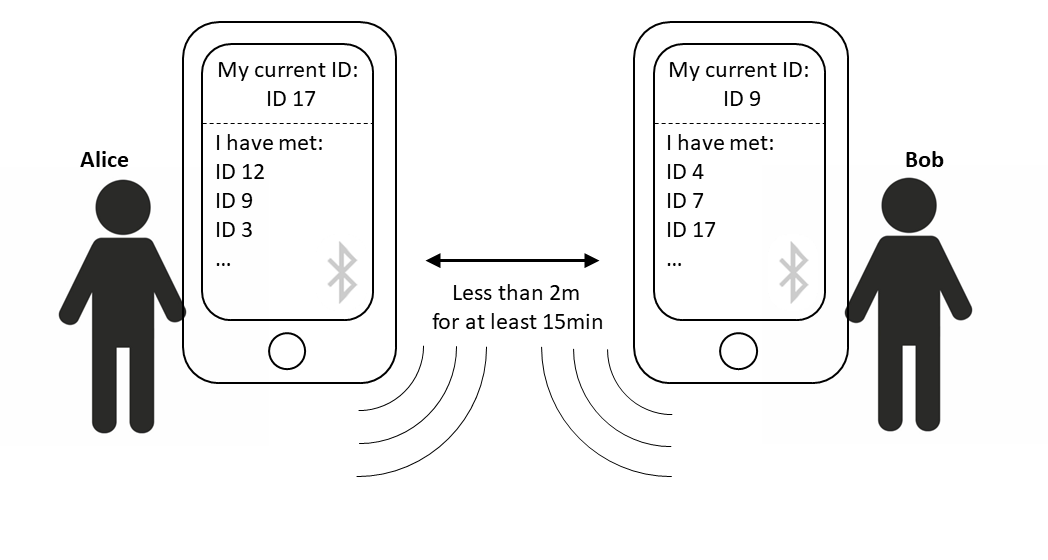
Figure 1: Every mobile phone stores a list of the mobile phones that were within 2 meters for at least 15 minutes. IDs are temporary but can be decrypted by the server.

A contact tracing system can be set up in a way that would allow for most data processing to happen locally on users’ mobile phones rather than on a central server. Only the notification of users who have been in contact with an infected person would need to be coordinated centrally. And even in this case the necessary data could be processed in a way that would effectively preclude the central server from identifying the users. The system would also not require collecting any location data.

An example for this kind of Covid-19 tracing system is the “Trace together” app from the Singaporean government, which is already in the spirit of the “privacy by design” approach, and similar to what we present below (albeit with a few modifications). The European consortium PEPP-PT is following a very similar concept.

The fundamental idea is simple: It does not matter where people get in contact with an infected person. Be it on the bus or at work – what matters is proximity to a contagious person. This means that particularly sensitive location data, such as GPS or radio cell data, is actually neither necessary nor useful. Instead, the only data that matters is whether two people have come into close enough contact to risk an infection. This in turn can be detected via Bluetooth low energy technology, which can record whether two mobile phones are in close physical proximity. The general drawback of Bluetooth, that it can only reach across a few meters, becomes an advantage here.
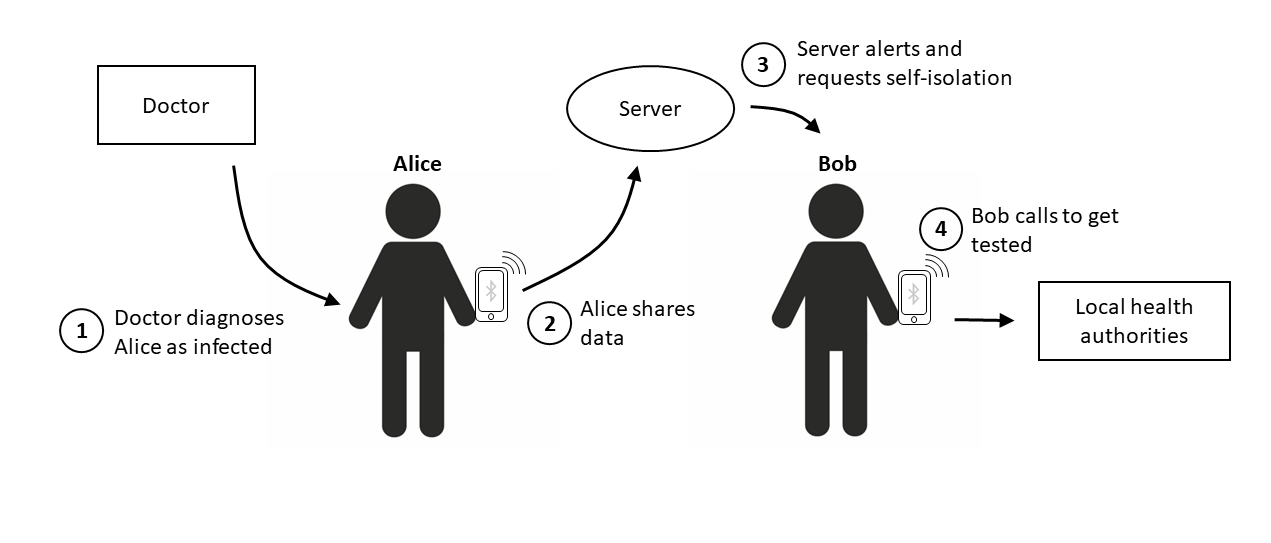
Figure 2: A user can share their data with the server after receiving a Covid-19 diagnosis. The server then alerts all phones that have been in close proximity with the infected phone. The alerted people would still need to contact their local health authorities, as their identity is not linked to the app.

The tracking would work as follows: As many people as possible voluntarily install the app on their phone. The app cryptographically generates a new temporary ID every half hour. As soon as another phone with the same app is in close proximity, both phones receive the temporary ID of the respective other app and record it. This list of logged IDs is encrypted and stored locally on the users’ phones (see Figure 1). As soon as an app user is diagnosed with Covid-19, the doctor making the diagnosis asks the user to share their locally stored data with the central server (see Figure 2). If the user complies, the central server receives information on all the temporary IDs the “infected” phone has been in contact with.

The server is not able to decrypt this information in a way that allows for the identification of individuals. However, it is still able to notify all affected phones. This is because the server does not need any personal data to send a message to someone’s phone. The server only needs a so-called PushToken, a kind of digital address of an app installation on a particular phone. This PushToken is generated when the app is installed on the user’s phone. At the same time, the app will send a copy of the PushToken, as well as the temporary IDs it sends out over time, to a central server. The server could be hosted, for example, by the Robert-Koch-Institut for Germany or by the NHS for the UK. This way, it would be possible to contact phones solely based on temporary IDs and PushTokens whilst completely preserving the privacy of the person using the phone.

Once a phone has been in close proximity to an “infected” phone, the user of that phone receives a notification together with the request to immediately go into quarantine at home. The user will then need to contact the local health authorities to get tested for the virus as soon as possible so that, depending on the outcome, the user is either able to stop quarantining or all their contacts can be informed (see Figure 2).

During the entire process no one learns the identity of the app user: Neither the other users who got in close contact with them, nor the local health authorities, and not even the central server, since the app is not linked to an identity. Location data is neither recorded nor stored at any point of the process.
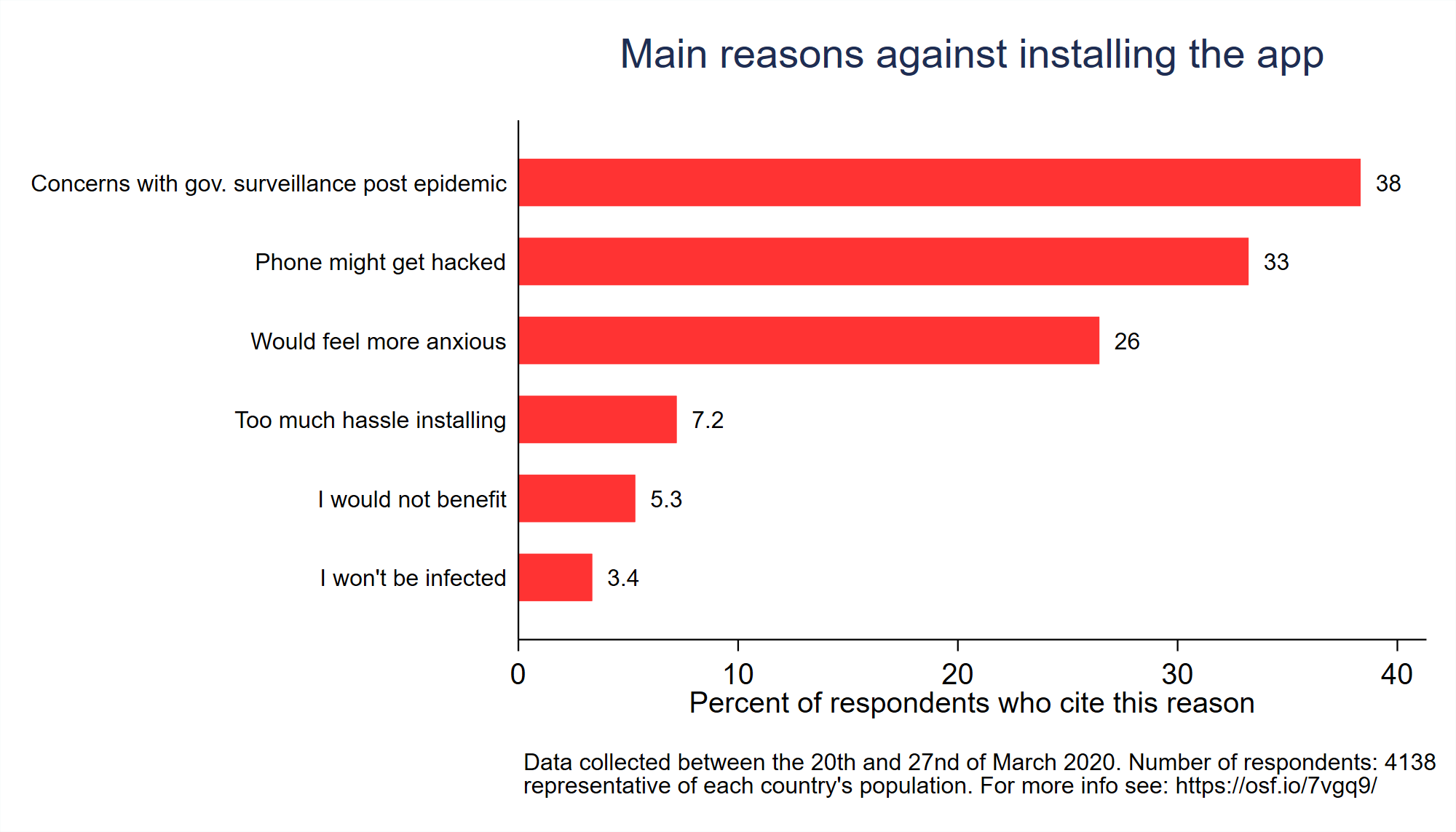
Figure 3: The most-cited reasons against the installation of a contact-tracing app (representative surveys in the UK, Germany, Italy and France, conducted 20–27 March 2020, for more information see here)

As mentioned above, we did not come up with this concept. Singapore introduced a very similar app and several European countries are working on comparable apps as well. We do not agree with all aspects of the Singaporean app and their practice of contact tracing. For example, every app installation in Singapore is linked with the user’s telephone number and is thus identifiable – something that is not strictly necessary and thus, for data protection reasons, should be rejected. Nevertheless, we like the general concept. The recently published pan-European contact tracing standard PEPP-PT looks promising and might prove to be a legitimate implementation of the privacy-friendly tracing approach outlined above.

Such an app could implement contact tracing much more effectively than a system that relies on radio cell or location data, since neither of these two data sources permit determining a person’s position with the necessary precision of two meters maximum. At the same time, such a concept would comply with existing data protection regulations.

Data minimisation begets acceptance

In the case of contact tracing, the approach that requires the least amount of data also seems to be the most effective epidemiologically. This is because an app like the one described above would be better suited to determine who actually was in close proximity than any of the other proposed solutions. Moreover, even digital contact tracing systems need users to cooperate (by installing the app and carrying their phones with them) for any chance of success. Consequently, the effectiveness of any contact tracing system depends on public support. There is reason to believe that the level of support can be increased by opting for a data-minimising solution. A representative survey across four countries shows that about 70 percent of respondents would install an app like the one described above on their phones (disclosure: Johannes Abeler, one of the co-authors of this article, is also the lead author of the survey study). The reason most frequently brought up against an installation is the worry that the government could use the app as an excuse for greater surveillance after the end of the epidemic (see Figure 3). If the government wants as many people as possible to install the app, it should take these concerns seriously and refrain from using location data. Contact tracing works without it.

Conclusion: Proportionality instead of „whatever it takes“

In the current crisis, we will have to endure more and deeper encroachments on fundamental rights than we are used to. Still, there is no reason to tolerate such encroachments to a greater extent than strictly necessary. Even under the current time pressure, it is important to find solutions that minimize data processing as far as possible. We have shown above that this is possible for the case of contact tracing. As the pandemic progresses, many other challenges will emerge. For each of them, one will have to check which data processing is necessary to address them and which ones can be avoided.

Trying to find the data-minimizing solution does not just protect fundamental rights. Such solutions will often increase the effectiveness and efficiency of the respective data processing system. Only if people trust a system – because it doesn’t spy on them – will the system find broad support in the population.
 
Johannes Abeler is Associate Professor in the Department of Economics at the University of Oxford and Tutorial Fellow at St. Anne’s College.

Matthias Bäcker (Twitter) is Professor of Public Law at Johannes Gutenberg-Universität Mainz.

Ulf Buermeyer (Twitter) is president of the non-governmental organization Society for Civil Rights (GFF.NGO) and desk officer at the Department of Justice of the Federal State of Berlin. This publication does not necessarily reflect the position of his employer.


Hilf mit! Mit Deiner finanziellen Hilfe unterstützt Du unabhängigen Journalismus.

Article note: BITTE, bitter, bitte - sofort!

Seebrücke ruft zur Menschenkette am Ostermontag, den 12. April auf: Lager evakuieren — Leben retten! Refugees Welcome!

Nicht nur die Bundesregierung sondern auch die Brandenburgische Landesregierung kann gemäß Rechtsgutachten¹ Flüchtende aus den Lagern evakuieren.

„Ministerpräsident Woidke soll auf die Evakuierung der Lager drängen und ein Sofortprogramm zur Aufnahme für die Flüchtenden starten.“ fordert Seebrücke-Aktivistin Jolina Parker.

Es ist ein Verbrechen, die tausenden Menschen in den beengten und hygienisch mangelhaften Lagern zu ignorieren und unter Quarantäne zu setzen. Die Losungen „Wash your hands” oder “Stay at home” sind für die Menschen in den Lagern wie Moria blanker Zynismus. Dort mangelt es an Warmwasser, Sanitäranlagen und Desinfektionsmittel. Abstandhalten funktioniert nicht auf engstem Raum.

In Zeiten von Corona heißt es: Jeder Tag, der jetzt vergeht, ohne zu handeln, macht die Katastrophe noch schlimmer.

Ebenso ist die Lage der hiesigen Sammelunterkünften mit Mehrbettzimmern und Gemeinschaftsküchen und ‑sanitäranlagen in Zeiten von Corona noch prekärer als sonst. Massenquarantänen sind gesundheitsgefährdend und menschenverachtend und unbedingt zu vermeiden! Es müssen sofort alle Kapazitäten wie leere Hotels und möblierte Wohnungen genutzt werden, um die Enge der Sammelunterkünfte zu entzerren.

DIE POTSDAMER SEEBRüCKE-INITIATIVE RUFT AM OSTERSONNTAG, DEN 12. APRIL UM 15 UHR ZUR ANGEMELDETEN MENSCHENKETTE VOM RATHAUS üBER DIE FRIEDRICH-EBERT-STRAßE BIS ZUM LANDTAG AUF.
Oberbürgermeister Mike Schubert hat von den katastrophalen Bedingungen auf Lesbos berichtet und dazu aufgerufen, keine Zeit mehr zu verschwenden und die Menschen dort sofort rauszuholen. Wir wollen, dass diese Botschaft in der Landesregierung ankommt.

„In der Ostertradition hoffen wir, dass sich viele Potsdamer*innen mit eigenen Schildern und Transparenten an der Menschenkette beteiligen. Wir werden alles tun, um den Infektionsschutz zu gewährleisten. D.h. der Verlauf der Menschenkette wird sicher auffindbar gekennzeichnet. Alle Teilnehmer*innen sind verpflichtet, einen Mindestabstand von 3 m einzuhalten und Mundschutz zu tragen (Schal oder Maske). Personen mit Erkältung oder ähnlichen Symptomen sollten zu Hause bleiben. Wir setzen auf die Eigenverantwortlichkeit und Solidarität unserer Demoteilnehmer*innen. Gleichzeitig werden wir mit eigenen Ordner*innen auf die Einhaltung des Infektionschutzes achten. Jede*r soll sicher demonstrieren können“, erklärt Anmelder und Seebrücke-Aktivist Simon Wohlfahrt.

IN DER WOCHE BIS ZUM 12. APRIL LäDT DIE SEEBRüCKE POTSDAM EIN, NOCH MEHR „SPUREN“ IN DER STADT ZU HINTERLASSEN:Wer Fotos eigener Banner oder beobachteter Graffiti veröffentlichen möchte, kann sich an die Facebook-Seite der Initiative oder an die E‑Mail-Adresse potsdam@seebruecke.org wenden. Unter dem Hashtag #LeaveNoOneBehind können Menschen im Internet ihre Solidarität mit Flüchtenden zeigen.

IN DEUTSCHLAND UND GANZ EUROPA: WIR LASSEN NIEMANDEN ZURüCK – AUCH NICHT AN DEN EU-AUßENGRENZEN! #LEAVENOONEBEHIND

https://www.facebook.com/Seebr%C3%BCcke-Potsdam-1850435155011395/
https://twitter.com/seebrueckepd
https://seebruecke.org/lokalgruppen/seebruecke-potsdam/

¹https://www.jura.uni-hamburg.de/lehrprojekte/law-clinics/refugee-law-clinic/forschungsprojekt-staedte-der-zuflucht/gutachten-landesaufnahme.pdf
und https://www.dropbox.com/s/21wghgyqi2ped69/L%C3%A4nderkompetenzen%20humanit%C3%A4re%20Aufnahme%20Griechenland.pdf

Article note: Danke für das unterstützenswerte Statement! #zustimm
Circa 25 Menschen haben gegen 16 Uhr mit Schildern und Transparenten in der Friedrich-Ebert-Straße  demonstriert. Passant*innen wurden durch aufgehängte Flyer ausführlich über die Forderungen der Protestierenden informiert. Die Aktion fand ohne Zwischenfälle statt und löste sich nach einer halben Stunde wieder auf.


HIER IST DAS STATEMENT ZUR AKTION:
————————————————————————————
Infektionsgefahr eindämmen – JA! 
Zusammenbruch des Gesundheitssystems verhindern – JA!
Polizeistaat und Abbau der Grund- und Freiheitsrechte – NEIN!
Einsatz der Bundeswehr im Innern – NEIN!
 
Die Eindämmung der Coronapandemie ist eine besondere Herausforderung. Doch mit ihrem widersprüchlichen Handeln riskiert die Regierung gerade unsere Sicherheit, unsere Gesundheit und nicht zuletzt die Grundlagen einer demokratisch verfassten Gesellschaft: Gewaltenteilung sowie Grund- und Freiheitsrechte. 
 
Die Corona-Krise ist eine Krise der Gesundheitsversorgung!
Die Ausbreitung des Corona-Virus trifft auf ein kaputt gespartes Gesundheitssystem. Seit Jahren kritisieren Gewerkschaftler*innen und linke Aktivist*innen die Zustände in den auf Rendite getrimmten und teilprivatisierten Krankenhäusern. Während der Staat nun Bürger*innen zum Schutzmasken-Nähen aufruft, diskutiert man im Verteidigungsministerium darüber, Milliarden Euro für Jagdbomber auszugeben. Jagdbomber sind nutzlos gegen eine Pandemie. Milliarden Euro aber könnten helfen, eine staatliche Produktion von Schutzkleidung und Medizintechnik auf den Weg zu bringen. Ein Gesundheitssystem mit genügend Vorsorgekapazität scheint für Staat und Kapital nachrangig, die Vorbereitung von Kriegen auch jetzt vorrangig. Diese Profitlogik ist das eigentliche Sicherheitsrisiko.
 
Krisenbewältigung: Verfehlt und demokratiefeindlich
Seit über einer Woche gilt in Brandenburg eine Verordnung zur Eindämmung des Virus. Am 1. April ist ein langer Bußgeldkatalog mit absurd hohen Beträgen in Kraft getreten. Angestellte des Ordnungsamts und die Polizei ziehen nun durch die Gegend, verteilen Strafanzeigen und Bußgelder. Folgende Beispiele haben nichts mehr mit Infektionsschutz zu tun:
Eine Kleinfamilie mit Kind wird wegen Ballspielens abgestraft
Strafzettel werden an Menschen verteilt, die entweder allein oder zu zweit, mit Sicherheitsabstand, auf einer Bank sitzen
Zwei Menschen beim Tischtennisspiel werden wie Kriminelle behandelt
Menschen werden beliebig nach Personalien kontrolliert – wer sie nicht dabeihat, wird abgestraft, obwohl es in Deutschland keine Pflicht gibt, einen Ausweis bei sich zu tragen
Experti*nnen haben bereits festgestellt, dass die Verbreitung des Virus nun ins familiäre Umfeld verschoben wurden. Andere warnen vor der Gefahr häuslicher Gewalt, wenn ganze Familien zu Hause eingesperrt sind. Nicht jede*r hat einen großen Garten und Ausweichmöglichkeiten. Besonders gefährdet sind Menschen, die weniger privilegiert, beispielsweise in Sammelunterkünften, Wohngruppen, Heimen, Pflegeeinrichtungen und in kleinen Wohnungen mit vielen zusammenleben. 
 
Doch Polizei und Ordnungsamt interessieren sich nicht für unsere Lebensrealitäten. Trotz Einhalten des Sicherheitsabstands werden Menschen drangsaliert, die einfach nur draußen verweilen. Für Obdachlose und Menschen mit Migrationsgeschichte wächst die Gefahr, draußen durch sogenannte Ordnungshüter mit Tendenz zu Rassismus und sozialer Auslese schikaniert zu werden. Fragen nach dem Wohnort oder die Aufforderung, sich in dessen Nähe zu bewegen, zeigt Willkür und Kontrollsucht des Staates.
 
Bundeswehr im Inneren bedeutet Verfassungsbruch nach Plan
Kommt die Bundeswehr zum Einsatz, um Polizeikräfte zu „unterstützen“, werden wir Szenen beobachten müssen, in denen Soldaten Passanten auffordern, von Parkbänken aufzustehen, weil sie in der Öffentlichkeit verweilend ein Buch lesen. Das vermeintliche Ziel des Infektionsschutzes hat daneben ohne Diskussion das Grundrecht auf Versammlungsfreiheit außer Kraft gesetzt. Öffentlichkeitswirksame Kritik an den Maßnahmen oder Forderungen vorzubringen ist somit durch eben jene Maßnahmen verboten, die Demokratie damit ausgesetzt.
 
Jede Idee einer Maßnahme, die die Freiheit und Grundrechte einschränkt, muss auf Alternativen überprüft werden.
Der Staat erzählt uns seit Jahren, dass der Ausverkauf des Gesundheitssystems alternativlos sei. Jetzt ist die Kacke am Dampfen und er erzählt, dass der Überwachungs- und Polizeistaat zur Bewältigung der hausgemachten Krise alternativlos sei.
 
Doch es gibt – offensichtlich  –  Alternativen. Wir fordern:
  • Verpflichtung für Unternehmen, uns „Home Office“ zu ermöglichen 
  • Verpflichtung zu ausreichenden Schutz- und Abstandsmaßnahmen in unseren Arbeits- und Produktionsstätten 
  • Sofortige Niederlegung der Arbeit in nicht systemrelevanten Berufen bei vollem Lohnausgleich, wenn Schutzmaßnahmen nicht realisierbar sind 
  • Verpflichtung eines Großteils des produzierenden Gewerbes und der Pharmaindustrie, ihre Produktion auf Schutzausrüstung und auf Medizinprodukte wie Testsets umzustellen
  • Flächendeckende Tests überall
  • Verfügbarmachung von Wohnraum in Hotels, möblierten Wohnungen etc., um den Infektionsschutz in Sammelunterkünften für geflüchteten Menschen und Betroffene häuslicher Gewalt zu gewährleisten
  • Gewährung unserer Versammlungsfreiheit unter Beachtung der Infektionsvermeidung durch gängige Methoden wie Sicherheitsabstand
Es gibt eine parteiübergreifende Fraktion in der Politik, die nur darauf wartet, ihre feuchten Träume eines Staates zu installieren, der die Bevölkerung auf Schritt und Tritt verfolgt, Menschen mit anderer Herkunft drangsaliert und sozial benachteiligte Menschen kriminalisiert.
 
Wir müssen auf die Erhaltung unserer Grund- und Freiheitsrechte bestehen. Sie sind hart erkämpft worden. Die jetzigen Beschränkungen zeigen uns: Sie bilden den Kern unseres Alltagshandels. Die aktuelle Notgesetzgebung ist ein Dammbruch. Sie schafft Präzedenzfälle und ebnet den Weg für einen autoritären Staat, der uns kontrolliert und von niemandem mehr kontrolliert werden kann.
 
Ordnungsamt und Polizei handeln rechtswidrig, willkürlich,
rassistisch, chauvinistisch?
Berichtet eure Erfahrungen mit den Hashtags 
#CoronaPolizei & #Potsdam

Article note: #hui

Keine Ahnung, inwiefern die Corona-Pandemie Auswirkungen auf den deutschen Arbeitsmarkt haben wird. Ich gehe davon aus, dass die spürbar werden sein. In den USA haben aufgrund des Virus‘ innerhalb der letzten 14 Tage 10 Millionen Menschen ihre Arbeit verloren. Soviel wie nie zuvor seit Erfassung dieser Daten. Visualisiert sieht das dann so aus und offenbart das verheerende Ausmaß.

Die US-Arbeitslosenanträge als Gif. Unvorstellbar. pic.twitter.com/tsXa25r3Kp

— Tibor Martini (@tibor) April 2, 2020