
geschätzte Lesezeit: 9 min

by Birgit Fingerle

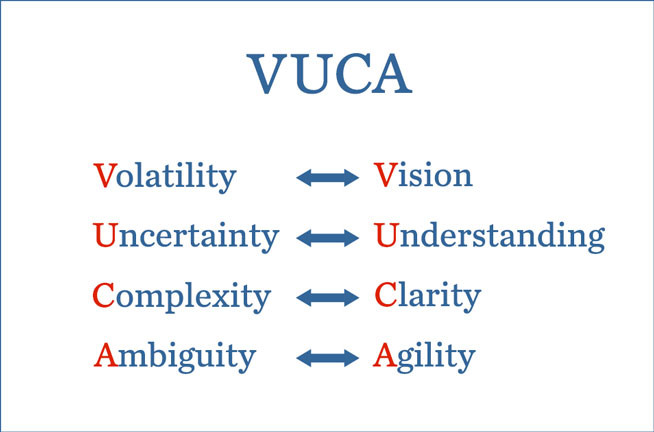
In a working environment characterised by volatility, uncertainty, complexity and ambivalence (VUCA), agility would appear to be the logical answer. Agile working translates into personal responsibility and self-organisation in view of a common goal, as well as the early involvement of customers. In agile working, each individual can use its powers of reflection and problem-solving skills to continuously improve products and processes within self-organised teams.
For the implementation of agile ideals and principles in practice, Scrum and Kanban – ( software development) help establish a project management framework. Just how the Scrum project management method works and which starting points there are for its use in library innovation and Open Science are aspects we will look at in the following.

Approaching the desired result in cycles and step-by-step

Scrum originates from software development, but is now also used as a project management method in many other disciplines, for example, in the development of a service or within research and development. Scrum is based on the principles of the ”Manifesto for Agile Software Development”, the collaborative working result of 17 renowned software developers back in 2001. It lays down values and rules of conduct for agile teams.
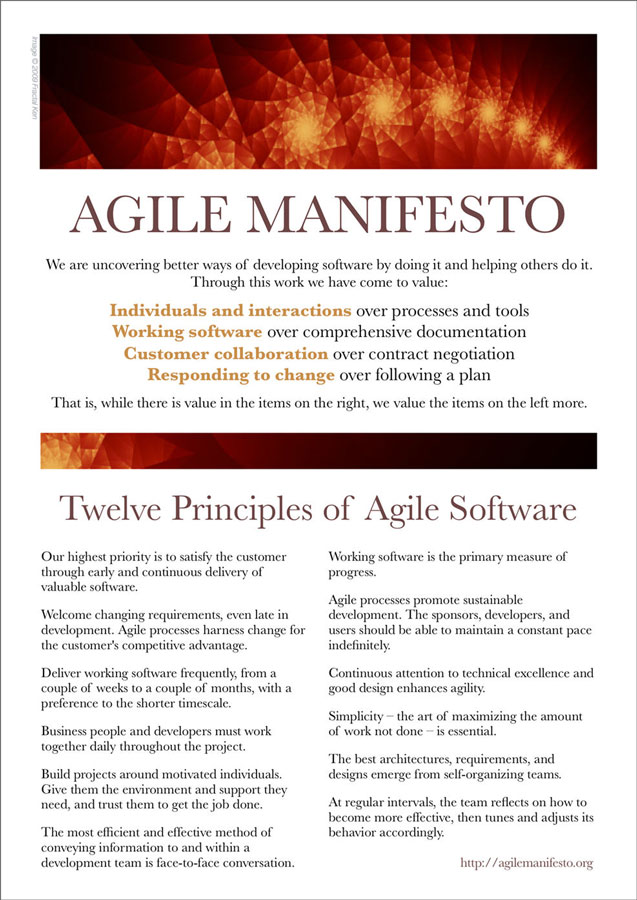
Agile Manifesto, Ken Fractal [CC BY 3.0]

Just how Scrum works has been defined in the Scrum Guide. The central characteristic underpinning the method is a procedure involving short, consecutive planning cycles, each spanning a few weeks. By adopting a step-by-step approach in these planning cycles (so-called “Sprints”), teams thus get closer and closer to the optimal result. At the end of each Sprint, there is a finished result.

For example, if a new online service is designed to support students directly in their learning, and Sprints of two weeks duration are chosen. During each two-week Sprint, part of the offer would be completed, in order that it could be put online immediately after the Sprint. With such short intervals, this project management approach addresses the problem of projects getting out of hand in terms of time and money. This goal is also pursued with the principle of “time boxing”, that is working in short, clearly defined time frames (the “time boxes”). Thus, a maximum duration is reserved for meetings, which is then not exceeded. Scrum is essentially very simple, but also flexible enough to manage highly complex projects.

The Scrum team consists of three roles

Scrum teams are highly self-organised. A Scrum team essentially consists of three roles: Product Owner, Scrum Master and (Development) Team.

  1. The Product Owner takes the view of customers and other stakeholders and describes their requirements for the product in what is known as the “Product Backlog”. During continuous discussions, this individual weighs up the various interests and decides which of the ever-changing wishes and requirements are most important. Staying with our example for a moment: The Product Owner gathers the various wishes and requirements of (potential) users and other stakeholders of the new online offering, and updates and coordinates them on a continual basis. Another important task is to formulate and repeatedly explain the “why”, that is the vision behind the product, for example with an elevator pitch. The Product Owner is responsible for the project’s three central factors: Quality, costs and time.
  2. The Scrum Master possesses an expert knowledge of Scrum. This person supports the team to ensure its adherence at all times to the Scrum principles, to design the process in an optimal way and to achieve the set goals. Further tasks include moderating team meetings and helping to overcome difficulties and blockades. This individual also trains project participants, in order for them to be able to fulfil their designated role.
  3. The Development Team typically consists of five to nine people from different disciplines. It determines which tasks are to be carried out and maintains a shared responsibility. Even within the team, the distribution of tasks is self-organised. If, for example, a learning partner exchange is to be set up for the new online offer, the team defines what work is required for this, following which the members then divide it among themselves. The group goes on to develop and supply the product. It determines the amount of work it can handle itself. In return, the team is responsible for the quality of the delivery.
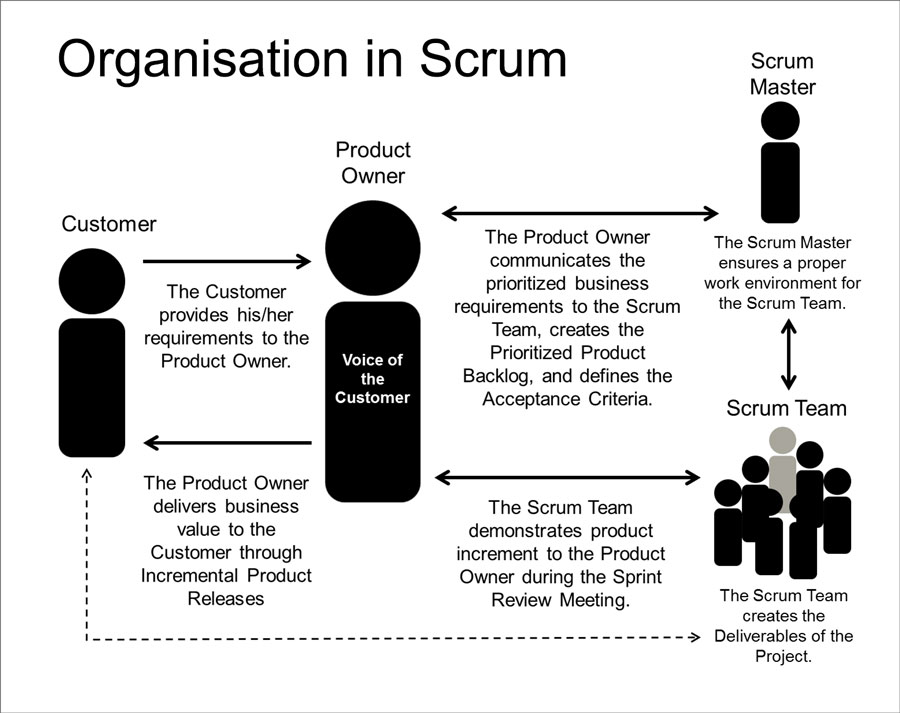
Organization in Scrum, Satpathyt [CC BY SA 4.0]

The Scrum Process: Precisely defined from start to finish

Initially, a product vision is described as a long-term plan, the “Product Backlog”, where all the wishes and requirements are recorded as “Items” (task blocks to be completed) in a list. Using the example of the new online offer to be created, the Product Backlog would thus contain the long-term task list for the project’s realisation. This list is then continuously refined and supplemented in the course of the project. The tasks are often described in the form of user stories (German). The Product Backlog is first and foremost a means of communication with the aim of ensuring that everyone involved understands which tasks are pending and why. It is managed by the Product Owner.
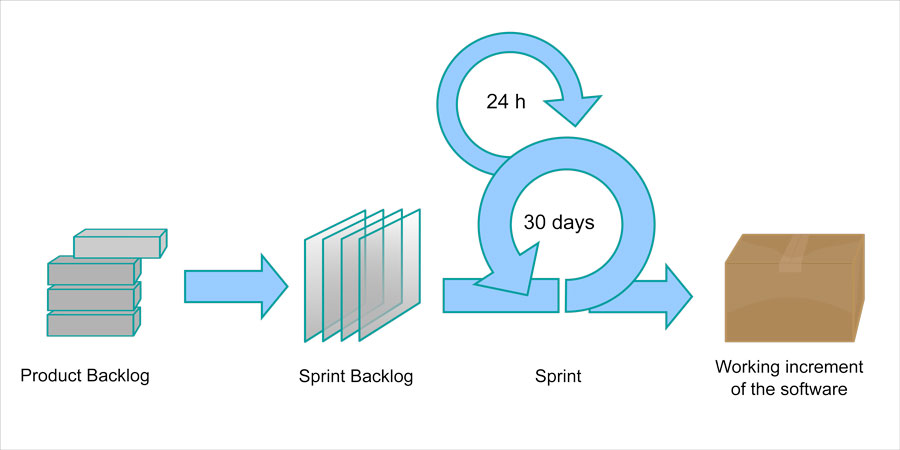
Scrum Process, Lakeworks [CC BY-SA 4.0]

The detailed plan (“Sprint Backlog”) is created at the beginning of each Sprint as part of the Sprint Planning process. From the prioritised Items contained in the Product Backlog, the team selects those that it currently considers feasible. In Sprint Planning, the following questions are clarified. Firstly: Which parts (Items) from the Product Backlog should be addressed in this Sprint? Secondly: How does the team distribute the work and what can they deliver at the end of the Sprint? The Sprint Backlog thus represents a list of those task blocks that are processed in the Sprint, using the example of which tasks are completed in the next two weeks, in order to implement the learning partner exchange that is to be completed by the end of the Sprint.
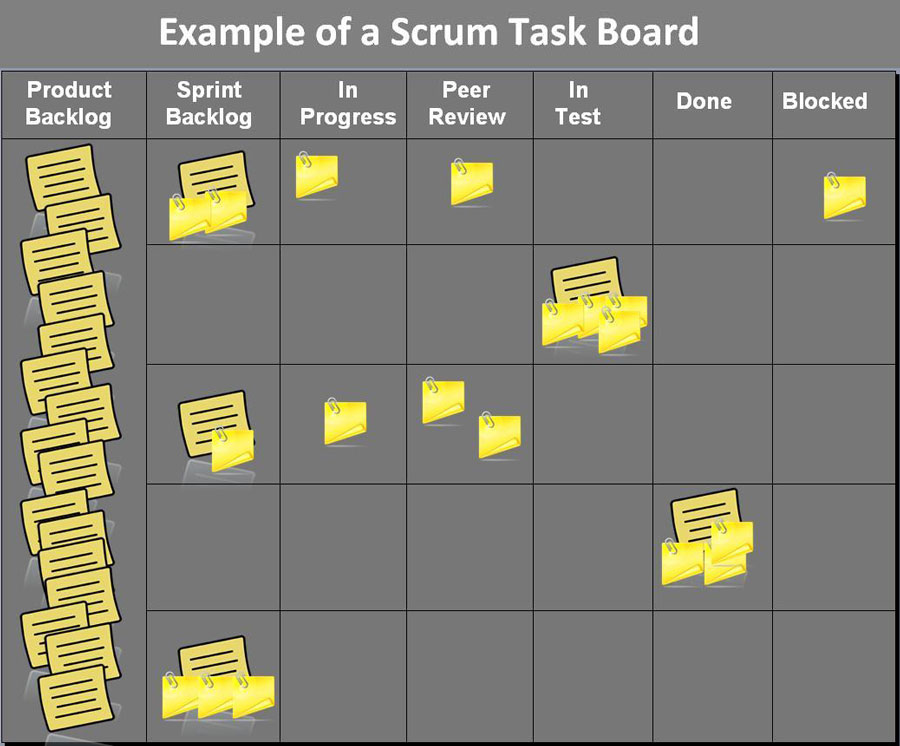
Scrum Task Board, Dr Ian Mitchell [CC BY SA 2.5]

To keep track of the progress in the Sprint Backlog during a Sprint, a Scrum Board or Task Board is usually used for the purpose of visualisation. This makes it possible to see at any time which tasks are to be processed and what their processing status currently is. The Task Board is often a Kanban Board.

All work progress is documented in short daily stand-up meetings (“Daily Scrum” or “Daily Stand-up”) held by the team, obstacles are identified in good time and any cooperation is discussed.
During a Sprint, potentially deliverable products – such as homepage functions or visualisations – are implemented. A Sprint, therefore, represents a good risk management strategy, because in every Sprint a functioning sub-project is created that is good enough to go into production.

At the end of each Sprint, the Development Team shows the Product Owner and other stakeholders the results and receives feedback. In our example, the team would present the partner exchange after the two-week Sprint. After the feedback, the Product Owner decides whether it will be put online directly. In the subsequent Sprint Retrospective, the Development Team withdraws and reflects on the work process and cooperation, in order to constantly ascertain sources of potential improvement. The Scrum Master assists to ensure that the set rules are followed and obstacles are overcome. Methods suitable for a retrospective include „Mad, Sad, Glad“ or a Timeline (German).

Scrumademics: Scrum for individual tasks in research

Scrumademics (PDF, German) is a special modification of Scrum for scientists – and could, in principle, also be transferred to other areas. What makes it special: There is no real team, no joint project, no “customers”. Instead, each team member drives its own project (for example doctoral thesis, professional article) and is, therefore, Product Owner and Developer simultaneously. The role of the Scrum Master is assumed by team members in rotation.

Each team member creates its own Backlog in which all products are listed until the project’s completion. Using a common Digital Board (such as Trello) the team records in lists what is currently being worked on and what still needs to be done. These lists are compiled from the individual Backlogs of all team members. To ensure clarity, each team member is assigned a colour.
Scrumademics is also a vivid example of the contribution made by agile working to dealing more effectively with the consequences of the COVID-19 crisis (German).

Digital tools facilitate Scrum projects

A whole range of apps and other tools can support the implementation of Scrum. They can be used, for example, to maintain Product Backlogs and Sprint Backlogs, to keep track of work progress and to support the Daily Stand-ups. These tools include

Digital tools with no particular focus on Scrum can also provide valuable support. Whiteboard systems such as Miro, Mural and NexBoard comprise templates for agile working, for example, for Daily Stand-ups and Retrospectives.

First steps with Scrum

If you want to start your first Scrum project, carefully consider which project is suitable in advance. The first steps might then be, for example:

  • Finding a Product Owner with enthusiasm for the envisaged product,
  • Writing a Vision Statement,
  • Creating an initial version of the Product Backlog,
  • Searching for a Scrum Master,
  • Ensuring support from management,
  • Putting together a Development Team,
  • Clarifying the product and Product Backlog requirements together with the team.

Additional ways to get started with Scrum can be found here:

Promote openness with the transparency of Scrum

Scrum, with its relatively rigid framework and the requirements stemming from different roles, is not suitable for every project. Derivations such as Scrumademics show, however, that it is also possible to apply Scrum when modified for your own context. Do you think your project is suitable for trying out Scrum in its purest form? Then you should hold on to the project management method for a while. Only then should you start to adapt Scrum for yourself.

If you don’t want to start with a complete Scrum project, you could take over parts of Scrum for yourself and get into agile work. Meaning that you could start with small steps like Project Boards, Daily Stand-ups, focused work phases or Retrospectives. With these small structural interventions, you can create greater transparency, promote exchange and improve cooperation.

Scrum offers an interesting project management approach to deliver innovation. With its iterative approach and the transparency of (interim) results, Scrum is also suitable for promoting the openness of Open Science projects themselves. What should always be considered: If methods and tools are applied without reflection, this does not necessarily lead to successful agile working. Success stands or falls with the team members and with the motivation, discipline and communication needed to overcome obstacles.

This might also be of interest to you

geschätzte Lesezeit: < 1 min

Um die Webseite zu verbessern und maß­geschneiderte Werbung anzubieten, setzt Golem.de Cookies und andere Techno­logien ein. Sie können Golem.de kostenlos nutzen, indem Sie der Nutzung aller Cookies zustimmen. Ihre Zustimmung können Sie jederzeit widerrufen.

Um der Nutzung von Golem.de mit Werbung zustimmen zu können, müssen Cookies in Ihrem Browser aktiviert sein. Weitere Informationen finden Sie hier.

Der Zustimmungs-Dialog konnte nicht korrekt geladen werden, eine Zustimmung gilt nur vorläufig. Informationen zur Problembehandlung finden Sie hier.

Cookies werden von Golem.de oder Dritten eingesetzt zur Analyse der Seitennutzung, zur Personali­sierung von angezeigtem Inhalt und Anzeigen, sowie der Messung ihrer Performance. Daraus können Erkenntnisse zu Zielgruppen abgeleitet und die Daten zur Produkt­entwicklung und -optimierung verwendet werden. Ausführlichere Informationen finden Sie in der Datenschutz­erklärung. Im Privacy Center sehen Sie eine Übersicht, welche Dienstleister auf Golem.de Cookies in Ihrem Browser setzen können. Ihre Zustimmung können Sie jederzeit per Klick in der Datenschutz­erklärung widerrufen.

geschätzte Lesezeit: 4 min
Ausbau

Glasfaser soll in 21 000 Haushalte der Landeshauptstadt kommen

Von Thorsten Neuhetzki

Potsdam wird Glasfaser-Stadt Potsdam wird Glasfaser-Stadt
Grafik: Telekom Im Rahmen einer Presseveranstaltung im Potsdamer Rathaus hat die Telekom heute den offiziellen Startschuss für den Ausbau von Glasfaseranschlüssen in Potsdam gegeben. Noch in diesem Jahr sollen in der Landeshauptstadt die Ortsteile Potsdam West und Potsdam Süd (Waldstadt) mit Glasfaser-Anschlüssen versorgt werden. 21 000 Haushalte bzw. 3 700 Gebäude sollen so potenziell an das Highspeed-Netzwerk angeschlossen werden. Potsdam gehört zu einer von zehn Städten, in denen das FTTH-Netz (Fiber To The Home) ausgebaut wird.

Potsdam wird Glasfaser-Stadt Potsdam wird Glasfaser-Stadt
Grafik: Telekom Bisher wurden die Telefonsignale auf dem letzten Stück zwischen dem Telekom-Verteilerkasten auf der Straße und dem Wohnungsanschluss auf einer Kupfer-Leitung übertragen. Im Kupferkabel nimmt die Übertragungsgeschwindigkeit aber Meter für Meter ab. In Zukunft werden Fotos, Videos und Musik den Weg in die Wohnungen ungebremst auf einer neu verlegten Glasfaser-Leitung zurücklegen. Der Vorteil: Beim Senden und Empfangen kann dann ein Tempo von bis zu 200 MBit/s erreicht werden.

550 Kilometer Glasfaser für Potsdam

FTTH-Ausbaugebiete in Potsdam FTTH-Ausbaugebiete in Potsdam
Grafik: Telekom Für die Verlegung des hochmodernen Glasfasernetzes sind in Potsdam aufwändige Bau- und Schaltarbeiten notwendig: Die Telekom plant, über 550 Kilometer Glasfaser zu verlegen und 76 neue Netzverteiler aufzubauen. Wo möglich werden die Glasfaserkabel durch Leerrohre geführt, die Telekom wird aber auch neue Kabeltrassen bauen. Außerdem wird sie das Glasfasernetz montieren und die zusätzliche Technik installieren. Der Ausbau wird voraussichtlich noch in diesem Jahr abgeschlossen sein. Die Kosten in Millionenhöhe übernimmt die Telekom. Potsdam ist bereits die zweite Stadt in Brandenburg, die an das Hochgeschwindigkeitsnetz angebunden werden soll. Über einen Start in Hennigsdorf hatten wir bereits berichtet.

Um die Wohnung oder Immobilie anzuschließen, braucht die Telekom vom Eigentümer die Zustimmung - Kosten entstehen nicht. Der Eigentümer muss die Zustimmung bis zum 15. Juli erteilen, damit die Telekom ihn in ihre Planungen aufnehmen kann. Wer sich erst später entscheidet und nachträglich ans Glasfasernetz angeschlossen werden möchte, muss die Kosten von mehreren hundert Euro selbst tragen. Informationen dazu gibt es auf einer speziellen Webseite auf der Seite sowie telefonisch unter 0800-7733888. Mit den Bauarbeiten wird Mitte Mai begonnen, die Vorvermarktung beginnt bereits im April.

Weitere Meldungen zu Internet per Glasfaser

Bild /

geschätzte Lesezeit: 7 minThe Georg Eckert Institute (GEI) Inception Report

Context

 On 24 th April 2019 , then Vice -President of the European Commission, Federica
Mogherini, announced that the EU would be funding a comprehensive review of the
Palestinian Authority curriculum, following a report by IMPACT -se.
 She stated the report would be conducted ‘ with a view t o identifying possible incitement
to hatred and violence and any possible lack of compliance with U NESCO standards of
peace and tolerance in education.’ 1
 The Georg Eckert Institute was selected to carry out the review with a scheduled start
date for spring 2019 with results to be made available by September 2019. 2
 The UK government announced on 11 May 2020 3 that Interim Report is expected by June
with a full report later in the year.
 An Inception Report 4 outlining the methodology of the study was issued on 12 th April
2019 however, was only made public on 18 th June 2020 following an FOI request.
 The Inception Report lays bare a number of comprehension and methodological issues,
raising concerns surrounding the reliability of the study.

1. Factual Inaccuracies in Inception Report
 The pre valence of factual inaccuracies in the GEI Inception Report 5 puts the
scholarship of the Interim Report into doubt.
 The report contains Arabic translation mistakes .
 Mistakes suggest a lack of familiarity with Palestinian Arabic usage and culture.
 Reference made to research that does not exist.

a. GEI uses mistranslated Arabic terms in the word bank cited in the Inception Report.
1 https://www.europarl.europa.eu/doceo/document/E -8-2019 -000906 -ASW_EN.html 2 https://www.gov.uk/government/news/uk -government -has -successfully -pushed -for -a-review -into -palestinian -
textbooks 3 https://www.parliament.uk/business/publications/written -questions -answers -statements/written -
question/Commons/2020 -05 -01/41933 / 4 http://data.parliament.uk/DepositedPapers/Files/DEP2020 -0322/Inception_report.pdf 5 http://data.parliament.uk/DepositedPapers/Files/DEP2020 -0322/Inception _report.pdf

These include:

روح نيعلا – Translated as “horoscope” (the astrological forecast of a person's future).
It means the women who accompany Muslim believers in paradise.

لافطا هراجحلا – Translated as “children stones” (translator’s meaning is unclear).
It means Children of the Stone s, a well -known phrase denoting the Palestinian youth guerilla
movement.

سريب – Translated as “piers” (raised structures that rise above w ater).
It refers to Peres (Shimon) , the late Israeli President.

هسكنلا – Translated as “remembrance” (the act of remembering something)
It means setback, defeat or failure and specifically and very commonly, the Palestinian day of
commemoration of the 1967 War .


b. There are glaring omissions in the GEI word bank for an institute studying a modern
Palestinian curriculum. These include:
حلاس - weapon
يدنج - soldier
ةيحضت - sacrifice
ةبكن - Nakba
داهشتسا ‎ - martyrdom, death of a martyr, or "heroic death”
ديهش ‎ - martyr (singular)
ةلرسا \ ديوهت - Judaization
سامح - Hamas
مرحلا فيرشلا \ تيب سدقملا - Al -haram Al -Sharif \ Bait Al -Maqdas - two common names of the Al -
Aqsa Mosque
- ةرخصلا ةبق Dome of the Rock
،ضرا يضارا - Land, Lands
برح - War
مد ءامد , - Blood
رفاك رافك , - Infidel, Infidels
)شعاد( ةيملاسلإا ةلودلا ميظنت ISIS

c. The word "refugees" appears consecutively, nine separate times in English for no clear
reason , while appearing once in the parallel Arabic word bank translation.

d. GEI mentions, without reference, an April 2019 IMPACT -se report that does not exist.
Other existent IMPACT -se reports are not mentioned.

2. Lack of Experience
 The EU asked that “the study shall be carried out by an independent and
internationally recognized research institute”. 6
 GEI has no t published independent research of the full Palestinian curriculum , old
or new.
 There is no publicly available evidence that the researcher for t his project has
previously published anything on the Palestinian curriculum.
 GEI’s last published research on the Palestinian curriculum that is available,
covered only seven textbooks from a curriculum of over two hundred textbooks . The
most recent book in this short study was from 2013 . The study was published as a
single chapter in a book, a full five years later . By publication, those seven textbooks
were no longer taught.

The researcher for this project 7 does not appear to have previously publi shed research on the PA
curriculum, old or new. We cannot identify any recognized scholarly articles or analysis on this
issue , nor do any appear on the list of publications on the GEI website bio page.

GEI has made only a few highly selective forays into researching Palestinian text books and has
at no point published a full and proper review.

GEI’s last monograph on PA textbooks is from 2013 . It was published five years later in a single
chapter of a 2018 book .8 By publication, the books were obsolete. The chapter itself 9 analyzed
just seven PA textbooks from a curriculum of over 200 books. They were taken from curricula
taught 2 010 -2013 , provided few examples, and those that existed were mainly from a single
Grade 11 book. On this basis, the author formed far -reaching conclusions.

GEI has not published research of PA textbook s at all, post the PA’s sweeping 2016 curriculum
reform. GEI is funded by the federal and state German governments. Naturally, i ts expertise has
been in researching curricula is centered on Germany and Europe, rather than those in the Middle
East.


6 https://www.europarl.europa.eu/doceo/document/E -8-2019 -000906 -ASW_EN.html 7 http://www.gei.de/en/mitarbeiter/riem -spielhaus.html 8 See GEI’s new book series , Palgrave Studies in Educational Media , with the prestigious publishing house
Palgrave Macmillan and its 2018 book: Multiple Alterities -Views of Others in Textbooks of the M iddle East :
http://www.gei.de/en/publications/psem.html 9 http://lib.uok.ac.ir:8080/multiMediaFile/15275266 7-4-1.pdf#page=88

3. Problematic Methodological Approach
 GEI is applying an over -complicated mix of methodologies . It is unclear as to how
the methodologies square with t he EU directive.
 The report does not reference a single Palestinian textbook that will be researched.
 No booklist is cited.
 Crucially , the full curriculum is not being reviewed.

In April 2019 the EU announced that the study of the PA curriculum had been commissioned in
order to identify “ any possible lack of compliance with UNESCO standards of peace and
tolerance in education ".10 There are no mentions of UNESCO standards within the inception
report.

Rather the proposed methodology, as best one can determine, is a mix of a Stanford University
group’s standards for textbooks and a qualitative approach derived from Grounded Theory. It is
unclear as to how this methodology is in line with the EU directive.

This combination of standards over -complicate the methodology. Sign ificantly, GEI’s
methodology does not include the UNESCO standard of unbiased information .11

“Triangulation” is cited with no explanation of what this entails . T he discourse analysis is
additionally undefined. Qualifying statements in the explanation of the methodology (‘where
possible’) allow for a less rigorous study. There is no clear explanation as to the classification of
Arabic language studies which appear to have been partially categorized as a science.

Moreover, the report doe s not reference a single Palestinian textbook that will be researched for
the study meaning there is uncertainty about the grades , semesters or subjects that have been
included.

GEI does not offer to cover the entire PA curriculum and the proposed sc ope and methodology
cover s only 72.3% of the PA curriculum for grades 1 -12 ( 160 books out of 221 ).

Note on GEI and IMPACT -se Collaboration

IMPACT -se’s research was published in GEI’s new book series 12, Palgrave Studies in
Educational Media, with the prestigious publishing house Palgrave Macmillan in two chapters of
a 2018 book titled Multiple Alterities -Views of Others in Textbooks of the Middle East.

In their 2018 book (p. 211 -212) GEI describes IMPACT -se’s research and methodology as:

“ba sed on page -by -page scrutiny of the books under study singling out each reference
to the Other and to peace, be it in a form of text, photograph, illustration, map, chart or
10 https://www.europarl.europa.eu/doceo/document/E -8-2019 -000906 -ASW_EN.html 11 Based on UNESCO Recommendation concerning education for international understanding, cooperation and
peace and education relating to human rights and fundamental freedoms, adopted by the General Conference at its
eighteenth session, Paris, November 19, 19 74, Article V.14. 12 http://www.gei.de/en/publications/psem.html

graph. Special attention was given to cases of non -reference, which are no less
im portant in textbooks research. The evaluation of the specific method of messages of
each reference (or non -reference) was made according to UNESCO recommendations
and principals. This way a clear picture had been drawn of the general attitude to the
Other and to peace in this region .”13

In GEI’s book of 2018 they describe Groiss’s methodology (p. 212) as resulting in ‘ a clear
picture had been drawn of the general attitude to the Other and to peace in this region .’14


13 http://lib.uok.ac.ir:8080/multiMediaFile/152752667 -4-1.pdf 14 http://lib.uok.ac.ir:8080/multiMediaFile/152752667 -4-1.pdf