Stellt euch mal vor, ihr wäret die Bundespolizei. Und ihr habt Bodycams eingeführt. Aber ihr habt noch keine Server und kein Storage. Wohin tut ihr die Aufzeichnungen?
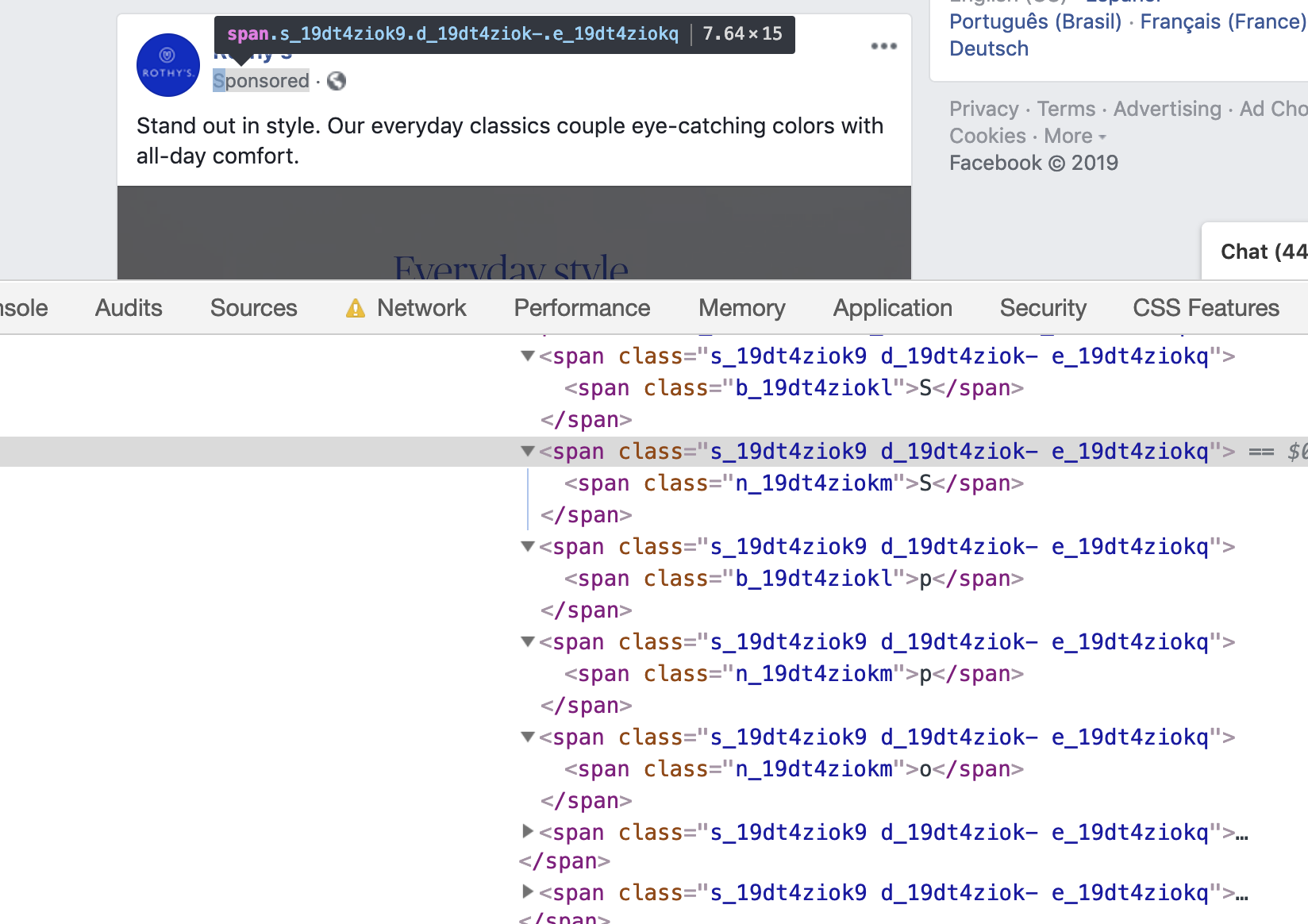
"Why do I need a 4Ghz quadcore to run facebook?" This is why. A single word split up into 11 HTML DOM elements to avoid adblockers. pic.twitter.com/Zv4RfInrL0
I popped over to Facebook to verify that and what I saw was a different and even more nested mess:
They are trying to fight your ad blocker browser extension. Of course they are. I'm sure at their scale not doing this means losing millions of dollars. But I wonder if it's really losing money when you factor in losing trust, and potentially losing people on the platform entirely.
It just feels so rude, doesn't it? Like a user specifically installs technology onto their computer in order to exert some control over what they allow onto their computers and into their eyeballs. And they are saying, "No, we do not respect that choice. We are going to fight your technology with our technology and force feed this stuff onto your computer and your eyeballs." Doesn't sit right.
I'm not unaware that ad blockers have ad adverse effect on the ability for websites to make money. That's quite literally how I make money. But I don't want to do it fighting and at the expense of breaking trust. I want to do it gracefully while building trust.
Anyway.
I wonder what writing HTML to help ad blockers would look like instead:
This span-based lettering stuff makes me think of libraries like Splitting.js and Lettering.js that break up text into individual <span>s for styling reasons.
Turns out that doesn't affect on-page search (i.e. if you search for "dog," you'll find <span>d</span><span>o</span><span>g</span>), but it does affect some screen readers in that they will treat each letter distinctly, which can result in pretty awful audio output, like pauses between letters where you wouldn't expect or want them.
Erste Maßnahmen gab es bereits auf der Strecke von Köln nach Dortmund, der mit 140 Prozent am stärksten ausgelasteten Trasse im Netz. So wurden etwa in den Hauptbahnhöfen Essen, Düsseldorf und Köln Stellpulte und Kabelschränke ausgetauscht, als sie erste Störungen zeigten - statt zu warten, bis die Teile endgültig kaputtgehen.
Oh wow. DAS sind die guten Nachrichten? Wir haben Dinge getauscht, als sie kaputt gingen? Nicht erst nach der Kernschmelze?
Meine Güte! Holt das Bundesverdienstkreuz raus! Soviel hat lange niemand mehr bei der Bahn geleistet!
Auch bessere Organisation soll helfen. So sollen zum Beispiel ICEs, die auf der linken Seite kaputte Türen haben, vorzugsweise mit der rechten Seite am Bahnsteig halten.